Desert Online General Trading LLC
Dubai, United Arab Emirates
Desert Online General Trading LLC
Dubai, United Arab Emirates


Full description not available


C**N
Really beautiful and helpful to me
I found this randomly and it's honesty spoke to me, and was a source of comfort and feeling of union
T**
A loving effort in capturing and reasoning with grief
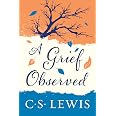
Someone close lost her husband to cancer last year. From the diagnosis to his death was slightly over one year. Confronting this reality, I read widely on suffering and then grief, in the hope that I would be able to walk side by side with her through this journey. Though not experiencing grief first hand, I hope I would be able to have some understanding of what she has been going through and what I can say to her or do will be informed and helpful.Most of the books I have read on the subject of suffering and grief are highly analytical, more suitable for someone who is preparing for these life events as eventual possibilities in life rather than for those who are actually confronting and dealing with them.A Grief Observed therefore is different in its nature. It was a journal recording Lewis's thoughts during his grieving period in his hope to make him feel better. Under normal circumstances, one would properly say that this book is not very well written because it is difficult to understand; it jumps and skips; it argues with itself. But this is not a normal circumstance, Rather it is a glimpse into a grieving widower's mind; and the confusion and muddle as conveyed by the book reflects that. Perhaps it is a world that does not make sense, hence the struggle to make sense of it. In a way, one can argue that Lewis set himself a difficult task - capturing in words what cannot be captured. How many can really speak of grief, let alone a man? Very often all that we can see of grief is tremendous sadness in silence especially after the initial shock and the initial angry outbursts.What I like about this book in particular is the honesty in questioning God. And I find it comforting that we are allowed to wrestle with Him. Lewis said that his great fear was not to find that God did not exist but that He was not good. Doesn't it sound like all of us at some point? And Lewis's reasoning: "Your bid - for God or no God, for a good God or the Cosmic Sadist, for eternal life or nonentity - will not be serious if nothing much is staked on it. And you will never discover how serious it was until the stakes are raised horribly high...Nothing less will shake a man - or at any rate a man like me - out of his merely verbal thinking and his merely notional beliefs. He has to be knocked silly before he comes to his sense. Only tortures will bring out the truth. Only under torture does he discover it himself." (p.33)Then Lewis moved on to ask if such extremities of torture should be necessary. "The more we believe that God hurts only to heal, the less we can believe that there is any use in begging for tenderness." (p.37) He drew parallels with a surgeon whose intentions were wholly good. "The kinder and more conscientious he is, the more inexorably he will go on cutting. If he yielded to your entreaties, if he stopped before the operation was complete, all the pain up to that point would have been useless." (p.38)Apart from these big questions, Lewis was, I find, quite sensitive in offering how one could cope with grief. I like his way more than, say, Queen Victoria's. It is not about getting over it or preserving the past but moving forward without dishonouring your marriage so dear to you. His advice, I believe is sound: Don't seek aches for their own sake - the less of them the better, so long as the marriage is preserved. Passionate grief does not link us with the dead but cuts us off from them. (p.47) This can be achieved when we concur with Lewis's ground breaking perspective that:"...then for both lovers, and for all pairs of lovers without exception, bereavement is a universal and integral part of our experience of love. It follows marriage as normally as marriage follows courtship or as autumn follows summer. It is not a truncation of the process but one of its phases; not the interruption of the dance, but the next figure." (p.43)I think this is a beautiful description which holds a lot of wisdom. I do not know about you, but for me I have chosen to adopt it in preparation for that inevitable phase of my marriage one day.
J**B
Yellow stickies - measuring progress through grief!
I was first signposted to this book nearly 18 years ago by a bereavement counsellor Maxine - who helped more than she knew or I ever told her!At the time I really couldn't see my way out of almost stifling grief - but she gave me a copy of this book and suggested I read it - and pop a yellow sticky in the pages that most resonated with me.A month or so on she suggested I re-read it and do the yellow sticky thing again - and already I could see I was moving on - if only through the stages of grief at that time. I hadn't believed it possible.Several readings later - loads more yellow stickies - and months passed - and I finally understood what she'd been hoping for.As hard as it seems - and as hard as it is to see - we do all move from where we started.I found some of the book - especially the more religious bits hard going - and skipped over them - whilst appreciating even at the time that they might bring some comfort to others.CS Lewis - wrote this book after the death of his love - portrayed in the film 'Shadowlands' - and despite being a rather restrained individual and theology boffin - went on to care for her son and from there we get the Lion, the Witch and the Wardrobe series - which made many kids like me really enjoy books.I still have that original copy with all of the yellow stickies - and treasure it always as it tells my journey back to the land of the living far better than I could!I've also bought copies for and passed on the yellow sticky advice on a very few appropriate occasions in the last 18 years. It has always helped.A truly great book - inspirational and untold help.If you ever find yourself in need of such a prop - well worth buying - and whilst the paper version and the yellow stickies - tried and tested - bookmarks or notes on kindle probably do the same thing.I've just looked it out again on the recent death of a close friend's husband - and will be passing on a copy again.
S**S
A soul laid bare
I read this as a follow-up to Lewis' earlier work, The Problem of Pain for an alternative look at theodicy. It has to be said that the book is extremely short (only 59 pages, fact). It is probably appropriate to state what the book is not, as much as what it is. Written in the immediate aftermath of the death of Lewis' wife, it is not a detailed product of careful study or a complete thesis on the subject of dealing with grief. Lewis was merely trying to gather his thoughts into some semblance that would make sense. His extraordinary erudition and lucidity are what make it a great book. I found myself at many times reading in print thoughts that had been half-articulated in my own mind.At such an extreme time of emotional stress, Lewis does what is only natural, and that is to question all that he believes in. Rather than throw all his beliefs out, he not only asks the questions but searches his soul for the answers. What results is one of the most honest of writings, where Lewis shows us a glimpse of his true soul. It is a level of honesty and openness that very few people ever dare to write publically, and one that I could only aspire to.In spite of its brevity, it is an immensely rich book and incredibly thought-provoking. It is not a huge time-investment to read it, and the payoff is worth it. I would have no hesitation is recommending to anyone, whether in a time of grief or not.
C**D
Great writing, bad formatting
C S Lewis's great work here rather spoiled and made almost unreadable by the poor formatting that throws in a couple of symbols in place of every apostrophe or set of quotation marks.
Trustpilot
1 week ago
3 weeks ago