Desert Online General Trading LLC
Dubai, United Arab Emirates
Desert Online General Trading LLC
Dubai, United Arab Emirates


🎮 Power Meets Precision: Own the Game, Not the Noise
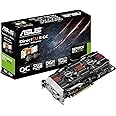
The ASUS GTX 770 DirectCU II OC 2GB GDDR5 graphics card combines a 1110 MHz GPU clock with advanced DirectCU II cooling technology, delivering 20% cooler and 3X quieter performance. Featuring a 10-phase DIGI+ VRM for stable power and intuitive GPU Tweak software, it supports 4K resolution and multiple display outputs, making it a powerhouse for professional-grade gaming and creative workflows.
| Brand | ASUS |
| Product Dimensions | 7.62 x 40.64 x 22.86 cm; 907.18 g |
| Item model number | GTX770-DC2OC-2GD5 |
| Manufacturer | ASUS |
| Series | ASUS GTX770-DC2OC-2GD5 |
| Colour | Black |
| Screen Resolution | 4096 x 2160 |
| Resolution | 4096x2160 |
| Processor Speed | 1110 MHz |
| Processor Count | 1 |
| Computer Memory Type | GDDR5 |
| Memory Clock Speed | 7010 MHz |
| Graphics Coprocessor | Nvidia GeForce |
| Graphics Chipset Brand | NVIDIA |
| Graphics Card Description | Nvidia GeForce GTX 770 |
| Graphics RAM Type | GDDR5 |
| Graphics Card Ram Size | 2048 MB |
| Graphics Card Interface | PCI Express |
| Number of HDMI Ports | 1 |
| Wattage | 600 watts |
| Are Batteries Included | No |
| Lithium Battery Weight | 0.5 Grams |
| Item Weight | 907 g |
| Guaranteed software updates until | unknown |
S**B
Best bang for the buck
I recently bought an Alienware Aurora i7 980 Xtreme from eBay. Alienware are the sports cars of the computer gaming world: only an idiot would buy them new, but they are very reasonable second hand (and actually cheaper than a self-build, more durable and look better). As is usual with eBay though, the seller was selling for a good reason: this was a very fast CPU but limited by a pair of ATI 6770s in crossfire. I certainly needed a faster graphics card to match the '980X.I took a look at Passmark to see what was what, and that listed the GTX 770 as the third fastest graphics card in the 'high end video cards' table (as of 18 July 2013), with a score of 6327. Only two cards are faster, the GTX780 (7922) and the GTX titan (8269). Looking at the cost of the other two cards, I decided the 770 was the best price-performance ratio, especially when I can stick another one in for SLI later when the prices drop a little. This was incidentally why I also picked a mainstream make such as ASUS - they are likely to be in production in 10 months time when I might want to go SLI. Further, the ASUS has a metal backplate on it, so the airflow when I get two in SLI will not be compromised (without the backplate, you can find dust getting snagged on the pins on the back of the first card as air blows over it from the second card). The backplate also makes the card more ridged: important because the heatsink is quite heavy.Once I'd put the CPU on overclock (4GHz), I was ready to start benchmarking. With GPU Tweak, I got a decent stable overclock on the 770 straight away by increasing CPU boost to max (1260) from the default of 1110, and setting power target to 110% (from 100%) and GPU target to 90C (from 79) The memory I left alone for now, as it looked to be pretty high to start off with: 7GHz(!).The memory is overclockable to up to 7.8GHz (at 7GHz it is already the fastest memory on a card to date: even faster than on the Titan, and it can easily overheat on overclock, so I'd strongly advise leaving memory at 7GHz)). If you want to do multi monitor SLI gaming at crazy quality, you might also consider getting one of the 4GB versions of the '770 as opposed to the 2GB on this card. I chose not to do that as I feel 4GB is overkill for now, there's only a handful of games that need it (from online discussions I've looked at, only Crysis comes close), and more memory usually equates to slower clocks.Although you can go higher by increasing the GPU voltage, I decided against this: turning up the voltage is usually a good way of frying the electronics, and you're only getting marginal gains for bragging rights (and why would you even bother: when playing Crysis2 on DirectX11 and everything on ULTRA @1920x1200, the GPU loading graph shows usage at 60-80%, and never even close to 100%, with the i7 980X never getting warm as it sits around 30% @3.7GHz... looks like current-gen hardware performance is finally leading gaming software requirements by quite a margin!). The only 'current gen' game that seriously stretches this card is Rome Total War 2. I get 40fps average with everything set to the highest settings @1920x1200. Not a high score for an fps, but still very playable for a strategy game (they typically look fine and play well down to 30fps).That gave me a 3DMark 11 score of 11037 (for comparison, stock speeds on the 770 gives me 10065, so overclock gives me a decent +10% real gaming performance). 3Dmark results noted this score as 'better than 87% of all results', so we're already almost in the top 10% of all computers. For comparison, the 3Dmark 11 website states that a high end gaming PC (i7-4770K and GTX Titan) gets 11894. That's so close to my current result that you won't notice the difference, although your wallet will - the Titan costs over twice as much as the 770! (NB - 3Dmark underutilises the 980X, so I don't think it will get me a higher score than the 4770K - only apps such as Softimage, Vue or Premiere seem to be able to hit 100% CPU usage as the 980X seems to be aimed at authoring rather than gaming... but I don't think any high end i7 will be a gaming bottleneck for some time!).All tests I've thrown at the 770 are smooth, no glitches, and good frame-rates at 1080p. I can't comment on 1440p gaming yet, although I will update this review when I upgrade to that resolution (which I will do once my wallet has recovered from my buying the Alienware, the GTX770, and a Samsung 840 pro SSD!). What I can say is that the ASUS GTX770 does not feel noisy on high loads (although this may be down to the heavy Aurora case), and is practically silent at no load.In terms of cooling, I've had no issues assuming proper case cooling: the card gets up to the mid to high 70s for most high end gaming (I've tried Crysis2, BF3). There are options for better cooling such as the Gigabyte windforce (Gigabyte Nvidia GTX 770 OC 2GB Fan PCI-E Graphics Card), but it feels like temperature is not an issue for overclocked gaming unless you are over-volting, and using a 3 fan solution will probably get you on noise. I'm happy to lose the ~2% gain of an extra fan and stay quieter. As an aside, my rig initially had slow but silent fans (a Noctua 92mm at half speed and a pair of 'Enermax silent' 950rpm 120mm fans). My cpu, chipset and '770 GPU were all running far too hot on load: mid 70s for the CPU, mid 80s for the GPU, and mid 90s(!) for the chipset. Making the GPU fans go faster had no effect whatsoever. Simply changing the Enermaxs for some decent fast-but-quiet replacements (Scythe 'Gentle Typhoons'), and setting the Noctua up for full speed fixed all my heating issues in one go (temps now are low 60s for the CPU, mid 70s for the GPU, and low 60s for the chipset). Moral of the story: case airflow is *much* more important than extra GPU fans.Physically, the card looks well manufactured. The quality seems very high, and there is no plastic on the casing outside the fan itself - its all metal. Note that there is a protective clear film on the backplate, so be sure to take it off as its easy to miss. If you smell something plasticky and melting once you start serious gaming and benchmarking, you've probably missed it :)I'll be using my PC for gaming, but mostly as a video editing machine (Premiere, After Effects, so the 770 will be used for its CUDA during realtime video editing) and image work (Photoshop, so again, a bit of CUDA). So far, I'm very pleased with my purchase - the third fastest graphics card, and for a very reasonable price, giving me a relatively cheap video editing workstation with a good gaming score thrown in. Its also expandable - if I need GTX Titan level performance later, I can always SLI.** Conclusion **I've always been a little put off by high end NVidia cards, as they tend to have very high price tags on them (as evidenced by the GTX 780 and Titan). The 770 is actually very reasonable, and is my first NVidia card since the GeForce 256 (which came out in 1999!). The price to performance is that good on the 770 that I switched from AMD/ATI.In terms of performance this card is the third fastest card on passmark. That's very good, as it beats even the current dual GPU AMD cards and with SLI will probably match the Titan. So you have some level of expandibility if you step up to 1440p or multi monitor.Another thing that has always put me off with high end cards has been the noise. The ASUS 770 is actually surpisingly quiet on the out-of-box clocks, and still pretty quiet on my overclock. NB - as the Aurora case is pretty thick (the sides are double skinned), I took the side off to re-check this, and it was still quiet, and whisper quiet with the case closed.In terms of overclock, I'm looking at 13% for the GPU, and a possible 11% for the memory (but I leave it at 7GHz as its very susceptible to overheat unless you have all your fans on 100%). With GPU at +13% and memory at 7GHz, I get around a 10% gaming performance increase over stock, and that takes me within sight of the 3DMark top end i7-4770/GTX Titan equipped gaming rig (it gets me to 92% of its performance). Pretty good!A totally new NVidia CPU architecture is not expected until next year ('Maxwell'), but the fact that the 770 is just an enhancement on last year's architecture ('Kepler') is probably the thing driving the surprisingly low price. If you wait for Maxwell, my guess is that you will be paying a lot more as NVidia will be pricing higher to recoup development costs.The biggest unknown issue for me is whether or not SLI will microglitch on this family of cards. I just don't know, and hopefully another reviewer can chip in.Another issue to consider is that DirectX11 has been out for a while, and DirectX12 may be on the horizon. You may want to wait a little until 12 appears, but I feel that it won't be worth the wait: there's few games that use 11 to its full abilities as it is, and I expect the take-up of DirectX12 to be very slow, and probably only immediate for the usual 2 or 3 headline games... and Windows 8 doesn't even use Aero anymore, so you can probably tell the way this is all going (IMO DirectX 12 will be about energy efficiency and tablets, just like Intel Haswell is).My full PC specs, as used for this review:Alienware Aurora with swapped motherboard: i7-980X (Xtreme) overclocked to 4GHz, water cooled, ASUS Rampage III Gene motherboard, 24GB (6x4GB) DDR3 at 2000MHz, single ASUS GTX770, Windows 8 Pro 64bit, GeForce 320.49 drivers, Samsung 840 pro 256GB SSD as OS boot drive, WD VelociRaptor for scratch file (page file and app caches) 2x1TB WD Black HDDs for data. Note that this computer was primarily built for video editing (but its also a very good gamer!).
M**E
Excellent Card - Worth it
I bought this card as a replacement for my Zotac nVidia GeForce GTX 650ti 1gb, which sadly developed a fault, rather than trying to claim under warranty I decided to upgrade - I was planning on an upgrade eventually and I spotted that Amazon had a really good deal on this card, so I took the opportunity. £160 off isn't to be argued with.I picked the ASUS version of the card because I've always had a good experience with their products, for example, my Motherboard is manufactured by them and I am very happy with it. In hindsight I should have picked ASUS for my 650ti, I had no experience with Zotac, didn't read any reviews but went for it because it was a cheaper version of the card as I was building on a budget, so I don't know if it's the reason the card went faulty (all manufactured goods have a failure rate, sometimes you can be the unlucky one), but I should have really stuck with what I knew.Anyway, going to the 770 was a big jump, the first thing I noticed was that it was twice the size of my old card, it's a beast, I have a fairly large PC tower (Xigmatek Asgard) and it was a little bit of a squeeze, the card is pretty heavy but was easy to install, however it does bend very slightly under the weight, but not enough to impact the card - the card itself is reinforced with a metal cover, which gives it extra support. I bought a six-to-eight pin PCI express converter cable as this card requires 6-pin and 8-pin connectors (my current cable is 6 & 6), so it was a bit fiddly managing the cables due to the size of the card, but it was still a good fit.Going from a mid range card to this I have found it runs a lot hotter, based on my current set up it will try to maintain a temperature of around 80 degrees C, the card can handle it, but if you are concerned, of course you may need additional cooling, which is what I'm doing. This card recommends that you have at least 600w of a PSU, I ended up using my 550w PSU, I've got a 750w one on the way, that said, my other components don't really use a lot of wattage, so it doesn't seem to be a problem, that said, I'm upgrading it to avoid any potential bottle necking.Now, how does it perform? I am running this with 8gb DDR3 RAM and a AMD FX 6300 Black Edition CPU (3.5ghz 6-core) and it runs beautifully, a good solid 60fps on 1080p, sometimes it can dip depending on how busy the scene is, for example, playing an MMORPG like Final Fantasy XIV: A Realm Reborn, but it's not noticeable unless you're watching the FPS with a counter, but it's damn smooth running games like Tomb Raider and Bioshock: Infinite on the highest possible settings. Previously with the 650ti I had to tone down the settings to improve performance on those titles, particularly with Tomb Raider where TresFX seemed to have a terrible impact on performance, this card? Not an issue.I would happily recommend this card to others. Particularly if they can get it for the price I paid.
S**D
Defective first card but a brilliant working replacement
To start - this is spectacular graphics card, and the best Nvidia card you'll get without paying substantially more for a Titan. I would definitely recommend it to any gamer.However, I had problems with the one I bought straightaway - it crashed repeatedly. These days hardware failure is pretty rare so I thought it must be a set up problem, but after much poking and testing I concluded it had to be the card.I rang up Amazon to see about a return (I got no warranty details when I bought it) and they were fantastic, even though it was well over the 30 day return period; after 15 minutes on the phone I had a replacement card dispatched at the same price I paid, even though it had since increased. I now have a working card, and procrastination can begin.Gaming with it is a fantastic experience - the graphics quality is superb and it can handle the highest settings. GeForce Experience optimises most of the games I have automatically - while this isn't always as good as manual tinkering it's a lot easier and a lot better than not doing it at all. ShadowPlay is also fun, but you can only record clips of your playing for up to 20min.I'll give it 4 stars because although my screen now looks breathtaking it would have been a lot better if the first card had worked (!) - but having trawled many forums and spoken to people while trying to fix it my experience was uncommon. If you do buy it, I would recommend doing so through Amazon as their customer service is top notch.
Trustpilot
1 month ago
2 weeks ago
2 days ago
5 days ago