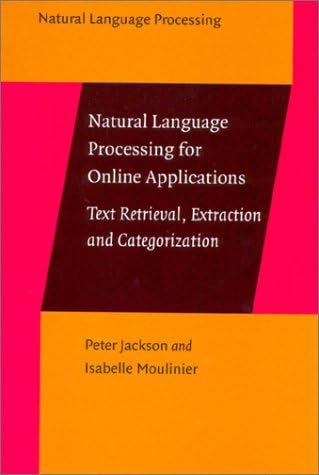
Natural Language Processing for Online Applications: Text retrieval, extraction and categorization
Product ID: 806975119
Buy anything from 5,000+ international stores. One checkout price. No surprise fees. Join 2M+ shoppers on Desertcart.
Desertcart purchases this item on your behalf and handles shipping, customs, and support to Greece.
Buy Natural Language Processing for Online Applications: Text retrieval, extraction and categorization by Jackson, Peter, Moulinier, Isabelle (ISBN: 9781588112491) from desertcart's Book Store. Everyday low prices and free delivery on eligible orders. Review: Readable Introduction to Natural Language Processing - Peter Jackson and Isabelle Moulinier introduce us to natural language processing, with the intent of delivering general, readable explanations of the core technologies needed on the web. "It is not intended as a vendor guide (such things are quickly out of date). Or as a recipe for building applications (such recipes are very context-dependent). But it does indentify the key technologies, the issues involved, and the strengths and weaknesses of the various approaches." The authors report industry best practices, research results, and introduce evaluation methods that will help readers make up their own minds. The book's five chapters lay out the basics of applied NLP. Readers review a transcript from the Eliza therapist program and are introduced to the general types of software needed to usefully process natural language. Natural typed language, that is. We are spared the complexities of handwriting and speech recognition. We first learn about document retrieval, including the math and strategies behind query processing and index construction. And how to evaluate the competing methods. We then turn to information extraction--how software indentifies key information in free text and uses it to build useful and concise summaries of needed information. Intuitive examples from news and legal applications illustrate these techniques. And we learn how to evaluate their results. Finally, the book describes methods for document classification. We learn various ways of operationalizing the concept of "similarity" between documents and how to choose the best one for different applications. A summary chapter explores how this family of text technologies support text mining. The book is well-written and achieves it's goal of general and accessible explanation to nonspecialists. The first edition was written almost ten years ago, but requires little updating. Readers interested in text mining will find it a workable introduction. They should follow it with something more technical and more current, however, such as Weiss, Indurkhya and Zhang's Fundamentals of Predictive Text Mining . Review: I recommend this very highly. The words "online applications" in the title suggest that this book is about NLP for websites, but it's much more general than that; certainly any of the technologies discussed in it could in fact be implemented on a website, but "online applications" should be interpreted as meaning something like "applications that are made possible or commercially viable by the availability of large bodies of documents over the Internet." The focus of the book is on technologies with commercial applications, and that aspect of the topics discussed in the book is addressed clearly and well. However, there's also plenty in the book that will be of interest to a researcher, especially one looking for an overview of a topic. In fact, the book reads much like a series of well-written review articles. The first chapter of the book discusses some of the general issues and challenges in natural language processing, on a level that should be accessible to pretty much anyone. (Actually, one of the really outstanding features of this book is its overall readability.) Subsequent chapters focus on information retrieval, information extraction, and text categorization. The final chapter has shorter sections on other topics, including summarization and named entity recognition. All chapters of the book are characterized by high readability, clear explanations of algorithms (and I say that as someone who struggles with ANY algorithm), and good explanations of the relevant evaluation metrics. This book would be a good starting point for anyone; if you're not a beginner in natural language processing, you'll still find much that's useful in this book.
| Customer reviews | 4.6 4.6 out of 5 stars (2) |
| Dimensions | 15.24 x 1.91 x 22.23 cm |
| ISBN-10 | 1588112497 |
| ISBN-13 | 978-1588112491 |
| Item weight | 431 g |
| Language | English |
| Print length | 236 pages |
| Publication date | 20 Jun. 2002 |
| Publisher | John Benjamins Publishing Company |
J**D
Readable Introduction to Natural Language Processing
Peter Jackson and Isabelle Moulinier introduce us to natural language processing, with the intent of delivering general, readable explanations of the core technologies needed on the web. "It is not intended as a vendor guide (such things are quickly out of date). Or as a recipe for building applications (such recipes are very context-dependent). But it does indentify the key technologies, the issues involved, and the strengths and weaknesses of the various approaches." The authors report industry best practices, research results, and introduce evaluation methods that will help readers make up their own minds. The book's five chapters lay out the basics of applied NLP. Readers review a transcript from the Eliza therapist program and are introduced to the general types of software needed to usefully process natural language. Natural typed language, that is. We are spared the complexities of handwriting and speech recognition. We first learn about document retrieval, including the math and strategies behind query processing and index construction. And how to evaluate the competing methods. We then turn to information extraction--how software indentifies key information in free text and uses it to build useful and concise summaries of needed information. Intuitive examples from news and legal applications illustrate these techniques. And we learn how to evaluate their results. Finally, the book describes methods for document classification. We learn various ways of operationalizing the concept of "similarity" between documents and how to choose the best one for different applications. A summary chapter explores how this family of text technologies support text mining. The book is well-written and achieves it's goal of general and accessible explanation to nonspecialists. The first edition was written almost ten years ago, but requires little updating. Readers interested in text mining will find it a workable introduction. They should follow it with something more technical and more current, however, such as Weiss, Indurkhya and Zhang's Fundamentals of Predictive Text Mining .
K**N
I recommend this very highly. The words "online applications" in the title suggest that this book is about NLP for websites, but it's much more general than that; certainly any of the technologies discussed in it could in fact be implemented on a website, but "online applications" should be interpreted as meaning something like "applications that are made possible or commercially viable by the availability of large bodies of documents over the Internet." The focus of the book is on technologies with commercial applications, and that aspect of the topics discussed in the book is addressed clearly and well. However, there's also plenty in the book that will be of interest to a researcher, especially one looking for an overview of a topic. In fact, the book reads much like a series of well-written review articles. The first chapter of the book discusses some of the general issues and challenges in natural language processing, on a level that should be accessible to pretty much anyone. (Actually, one of the really outstanding features of this book is its overall readability.) Subsequent chapters focus on information retrieval, information extraction, and text categorization. The final chapter has shorter sections on other topics, including summarization and named entity recognition. All chapters of the book are characterized by high readability, clear explanations of algorithms (and I say that as someone who struggles with ANY algorithm), and good explanations of the relevant evaluation metrics. This book would be a good starting point for anyone; if you're not a beginner in natural language processing, you'll still find much that's useful in this book.
Trustpilot
3 weeks ago
3 weeks ago