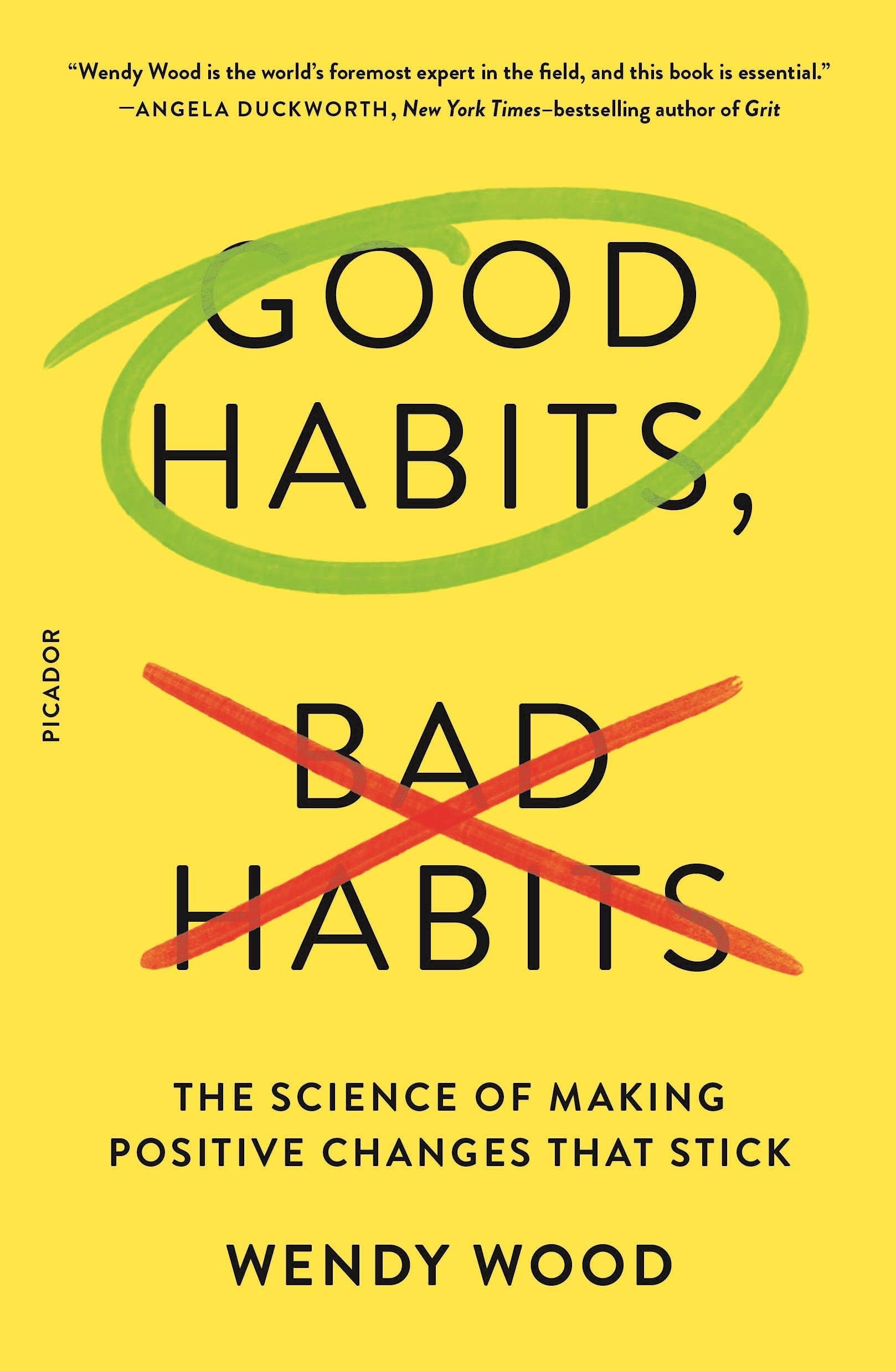
GOOD HABITS BAD HABITS: The Science of Making Positive Changes That Stick
Product ID: 739104018
Desertcart purchases this item on your behalf and handles shipping, customs, and support to Greece.
A landmark book about how we form habits, and what we can do with this knowledge to make positive change We spend a shocking 43 percent of our day doing things without thinking about them. That means that almost half of our actions aren’t conscious choices but the result of our non-conscious mind nudging our body to act along learned behaviors. How we respond to the people around us; the way we conduct ourselves in a meeting; what we buy; when and how we exercise, eat, and drink—a truly remarkable number of things we do every day, regardless of their complexity, operate outside of our awareness. We do them automatically. We do them by habit. And yet, whenever we want to change something about ourselves, we rely on willpower. We keep turning to our conscious selves, hoping that our determination and intention will be enough to effect positive change. And that is why almost all of us fail. But what if you could harness the extraordinary power of your unconscious mind, which already determines so much of what you do, to truly reach your goals? Wendy Wood draws on three decades of original research to explain the fascinating science of how we form habits, and offers the key to unlocking our habitual mind in order to make the changes we seek. A potent mix of neuroscience, case studies, and experiments conducted in her lab, Good Habits, Bad Habits is a comprehensive, accessible, and above all deeply practical book that will change the way you think about almost every aspect of your life. By explaining how our brains are wired to respond to rewards, receive cues from our surroundings, and shut down when faced with too much friction, Wood skillfully dissects habit formation, demonstrating how we can take advantage of this knowledge to form better habits. Her clear and incisive work shows why willpower alone is woefully inadequate when we’re working toward building the life we truly want, and offers real hope for those who want to make positive change. Review: Worth it reading - Nice book tells how to build a good habit and leave bad one Review: Best in its class. - Excellently researched book on habits formation and the psychology behind routine.
| Best Sellers Rank | #703 in Self-Help for Success #1,866 in Sciences, Technology & Medicine (Books) #2,646 in Personal Transformation |
| Customer Reviews | 4.4 out of 5 stars 788 Reviews |
B**D
Worth it reading
Nice book tells how to build a good habit and leave bad one
S**M
Best in its class.
Excellently researched book on habits formation and the psychology behind routine.
S**L
Thanks note
Just got this amazing book, to start my new year in a new way! 🔥 Thanks Amazon for quick delivery.
C**A
Amazingly helpful
The best book on Habits and subconscious working of ourselves. Very interesting and informative. It's a classic reference.
G**L
Simple sweet and straight forward points with clear examples
Good
A**A
Great read
Great read
C**S
How to control one’s habits
Very good book, full of insight and useful advice
J**D
Interessant und hilfreich
Wer schnelle und einfache Lösungen für seine Probleme sucht, wird hier nicht fündig, aber wenn man sich darauf einlässt und etwas Zeit investiert, kann man mit den hier gewonnenen Erkenntnissen echte und vor allem langfristige Veränderungen in Gang setzen.
T**E
How the deeper part of our mind controls our behavior, explained by top habit scientist
From the opening pages of "Good Habits, Bad Habits," I appreciated Wendy Wood's exploration of what she calls our "second self" - the subconscious mind that controls much of our behavior without us even realizing it. As someone deeply interested in personal development, this book offered valuable insights into why real change is so hard despite our best intentions. Wood, a professor at USC, is one of the foremost researchers in habit formation. Her central premise is powerful yet simple: what we often mistake for extraordinary willpower in successful people is actually the result of well-established habits. The book's biggest strength lies in its scientific approach to understanding how approximately 43% of our daily behaviors (and up to 88% of our hygiene routines) operate on autopilot. Wood breaks down the three pillars of habit formation - context, repetition, and reward - providing a framework that explains why New Year's resolutions often fail and why environmental factors beat willpower almost every time. I found her exploration of "friction" especially useful. By explaining how small environmental changes can dramatically impact behavior (like how reducing the distance to a gym increases attendance), Wood offers practical strategies anyone can apply. Her discussions on habit stacking, replacement habits, and the concept of habit discontinuity (how major life changes create opportunities for new habits) provide actionable insights rarely found in typical self-help books. The chapter on stress and habits explains why we fall back on established patterns during difficult times - whether healthy or unhealthy. Understanding this alone is worth the price of the book, especially for those struggling with stress-triggered behaviors. What sets this one apart from other habit books is that Wood isn't just reporting on research - she's one of the pioneering scientists who conducted many of the foundational studies she references. This gives strong credibility to her conclusions and recommendations. You're hearing directly from a primary source in the field, not a secondary interpreter. While Wood writes for a general audience, if there's any critique to offer, it's that the book occasionally reads somewhat academically. However, you could also consider this one of the book's strengths. Unlike many pop psychology books that oversimplify complex topics, Wood respects our intelligence enough to share the nuanced reality of how habits truly function in our brains and she doesn't promise any magical 21-day transformations. Some people might feel like it’s a downer hearing how much of their bad behavior is on autopilot. But overall, Good Habits, Bad Habits gives a message of hope. When you understand how habit formation works, then we understand how we cam make it work in our favor. You learn that making changes isn't about iron willpower but about creating a environment that supports our goals and repeating behaviors until they become automatic. If you don’t mind books that are a little on the sciencey side, citing lots of research, then you will enjoy this book.
A**E
Completely new perspective
Great read factual and fascinating
A**Y
Interesting
Like many other reviewers i thought this would be more of a self-help book with guides and strategies on how to develop the habits you want. It isn't! Instead it covers the scientific research into the psychology of habits in a readable way, without too much jargon and complicated theory. Although it's not aimed at being a self-help book, it describes how our habits can develop, how we maintain them (even if we don't want to) and what can cause them to change. In particular it emphasises how willpower alone is not sufficient. This can give you ideas of ways to help you change your habits so they work better for you. You'll also know if any self-help book on habits is talking sense or not.
Trustpilot
2 weeks ago
1 week ago