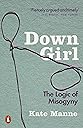
Down Girl: The Logic of Misogyny
Product ID: 734109916
Desertcart purchases this item on your behalf and handles shipping, customs, and support to Greece.
'Everyone should read Down Girl . It should be distributed in schools and every board room, athletic department and legislative space' - Soraya Chemaly A transformative book on how misogyny works from a hugely influential thinker Misogyny is a hot topic, yet it's often misunderstood. What is misogyny exactly? Who deserves to be called a misogynist? How does misogyny contrast with sexism, and why is it prone to persist - or increase - even when sexist gender roles are waning? In Down Girl moral philosopher Kate Manne argues that misogyny should not be understood primarily in terms of the hatred or hostility some men feel toward all or most women. Rather, it is primarily about controlling, policing, punishing and exiling the "bad" women who challenge male dominance. And it is compatible with rewarding "the good ones" and singling out other women to serve as warnings to those who are out of order. An incredibly forensic analysis of the logic of misogyny from a brilliant thinker, Down Girl is essential reading for the #MeToo era. Review: Powerful - Important discussion. Recommend for anyone interested in gender Review: Good purchase - Great
| Amazon 売れ筋ランキング | 洋書 - 75,286位 ( 洋書の売れ筋ランキングを見る ) Gender Studies - 214位 Feminist Theory - 256位 Social Philosophy - 297位 |
| おすすめ度 | 5つ星のうち4.5 969 レビュー |
B**D
Powerful
Important discussion. Recommend for anyone interested in gender
A**R
Good purchase
Great
H**R
Misogyny Is a Moral Priority
I LOVED this book. It was not an easy or a quick read, but it relied on such interesting narratives and made so many surprising, provocative points that I often stayed up reading well past my bedtime because I truly found it hard to put down. Much of the book was validating and affirming rather than challenging; I've spent a lot of years now attempting to explain misogyny to people who aren't really sure it A) exists or B) harms women all ~that~ much if it does exist, so especially in the first third of the book, a primary pleasure was encountering ideas I understood already and seeing Manne express them succinctly and defend them very thoroughly. In particular, I was completely on board with Manne's observation that //a woman is regarded as ~owing~ her human capacities to particular people, often men or his children within heterosexual relationships that also uphold white supremacy, and who are in turn deemed entitled to her services. This might be envisaged as the de facto legacy of coverture law—a woman’s being ‘spoken for’ by her father, and afterward her husband, then son-in-law, and so on. And it is plausibly part of what makes women more broadly somebody’s ~mother, sister, daughter, grandmother,~ always somebody’s someone, and seldom her own person. But this is not because she’s not held to be a person at all, but rather because her personhood is held to be owed to others, in the form of service labor, love, and loyalty. (173)// That squares absolutely with explicit statements I encountered especially at church about "the divine role of women." And one reason I like this book is because, without ever acknowledging that such a thing exists, it demolishes the nonsense feminism known as "complementarianism": the idea that men and women have different roles by divine decree and that you can argue for women's full empowerment by saying that they owe the men in their lives all this nurturance and support—that, in fact, real feminism will help women be more nurturing and supportive of dudes. [Seriously. There are women who claim to be feminists who say this stuff.] What I really had to grapple with was Manne's analysis and rejection of the idea that the problem with misogyny is that men fail to see women as human and that certain harmful behaviors would stop if men could fully recognize women as human: //a fellow human being is not just an intelligible ~spouse, parent, child, sibling, friend, colleague,~ etc., in relation to you and yours. They are also an intelligible ~rival, enemy, usurper, insubordinate, betrayer,~ etc. Moreover, in being capable of rationality, agency, autonomy, and judgment, they are also someone who could coerce, manipulate, humiliate, and shame you. In being capable of abstract relational thought and congruent moral emotions, they are capable of thinking ill of you and regarding you contemptuously (147).... We may see others as ~rivals, insubordinates, usurpers, betrayers,~ and ~enemies~ (inter alia), without ever losing sight of these people's full humanity. And we may subsequently be disposed to try to defeat, chastise, trounce, punish, destroy and permanently close the eyes of those we know full well are people like us (158) .... People may know full well that those they treat in brutally degrading and inhumane ways are fellow human beings, underneath a more or less thin veneer of false consciousness. And yet, under certain social conditions—the surface of which I've just barely scratched in this chapter—they may massacre, torture, and rape them ~en masse~ regardless. (168)// By the end I was persuaded. I think she's right. I also really dug the coinages "himpathy" and "herasure." Manne acknowledges that her polemic isn't likely to succeed in creating a lot of new converts to the cause: she writes that she is not particularly "optimistic about the prospects of getting people to take misogyny seriously—including treating it as a moral priority, when it is—unless they already do so” (280) in part because “Misogyny is a self-masking problem. Trying to draw attention to it is illicit by the lights of the phenomenon itself, since women are supposed to minister to others, rather than solicit moral attention and concern on their own behalf.” (281-82) But if you already consider misogyny a moral problem, this book is a terrific resource because it lays out the stakes so clearly and articulates strong, coherent responses to common objections to feminist ideology.
S**E
Easy to read
Very good book.
A**E
Brilliant
Brilliant!! It is very academic writing, but even with that, I found it hard to put down. Essential reading for the times we're in.
Trustpilot
5 days ago
3 weeks ago