Health Care in Maya Guatemala: Confronting Medical Pluralism in a Developing Country
G**S
Good overview of public health and NGO issues among the Guatemala Maya
The is a medical anthropology book without the normal arcane jargon of anthropologists. Good introduction to the post-Civil War public health challenges in rural Guatemala. Wish I have read this before joining Healer2Healer.org as a volunteer in April 2011 in Santa Cruz del Quiche. Other supporting background readings for those volunteering with NGOs in Guatemala include "Time and the Highland Maya" by Barbara Tedlock, "Wind in the Blood: Mayan Healing & Chinese Medicine" by Hernan Garcia, Antonio Sierra, Gilberto Balam and Jeff Conant, and (skipping over the very academic jargon of the linguistic methodology chapters) "K'iche': A Study in the Sociology of Language" by M. Paul Lewis. This last book has excellent discussions of ethnic and political dyanamics in 5 key towns in the Western Highlands of Guatemala.
L**H
good
good
M**T
Love this book
Incredible book full of great resources for a project I am working on
P**S
Confronting Medical Pluralism in a Developing Country
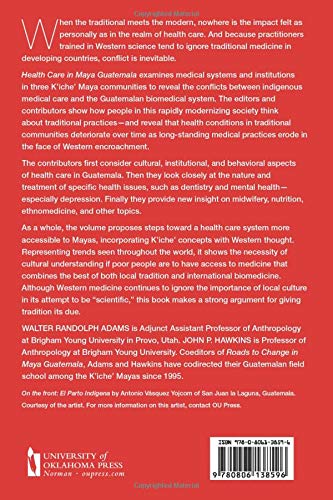
Indigenous peoples around the world are at the center of many conflicts: natural resource management, intellectual property rights, sovereignty, identity, and health care to name just a few. In each country, and among each indigenous group, these conflicts differ. Adding to the complexity of each idiosyncratic conflict is the continued encroachment of non-indigenous (primarily Western) cultural practices, exacerbating specific situations for each indigenous group. The country and indigenous people of Guatemala are no exception to this mix - or emerging pluralism - of the old and the new, indigenous and non-indigenous, ancient and modern. Health Care in Maya Guatemala, the newly published book from the University of Oklahoma Press and edited by Walter Randolph Adams and John P. Hawkins highlights this contemporary dance of conflicts by specifically examining health care among the indigenous Maya peoples.Covering a range of issues effecting the indigenous Maya peoples of Guatemala - specifically three neighboring K'iche' Maya communities in the central west highlands - the book offers Central American specific examples of cultural, institutional, and behavioral health care perspectives. Further, the editors have made sure to include several chapters on specific aspects of the nature and treatment of various conditions, such as midwives, childbirth, development, dentistry, and depression. As such, the book is well rounded and encompassing, making it accessible to specialists, applied researchers, and interested or concerned individuals. Furthermore, because the chapters come from several years of field school programs held for advanced undergraduates, this book is an excellent text for medical anthropology courses.Much of the importance in the book, however, resides in the unique contribution to the larger medical and anthropological fields that it makes. For example, the book provides important indigenous perspectives to the Complementary and Alternative Medicine (CAM) debate. Here in the West we are enthralled with indigenous forms of medicine, methods of healing (including the body, mind, and spirit), biopharmacy, and anything alternative to the mainstream medical world. Health Care in Maya Guatemala, however, comes from the other perspective - that of the indigenous Maya peoples and their perspectives on Western versus traditional health care practices. Rather then framing its arguments in terms of the West cannibalizing Guatemalan Maya indigenous medical knowledge, it examines why indigenous people in Guatemala are neglecting their own ethnomedical knowledge (which works quite well), and instead willingly adopting many aspects of Western medicine.Through the use of short-term participant observation, informal interviews, and other standard anthropological methods, the process of this adoption are intricately captured. Not only are the shortcomings of Western medicine in a culture that has a different understanding of the patient/client role clearly documented, but so are the attractions and perceived powers of Western pharmaceutical medicine discussed. By focusing on three neighboring K'iche' Maya communities in the central west highlands chapters within Health Care in Maya Guatemala argue that the process of medical pluralism - the mishmash of indigenous and Western medical practices - is currently the norm in Guatemala and much of the rest of Central America. Not only is it the norm to a large extent, but it is not necessarily that bad.Beginning as early as the 1950s, the influx of Western medicine has had an influence on the indigenous Maya of southern Mexico and northern Guatemala (Adams 1952, Paul 1955). The process and methods of this influence has not always been the same, and the editors and their students have teased out several of the unique characteristics of this plurality. For example, the Maya medical term yab'ilal is used to describe a "disease for everyone" and k'oqob'al is used to describe when "someone is making you sick." As a result of these indigenous categories, Western biomedicine has had more of an influence on diseases placed in the yab'ilal category, while those changes brought about by Catholic and Protestant missionaries have effected k'oqob'al diseases. That is, Western medicine's fixation on microbial and pathogenic types of diseases has resulted in its influence on "diseases for everyone" while more Western based psychological or mental diseases have impacted k'oqob'al diseases.Another component of this medical pluralism is that indigenous healers often do not know unlimited amounts of ethnobotanical knowledge as they are often romantically framed in the West. Rather, as the chapters in this book document, many indigenous medical practitioners (in this case comadronas [midwives], curanderas [healers], hueseras [bonesetters], and cura los ojos [eye doctors]) often know only a handful to several dozen plants that have medicinal properties. Furthermore, most are self-taught with only a minimal amount of training. However, as discussed via first-person interviews many have experienced what has come to be known in the anthropological literature as "the call." Several other aspects of the medical pluralism found among the indigenous Maya are also documented, adding to the books overall reach and value.In general Health Care in Maya Guatemala attempts to reverse the trend found not only in Guatemala, but in much of the medical research dealing with indigenous peoples; that of focusing on behavioral, quantitative, and mechanistic research projects. Rather, this book returns to a more anthropological, qualitative, and applied research and scholarship agenda. Part of this is the overarching theme of giving something back to the Maya. This is done not only by the publication of the book and its extensive use of indigenous linguistic terms, but also by focusing on a very useful and applied topic: health and the useful applications to promote health.+++++++++++++++++++++++++++++++++++++Indigenous Peoples Issues & Resources[...]
Trustpilot
1 month ago
4 days ago
2 weeks ago
1 month ago