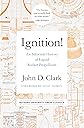
Ignition!: An Informal History of Liquid Rocket Propellants (Rutgers University Press Classics)
Product ID: 66687885
📚Rare reissue, first time in decades
🚀Decades of rocket fuel innovation
⚗️Deep dive into complex chemistry
Desertcart purchases this item on your behalf and handles shipping, customs, and support to Greece.
🚀 Ignite your curiosity with the explosive history of rocket fuels!
Ignition! is a newly reissued classic that chronicles the perilous and groundbreaking development of liquid rocket propellants. Authored by John Drury Clark, a leading scientist and sci-fi writer, this book offers a rare insider’s perspective on the chemistry, politics, and innovation that propelled humanity into space. Combining technical depth with engaging memoir-style narration, it’s a must-have for professionals and enthusiasts eager to understand the science and history behind space exploration’s most volatile fuels.

| Best Sellers Rank | 61,515 in Stationery & Office Supplies ( See Top 100 in Stationery & Office Supplies ) 16 in History Curriculum Resources |
| Customer Reviews | 4.7 out of 5 stars 1,660 Reviews |
M**M
Amusing, highly technical book by one of the people doing it - and surviving
The author is clearly one of the people at the forefront of this research - highly specialised as it was - for a period of many decades. His narration - and it is really a narration of What We Did And When - style is highly amusing and accessible. He writes almost as if he were giving a Plenary lecture right before the conference Reception. Some of the stories he tells are hilarious; some literally tragic in multiple horrific ways and some of squirming sales reps forced to make fools out of themselves because 'we need to pretend our product is special' but are talking to engineers that 'Know'. This is a complex subject with a lot of chemical names - and few structural diagrams except when the compounds got really crazy-weird as some did; perhaps this is for the best. Hence you will either need a really good memory for what 'UDMH' / 'IRFNA (red fuming nitric acid)' is - or consult the helpful glossary at the back (a lot). At one point I thought about copying the glossary onto separate sheets for quick consultation. Higher education in Chemistry helps...though only do much as the chemistry is so specialist you either know it very specifically or little more than anything you learned about the reactivity scale of elements (Fluorine as the master) at school is going to help before you start reading. A lot of the challenges were physical (how to stop the fuel freezing at above -56C this being a military requirement for example) or how to get the fuel to 'light' smoothly and political (programs start; money is awarded; companies pile in, fashions change and interests move on to another program that starts). As the author states he expresses his own opinion. He does this fearlessly as one might expect from a person now retired from his senior position with many of his more incompetent - or simply unlucky - contemporaries dead (literally). I'll probably be sending this book out for Christmas presents to some of my more geeky friends in December 2019 having read it myself in 2018.
D**T
Excellent Book
A fascinating informal history of liquid fueled rocket propulsion, something that still does not go right as SpaceX found yesterday (21/4/2019). Having just read this book the reporting of the accident and fuel type made a lot more sense. Everyone's interest should be piqued by the statement at the beginning that the chemists and engineers that designed the liquid rocket fuels up the the early 70's when this was originally written were "beyond insane". It was certainly a hairy business, and one wonders what modern safe working practice would have accomplished in the time. However this work was undertaken in the darkest days of the cold war when there was a more complex balance of risks. The book uses a bit of inorganic chemistry to explain what happens, but nothing that someone that did chemistry to the British O level (taken at 16) 50 years ago cannot follow. For those not familiar with basic chemistry the book is still an interesting read and quite understandable if you skip the chemical equations. It is well worth reading, particularly, if like me, you have a geeky interest in all things to do with science, engineering and the military history of the cold war era.
W**N
A funny and informative book on the early days of rocket design and fuels
This book is a surprisingly easy (and funny) read. There are sections of chemistry which, for a layman like me, are pretty impenetrable, but for the most part it is very approachable. Think of a real life, government funded, version of the Darwin awards.
R**N
Proof the only people braver than the astronauts were the rocket fuel scientists
This book is a very entertaining look at the insane mad science of rocket fuel development in the 1950s and 60s. While we have settled on a few common rocket fuels now, like RP1/LOX and LH2/LOX, we were toying with such insane things as Chlorine Triflouride, Dimethyl Mercury, and Liquid Ozone. All to very states of cartastrophic fires, explosions and poisonings. This book is written to make you laugh and learn. But when you stop laughing you realise "holy cow, someone was burned alive screaming from contact with Chlorine Triflouride." Truly an entertaining and informative read, let's all be grateful today we aren't toying with this mad science anymore now that we've settled on a few, sane propellants
M**.
Fascinating and Hilarious
A fantastic and amazing look into the mad world of rocket propellant research up to the 1980s (which is most propellant research) revealing the fascinating science while entertaining the reader the whole way. I would recommend this to anyone interested in rocket science however I would recommend knowing a fair bit about chemistry before you read this as while the author does a good job of making the science understandable for the Layman it is still difficult to understand in places ( I am currently in 1st year A level chemistry).
A**N
Very good read
The history of liquid propellants from the 50's to the 70's. The author writes with a great deal of knowledge, with just a little humour here & there. Bangs and smells, I found it very interesting.
L**S
A good history well explained.
A good history of the subject. Easy to read and the characters of the people involved and the politics, requirements of the paymasters etc are well described. The technical chemistry isn't that much and can easily be ignored yet the story remains fascinting. It actually is understandable rocket science!
M**R
Fun accoubt
Fun account of the development of rocket fuels, with quite a few failures!
J**A
Category under Good book
Good
N**H
Perfect quality, SUPERB & entertaining read - very accessible to anyone
Ignore any old reviews - its a completely new version!!! This much be a new version, because its not a "shoddy pdf" - its a normal text kindle e-book, font is changeable etc Works like every ebook i've had. This is an awesomely entertaining read! Super funny - great wit from the writer. There's a few heavy parts sure, but if you dont understand them - it doesnt detract from the read at all. Its a great read & gives massive insight into the challenges these poor souls had to go through & overcame. Written in a down to earth, informative way.
C**N
Per gli appassionati di chimica, tecnologia.
Pur se scorrevole e divertente, richiede pero ‘ una base di conoscenza di chimica non banale per essere letto. Consigliato.
R**R
Great book about the Heroic Age of Rocket Fuels! Humorous, Fun -and- Authoritative
Told by a man who was there, in the middle of it. A person who liked "energetic chemistry" (explosions) so much that he made a career of it. With a sense of humor about: Which rocket fuels worked, which didn't, why, how the problems were fixed, and much of the interesting personal dirt besides. It lists promising fuels, and even how to recognize them by flame color. Wouldn't you like to know about the "secret rocket fuels"? And what went wrong with them? (And actually, a few went -very- right.) And don't you want to know how red fuming nitric acid is kept in metal containers (i.e. rockets) without eating holes in them? And also, wouldn't you be sad to miss the before and after photos of a rocket engine test cell that had a "malfunction"? Great fun.
E**R
Ignition! - Sehr lesenswert
Habe das Buch aus einem allgemeinen Interesse an Raumfahrt und Raketentechnik gekauft und gelesen. Es handelt tatsächlich fast nur von Treibstoffen, die sonstigen "Hintergründe" beim Entwicklungsprozess kommen kaum vor, das sollte der geneigte Leser vielleicht vorher wissen, der Titel hält hier absolut was er verspricht. Das Buch ist aber sehr kurzweilig geschrieben, zuweilen sehr lustig aber immer informativ und nie langweilig. Man muss auch kein studierter Chemiker sein um das Buch zu lesen, ein wenig Grundwissen sollte man schon mitbringen aber wer in der Schule mal einen Chemiekurs hatte und bereit ist etwas zu recherchieren sollte gut klar kommen und darf sich auf ein spannendes und interessantes Buch über die ersten Jahre der Raketentreibstoffentwicklung freuen. Nebenbei bekommt man auch einen schönen Einblick in den Laboralltag, wie die Forscher damals gearbeitet haben und mit welchen technischen und bürokratischen Hindernissen sie sich herumschlagen mussten. Von mir eine klare Empfehlung für alle die ein gewisses Interesse an Raumfahrt, Treibstoffen und Technikgeschichte haben!
Trustpilot
1 day ago
3 weeks ago