

Desert Online General Trading LLC
Warehouse # 7, 4th Street, Umm Ramool, Dubai, 30183, Dubai
Desert Online General Trading LLC
Warehouse # 7, 4th Street, Umm Ramool, Dubai, 30183, Dubai

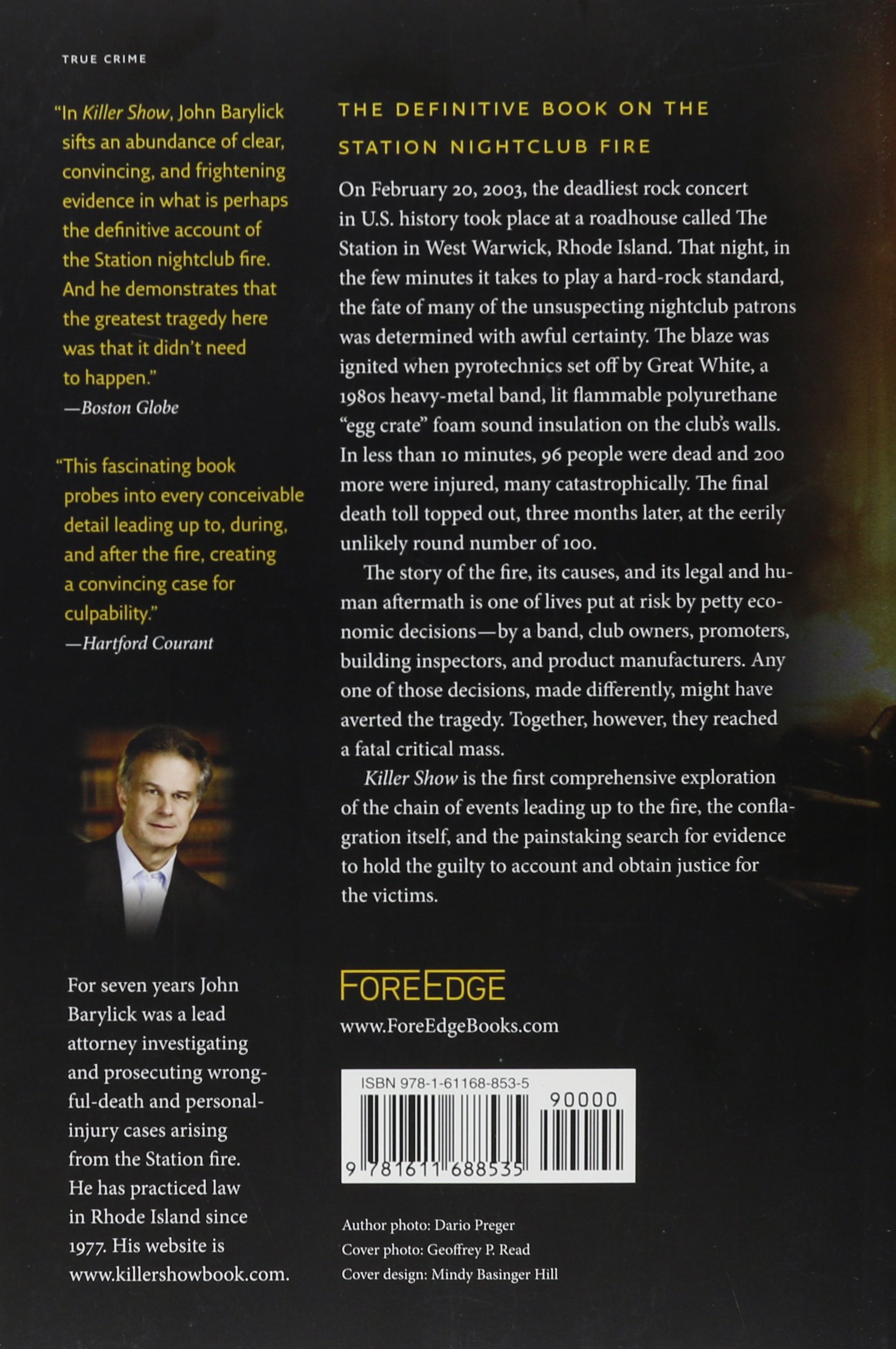
Killer Show: The Station Nightclub Fire, America’s Deadliest Rock Concert
B**R
Great book on so many levels! Deserves 5+ stars
In his thoughtfully written and well researched book Mr. Barylick sets himself apart from many of his colleagues in his chosen profession as a man of integrity, empathy and ethics. I say this as a life long resident of the state of RI having followed Mr. Barylick in the news as he led the Plaintiff Steering Committee in hopes of salvaging some justice for the victims of this entirely preventable tragedy.Having said that this book is an eyeopener. After reading it I realized that I barely knew anything about the details of this case but thanks to Mr. Barylicks masterpiece that has all changed.I won't go into the details of the book as many previous reviewers do an excellent job of that but one page in particular at the end struck me as the moral of this tragic fable.On the bottom of page 237 continuing onto p238 is a list Mr. Barylick compiles stating the 10 issues that contributed to this fire. He states rather ironically that had just 1 of these things occurred differently the outcome of this fire and the ensuing death toll could have been significantly less (or in the case of pyrotechnics no deaths at all).Reading his list brings one to the same conclusion. Greed and regulatory incompetence are to blame for all ten!Had the Town of West Warwick done its job with respect to fire inspections and club capacity this would have been prevented. Had miscreant (Mr. Barylicks apt description) Great White singer Jack Russell the 1st clue as to what his band was doing with pyrotechnics this would have been prevented. Had the deadbeat Derderian brothers actually run a respectable night club instead of a dilapidated fire trap where their only thought was wringing every last cent out of this dump, sadly once again, this would have been prevented. True capitalists these two are by the way - they would have fit right in as characters in Sinclairs The Jungle.Greed, incompetent town bureaucracy and unregulated polyurethane foam (liquid gasoline as its called) used as soundproofing caused the deaths of 100 people. What kind of message is sent when only 3 people do time for a tragedy such as this? Jack Russell is still allowed to eke out a living as a washed up rocker and the W. Warwick fire inspector collects his pension and a disability claim to boot. If you have any questions as to how RI state pension fund was an unfunded 9.4 billion (yes Billion) disaster ready to implode in 2011 look no further than the previous sentence.This is politics and justice Rhode Island style!
R**L
There but for the grace of God......
A personal confession: in my 20s and early 30s, I was unmarried and living in a large metropolitan area. My taste in music was not the sort of groups that played in stadiums. So I spent a lot of time clambering in and out of rickety clubs to see upcoming bands. Some achieved stardom. Most did not. I had some self-imposed rules for these excursions (no more than 3 beers and being aware of exits in case a hasty departure was necessary) and convinced myself I had been sufficiently proactive about my safety.Of course I was deluding myself. When the Rhode Island disaster occurred, I recognized the venue as a carbon copy of the sort of place I used to go to. With the clarity of hindsight, I can now easily envision myself trapped in the scrum of people struggling to get out the front entrance, piled seven deep and wedged so tightly that movement, let alone survival is impossible. Imagine yourself in a small place surrounded by almost 500 other people, your alertness pleasantly altered by the beers you've been encouraged to drink. The headliners blast into their first song and dazzling pyrotechnics temporarily blind you. When your vision clears, you see fingers of flame creeping up the back wall. Is that part of the show or is something wrong? They reach the ceiling and begin to spread, slowly at first but then more rapidly. As smoke fills the room, you (and 500 other people) surge towards the one narrow exit you are aware of. The alarms start to blare, the lights suddenly go off and you are now blindly groping in choking toxic smoke as the air heats up around you. From the time the squib pot is ignited until the entire building is raging, full on is less than 3 minutes. If you weren't out in the first 90 seconds, your chances were slim and none. The wonder isn't that 100 people died. The wonder is that the death toll wasn't higher.It is hard to imagine that John Barylick's version of events could be improved upon. Barylick has the vantage point of being an attorney for the survivors, so he has a front row seat to all the events and subsequent machinations. He painstakingly weaves all the elements of the story (governmental oversight (or lack thereof), architecture, fire science, forensics, biology, causation, rehabilitation and litigation) into a seamless, highly readable story. In between the technical information, Barylick is aware that this is first and foremost a human tragedy and he puts names and personal stories to humanize the numbers. I thought the litigation portion of the story would be anticlimactic, but Barylick makes it as interesting (and ultimately infuriating) as the events that preceded it. I followed the story closely after it occurred, but this book exposed a wealth of information I had no idea existed. The most amazing vignette was of concert-goer Mike Vargas, whose insane story of survival has to be read to be believed.What makes Barylick's book required reading for risk managers is how ably it demonstrates the chain of causation that led to the outcome. It wasn't one main thing that happened - it was an accretion of commissions and omissions that accumulated into a perfect storm of consequences. One despairs at the number of places where a single act could have prevented the tragedy. The villains in this book weren't purposely evil. No one is accusing them of trying to kill as many people as possible. But the neglect, greed and inattention of folks like Denis Larocque, the Derderian brothers and Jack Russell ultimately had the same effect. The Derderians and Russell seem to be the callow sort capable of brushing the ashes off their clothes and blithely continuing their lives (even if many others weren't able to). The only one who seems worthy of sympathy is Great White road manager Dan Biechiele. In igniting the fireworks that fateful February night, Biechiele only did what he (and many others) had previously done in the club. In doing so, he unwittingly set off the bomb that had been patiently waiting for the final spark. Unlike others, he accepted responsibility and made no attempt to equivocate or deflect blame. His remorse seemed genuine rather than calculated. This stands in sharp contrast to those who spent the immediate aftermath lawyering up and shuffling assets to places where they couldn't be seized.Disasters also cause some to rise to the occasion. We have the heroism of Shamus Horan, who pulled people through a broken window from the flames. There is the example of bouncer Tracey King, who pushed and threw patrons out of the building until the flames consumed him. And the event was a testimony to the quality of New England regional medical care. 96 succumbed at the site. Of those who made it to hospitals, only 4 more died. Given the severity of the injuries, this is nothing short of astonishing.You would have hoped that folks had learned after the Station fire. But since then, there has been the 2004 Republica Cromanon fire in Argentina (194 dead), the 2008 Wuwang China fire (43 dead), the 2009 Santika club fire in Thailand (66 dead), the 2009 Lame Horse club fire in Perm Russia (156 dead) and the 2013 Kiss nightclub fire in Brazil (242 dead). All can be traced to the same preventable cause - pyrotechnics used in an enclosed space in close proximity to flammable decorations. Future tragedies of this type appear to be sadly inevitable. But Barylick's highly readable, highly recommended cautionary fable is ample evidence that they shouldn't have to be.
C**R
avoidable
the most tragic thing about this story is that it was 100% avoidable. and not to blame the band but WHY do you need pyro in a TINY club???? This isn't the 80s and you are not playing stadiums...This book was very detailed and told a great story, I remember when this happened but I did not know all of the facts... being that I attend a lot of shows in similar venues this really hit home... check it out you won't be disappointed
N**Y
Such a sad read
This is heartbreaking to read. Very well written and contains great in-depth knowledge of what went wrong.
S**N
In perfect condition
A sad read but brilliantly written. The tragic turn of event. Felt so personal. As a metal fan of similar age. Attending many small gigs of favourite bands. Could have been us. My heart and soul goes out to everyone effected by this tragedy. I was able to get this hard copy book that I’ll keep in my small library as a personal treasure.
M**N
Beautifully written and a moving, compelling true story
This book really stuck in my head. It takes an incredibly complicated story and weaves it together with such elegance that you can switch between technical explanations of flammable material and traumatic personal stories of loss. This book shows how the brief coverage a story like this gets in newspapers on or TV can never truly explain what happened. It's a story of human greatness and failure, a perfect storm of safety risks and very strong warning that lessons like this must not be forgotten. I am genuinely more aware of the safety of my surroundings after reading this book. It's an incredibly powerful read and a sensitive portrayal of the people who lost their lives at The Station Nightclub in Rhode Island. Highly recommended book.
B**S
Informative Story About This Tragic Event
Well written, spell-binding story that was hard to put down. Has photos. I would have liked viewpoints and stories from more victims that are in the book, and more photos - perhaps a few frame-by-frame from the video, nevertheless it is an excellent book about this tragic event.
T**A
Emotional
An avoidable tragedy, so many lives lost with so many more lives irreversibly changed. This book is a must read, for if nothing else, it serves to remind us just how lucky we are and but for the physical position/location within the club that theses poor souls found themselves in at the time of ignition determined to a large degree whether they lived or died. This tragic, disturbing and emotional story expertly detailed by John Barylick. I never go anywhere now without scanning for exits! Trust me, after reading this book, neither will you!
Trustpilot
3 weeks ago
5 days ago