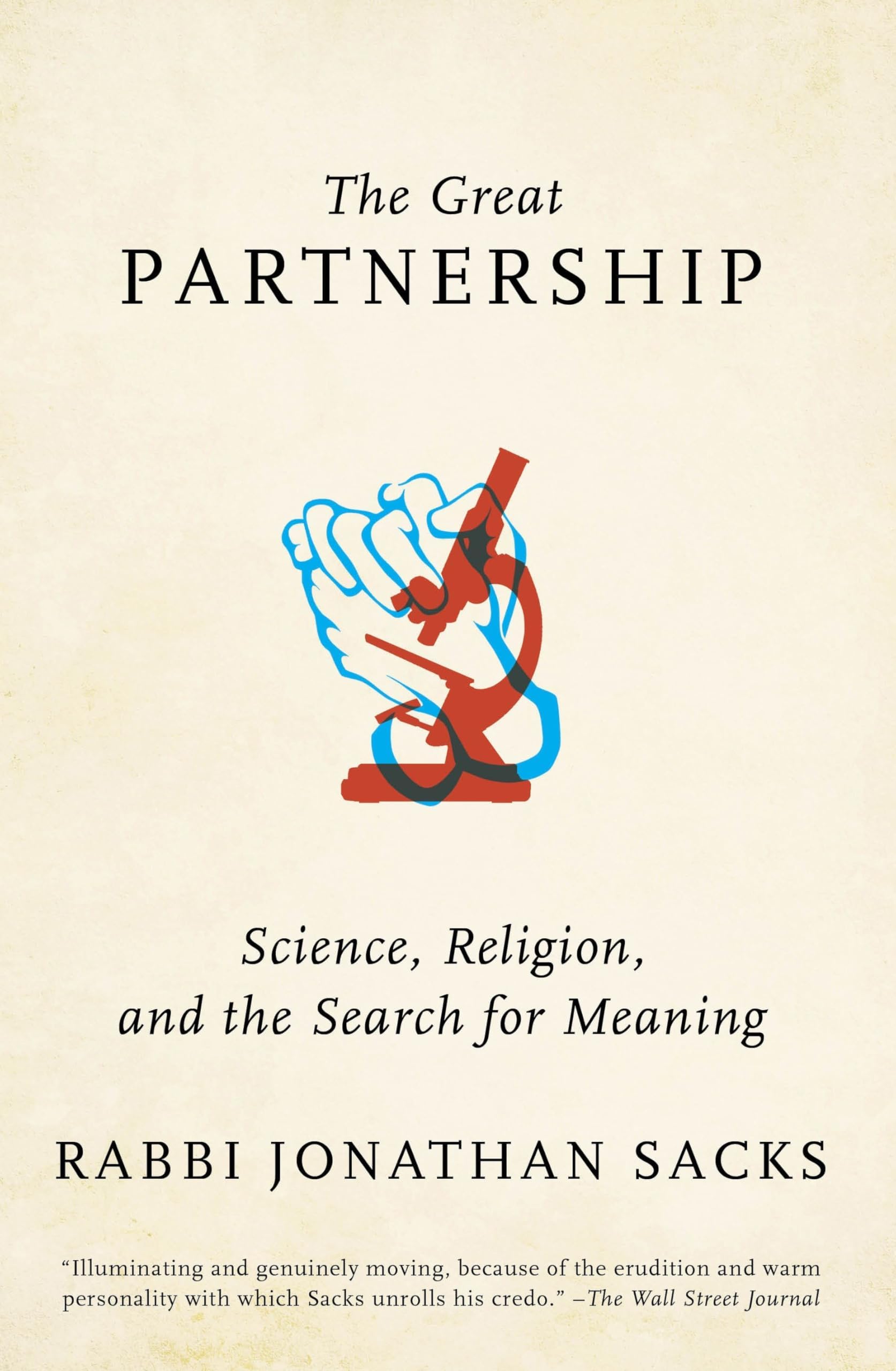
The Great Partnership: Science, Religion, and the Search for Meaning
Product ID: 6536970
Desertcart purchases this item on your behalf and handles shipping, customs, and support to Greece.
The Great Partnership: Science, Religion, and the Search for Meaning [Sacks, Jonathan] on desertcart.com. *FREE* shipping on qualifying offers. The Great Partnership: Science, Religion, and the Search for Meaning Review: A Careful Treatment of Thoughtful Religion, Philosophy, and Science - Rabbi Jonathan Sacks wrote a thoughtful book that does not provide "all the answers," but the book is one to make readers think. As an aside, the books that "provide all the answers" are not worth reading or considering. While Rabbi Sacks is obviously Jewish, his book is not exclusively "Jewish," and he shared philosophical and non-Jewish insights re where science and religion merge into seriously thinking. Those who are superficially religions will despair about scientific achievement.. Those imbued about science can blunder if they miss a sense of good vs. evil or right vs. wrong. A limited religious view can lead to fanaticism and cruelty. As Sacks noticed the worst atrocities in history were committed during the 20th. century via the Soviets and their followers The latter had no sense of good vs. evil. Sacks noticed that these political ideologues had only one concept and that was power at any price. Sacks also wrote that dissenters should be dismissed if their thinking is correct even those many do not accept their concepts. Rabbi Sacks further amplified his book by comparison/contrast. In the Book of Exodus 3: 14, G-d said I AM WHO I AM or I WILL BE WHO I WILL BE. These transcendent phrases have a deeper meaning in the Hebrew language. Or, as some astronomers have written, the more the universe is comprehensible, the more is seems incomprehensibly or pointless. In other words, understanding religion and science can lead to more understanding without "final answers. Religious concepts provide meaning to such concepts as mercy, actual love, kindness, compassion, etc. Science explains the how of the Cosmos while religion can partially explain. Religious convictions can give meaning to life and make men and women more humane. Rabbi Sacks warned readers of fanatical redemptive salvation based on race, religion, and false national identify. Sacks made a poignant remark that religion is based on faith in G-d, science is based on faith in naturals law which one can surmise originate with G-d. Or, as Rabbi Sacks wrote, science takes things apart, while religion puts things together to see what they mean. While reading is now being lost in a sea of useless technology, the development of writing was the beginning of civilization. The oldest know alphabet is known as proto-Sinaitic which is dated c. 1800 BC. Older written languages used complex phonographs such as Cuneiform both of which had too many characters. Proto-Sinaitic probably evolved into Hebrew and Aramaic which were the original languages of the Hebrew Bible or Old Testament. Yet, the Ancient Greeks also influence the Ancient Hebrews and vice versa. The first translation of the Old Testament was translated into Greek between c.287-247 BC. Many of the Ancient Greek thinkers had high regard for Hellenized Jews who in turn were impressed by Greek philosophy, mathematics and science. The sections on alphabets was historically interesting. While the entire Old Testament was originally written in Hebrew and Aramaic, the entire New Testament was originally written in Greek. As Rabbi Sacks implied above, a search for science can lead to search for G-d and "unsettled questions." Sacks made another connection between Ancient Judaism and the Ancient Greeks when he wrote that Socrates was the Ancient Greek closest to the Ancient Rabbis. Both raised difficult questions and did not raise issues that insults intelligence. Rabbi Maimonides (1135-1204) warned against false prophets and superstition/phony miracles. Socrates (c.470-399 BC) "kept the gods at arms' length. Or as Rabbi Sacks wrote, "Faith is not certainty. It is the courage to live with uncertainty. The problem that has plagued religious leaders, philosophers, and even scientists is The Dignity of Man. In Late Modern European, US History, the dangerous thinking is that technology and secular ideologies have diminished human dignity. Political leaders, "sociologists," and other "social scientists" have reduced men to predictable robots. Sacks noticed that even after the failure of "The god(s) that failed," few thoughtful have barely noticed due to "the killing of history." The new social scientists have been anointed as "the new clergy" their "academic bafflegap" and meaningless pronouncements. How has all this affected relationships? Rabbi Sacks warned readers that relationships are based on usefulness and betrayal. Strong family relationships can mitigate tyranny. Yet, solid family relationships are a defense to tyranny when family love is so much more important than love of the state or tyrant. No wonder those who led Big Communism preached love of the leader cult. Sacks could have cited Soviet family betrayal re children vs. parents, husband vs. wife, and friends betraying each other to become " the tattle tale hero." Sacks gave fair warning of this issue in the West. This reviewer was impressed with Sacks' describing thoughtful religion as the "music of life." Anyone familiar with Sacred Classical Music would agree with this phrase. Even Rabbis and Catholic authorities often blessed scientists if only because all concerned were concerned with the mystery of the Cosmos-and G-d. In other words, serious religious people wanted to better understand the Cosmos, G-d's Creation. People who have different views re science and religion and converge on "The Meaning of Life." The more important section and the one left more questions was Sacks' section about The Problem of Evil. As Rabbi Sacks commented, a too confident sense of justice can lead to injustice. Such false confidence can lead to false ideology and the horribly tragic consequences of such false pride. As noted in the book, religion and political ideology can go wrong when political "isms" and religion go wrong. Sadly, those who are most arrogantly confident in their religious/political fanaticism often fail at the cost of too many innocent victims. Rabbi Sacks wrote a thoughtful, readable book. Sacks dealt with serious philosophical, religious, and scientific issues in clear, concise terms. The undersigned was dissatisfied with Sacks' treatment of evil, but much greater men and women have also failed to give a satisfied answer to the problem of evil. Those who enjoy good literature, serious philosophy, and scientific inquiry will enjoy this book. Again, readers be warned that there no final answers in this book. James E. Egolf December 18, 2015 Review: It is an excellent book, written by a religious - It is an excellent book, written by a religious, well-educated, bright man. He is certainly an excellent writer, very clear, consistent. For me it was the first glimpse into a world of religious people. In my understanding, J. Sacks addresses "his" (religious) people to show them that science does not contradict religion. He addresses "my" side (atheists) and shows that religion is the only good way to run a society and that "The atheist is no more sure of the godlessness of the universe than the believer is of his or her God-filled vision. So why choose that way rather than this?" In "Sapiens: A Brief History of Humankind" by Y. Harari, the author shows that religion is the only way to run a society. But, Harary presents religion in an abstract way, defined as something not proven, but considered true among people that form a society. In his model socialism, capitalism, humanism (religion of today in the free world), evolutionism (and Nazism as a part of it), Judaism, Christianity, and so on, are religions. For J. Sacks religion is something that involves God. From here, in his presentation, there is good religion, bad religion and everything else. The last two, in his presentation, are bad. As a humanist, I cannot accept this (humanism is in the category of the last two), but I am aware now, after reading these books, that this is, like it always was, just "good religion against bad religion". In this book there is very detailed presentation of monotheism and it's influence on mankind. Based on principles of monotheism, the author shows that science, Darwinism included (!), absolutely does not contradict religion. This is between him and his people, but it is presented on a very high level. To me it has no meaning, not because it is wrong, but because it is irrelevant. Big bang or God makes no difference to me. J. Sacks never mentions in his book religious rituals, prayers, holidays, etc., like they do not exist. This is smart. He would lose me instantly, should he act otherwise. To summarize, for me this glimpse into the world of religion is very interesting. To understand what monotheism is, is important, though not of big use for me. Presentation of problems that challenge any human society at any time is important. However, the book did not convince me that religion that involves God is the only way to run a human society. Anyway, to read this book is a pleasure.


| Best Sellers Rank | #94,300 in Books ( See Top 100 in Books ) #13 in Women & Judaism #81 in Science & Religion (Books) #84 in Religion & Philosophy (Books) |
| Customer Reviews | 4.7 4.7 out of 5 stars (606) |
| Dimensions | 5.12 x 1.09 x 7.96 inches |
| Edition | Reprint |
| ISBN-10 | 0805212507 |
| ISBN-13 | 978-0805212501 |
| Item Weight | 14.4 ounces |
| Language | English |
| Print length | 384 pages |
| Publication date | September 2, 2014 |
| Publisher | Schocken |
J**F
A Careful Treatment of Thoughtful Religion, Philosophy, and Science
Rabbi Jonathan Sacks wrote a thoughtful book that does not provide "all the answers," but the book is one to make readers think. As an aside, the books that "provide all the answers" are not worth reading or considering. While Rabbi Sacks is obviously Jewish, his book is not exclusively "Jewish," and he shared philosophical and non-Jewish insights re where science and religion merge into seriously thinking. Those who are superficially religions will despair about scientific achievement.. Those imbued about science can blunder if they miss a sense of good vs. evil or right vs. wrong. A limited religious view can lead to fanaticism and cruelty. As Sacks noticed the worst atrocities in history were committed during the 20th. century via the Soviets and their followers The latter had no sense of good vs. evil. Sacks noticed that these political ideologues had only one concept and that was power at any price. Sacks also wrote that dissenters should be dismissed if their thinking is correct even those many do not accept their concepts. Rabbi Sacks further amplified his book by comparison/contrast. In the Book of Exodus 3: 14, G-d said I AM WHO I AM or I WILL BE WHO I WILL BE. These transcendent phrases have a deeper meaning in the Hebrew language. Or, as some astronomers have written, the more the universe is comprehensible, the more is seems incomprehensibly or pointless. In other words, understanding religion and science can lead to more understanding without "final answers. Religious concepts provide meaning to such concepts as mercy, actual love, kindness, compassion, etc. Science explains the how of the Cosmos while religion can partially explain. Religious convictions can give meaning to life and make men and women more humane. Rabbi Sacks warned readers of fanatical redemptive salvation based on race, religion, and false national identify. Sacks made a poignant remark that religion is based on faith in G-d, science is based on faith in naturals law which one can surmise originate with G-d. Or, as Rabbi Sacks wrote, science takes things apart, while religion puts things together to see what they mean. While reading is now being lost in a sea of useless technology, the development of writing was the beginning of civilization. The oldest know alphabet is known as proto-Sinaitic which is dated c. 1800 BC. Older written languages used complex phonographs such as Cuneiform both of which had too many characters. Proto-Sinaitic probably evolved into Hebrew and Aramaic which were the original languages of the Hebrew Bible or Old Testament. Yet, the Ancient Greeks also influence the Ancient Hebrews and vice versa. The first translation of the Old Testament was translated into Greek between c.287-247 BC. Many of the Ancient Greek thinkers had high regard for Hellenized Jews who in turn were impressed by Greek philosophy, mathematics and science. The sections on alphabets was historically interesting. While the entire Old Testament was originally written in Hebrew and Aramaic, the entire New Testament was originally written in Greek. As Rabbi Sacks implied above, a search for science can lead to search for G-d and "unsettled questions." Sacks made another connection between Ancient Judaism and the Ancient Greeks when he wrote that Socrates was the Ancient Greek closest to the Ancient Rabbis. Both raised difficult questions and did not raise issues that insults intelligence. Rabbi Maimonides (1135-1204) warned against false prophets and superstition/phony miracles. Socrates (c.470-399 BC) "kept the gods at arms' length. Or as Rabbi Sacks wrote, "Faith is not certainty. It is the courage to live with uncertainty. The problem that has plagued religious leaders, philosophers, and even scientists is The Dignity of Man. In Late Modern European, US History, the dangerous thinking is that technology and secular ideologies have diminished human dignity. Political leaders, "sociologists," and other "social scientists" have reduced men to predictable robots. Sacks noticed that even after the failure of "The god(s) that failed," few thoughtful have barely noticed due to "the killing of history." The new social scientists have been anointed as "the new clergy" their "academic bafflegap" and meaningless pronouncements. How has all this affected relationships? Rabbi Sacks warned readers that relationships are based on usefulness and betrayal. Strong family relationships can mitigate tyranny. Yet, solid family relationships are a defense to tyranny when family love is so much more important than love of the state or tyrant. No wonder those who led Big Communism preached love of the leader cult. Sacks could have cited Soviet family betrayal re children vs. parents, husband vs. wife, and friends betraying each other to become " the tattle tale hero." Sacks gave fair warning of this issue in the West. This reviewer was impressed with Sacks' describing thoughtful religion as the "music of life." Anyone familiar with Sacred Classical Music would agree with this phrase. Even Rabbis and Catholic authorities often blessed scientists if only because all concerned were concerned with the mystery of the Cosmos-and G-d. In other words, serious religious people wanted to better understand the Cosmos, G-d's Creation. People who have different views re science and religion and converge on "The Meaning of Life." The more important section and the one left more questions was Sacks' section about The Problem of Evil. As Rabbi Sacks commented, a too confident sense of justice can lead to injustice. Such false confidence can lead to false ideology and the horribly tragic consequences of such false pride. As noted in the book, religion and political ideology can go wrong when political "isms" and religion go wrong. Sadly, those who are most arrogantly confident in their religious/political fanaticism often fail at the cost of too many innocent victims. Rabbi Sacks wrote a thoughtful, readable book. Sacks dealt with serious philosophical, religious, and scientific issues in clear, concise terms. The undersigned was dissatisfied with Sacks' treatment of evil, but much greater men and women have also failed to give a satisfied answer to the problem of evil. Those who enjoy good literature, serious philosophy, and scientific inquiry will enjoy this book. Again, readers be warned that there no final answers in this book. James E. Egolf December 18, 2015
S**G
It is an excellent book, written by a religious
It is an excellent book, written by a religious, well-educated, bright man. He is certainly an excellent writer, very clear, consistent. For me it was the first glimpse into a world of religious people. In my understanding, J. Sacks addresses "his" (religious) people to show them that science does not contradict religion. He addresses "my" side (atheists) and shows that religion is the only good way to run a society and that "The atheist is no more sure of the godlessness of the universe than the believer is of his or her God-filled vision. So why choose that way rather than this?" In "Sapiens: A Brief History of Humankind" by Y. Harari, the author shows that religion is the only way to run a society. But, Harary presents religion in an abstract way, defined as something not proven, but considered true among people that form a society. In his model socialism, capitalism, humanism (religion of today in the free world), evolutionism (and Nazism as a part of it), Judaism, Christianity, and so on, are religions. For J. Sacks religion is something that involves God. From here, in his presentation, there is good religion, bad religion and everything else. The last two, in his presentation, are bad. As a humanist, I cannot accept this (humanism is in the category of the last two), but I am aware now, after reading these books, that this is, like it always was, just "good religion against bad religion". In this book there is very detailed presentation of monotheism and it's influence on mankind. Based on principles of monotheism, the author shows that science, Darwinism included (!), absolutely does not contradict religion. This is between him and his people, but it is presented on a very high level. To me it has no meaning, not because it is wrong, but because it is irrelevant. Big bang or God makes no difference to me. J. Sacks never mentions in his book religious rituals, prayers, holidays, etc., like they do not exist. This is smart. He would lose me instantly, should he act otherwise. To summarize, for me this glimpse into the world of religion is very interesting. To understand what monotheism is, is important, though not of big use for me. Presentation of problems that challenge any human society at any time is important. However, the book did not convince me that religion that involves God is the only way to run a human society. Anyway, to read this book is a pleasure.
D**S
This is an excellent book. It takes two great themes namely science and religion and shows how their insights complement one another. It does in a gentle, kind, tolerant and learned manner reflecting Rabbi Sacks's many years of thought and study on these topics. As I grow older I am noticing that those who know most often show the greatest plasticity of thought and the greatest ability to understand and respect a student's or an opponent's views. Rabbi Sacks demonstartes this ability very well, making his case strongly, whilst acknowledging well and fairly other significant thinkers and their work. The case he is amking is basically summarised as being that religion and science are in partenrship, not oppposition to one another. Many people, taking their lead from Richard Dawkins and his books such as The God Delusion will reject this idea, but Sacks shows well why their occupation of one pole of the partnership is only a partial understanding of the world. In this he is echoing Nagel's thoughts in The View From Nowhere and Mind and Cosmos: Why the Materialist Neo-Darwinian Conception of Nature is Almost Certainly False The basic ideas can be summarised briefly to:- The difference between is and ought The difference between description of events and ascribing meaning to events The balance between reducing things to components and then being able to see how parts belong to wholes. Sacks honours the roles of both science and religion, and shows optimistically how they can fit together and work together. He offers a way of co-existence that allows both to flourish, and a way of thinking that can enrich our personal and shared experiences of life. This is a great and helpful book and I recommend it to other readers.
A**U
PESSIMO PRODOTTO, PAGINE ILLEGGIBILE E SENZA NUMERAZIONE
A**R
it is an excelent book that explain that science and religion come to diferent things! science is how things works and religion is the meaning of them!
K**E
Profundo
A**Y
We are a group using The Great Partnership as the basis of this year's Spirituality and Philosophy discussion/book club. I wish I could articulate the impact, the value and the insight I gained from reading about Rabbi Sacks' journey to 'finding G/god', perhaps another reviewer will be more effective. While this can initially be a difficult read, as you adjust to Sacks' style and his sweeping / all-encompassing statements which seem to have no supporting information... he properly addresses each one of them as you move through the book. I found profound definitions for God, faith, community, religion and many other concepts which rise above contemporary secularism. I have so marked up my first copy with underlining, notes and asterisks that I've chosen to buy it again, just to have a clean copy. There are times we, as a group had to remind ourselves that some of the book is about Sacks' own journey and other parts are shared, supported and incredibly insight-filled. Full of history, interpretation and a peek into the relational approach of the Jewish tradition. I highly recommend this book especially if you are able to share the experience with others.
Trustpilot
1 month ago
1 month ago