
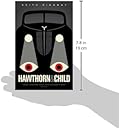
Hawthorn and Child
Product ID: 63457722
Buy Hawthorn and Child by Ridgway, Keith from desertcart's Fiction Books Store. Everyday low prices on a huge range of new releases and classic fiction. Review: "Under all the cracks there is something that is not broken." - Hawthorn & Child was originally subtitled, on its publisher's website, `A Set of Misunderstandings'. The misunderstandings might begin in trying to define it. It's a series of stories which is really a novel, about two London police detectives and the people they encounter. It begins with an unsolvable mystery, when a young man is shot from a passing car on a quiet north London street. The brief information provided by the victim as he lies on the hospital table ("They poked and peered at the body. They tubed the body and they hooked it up. They shifted and bound the body") becomes the bedrock of a police investigation, a grand structure spun around no more than air. This is a book which is all about the details: the ones we don't know, the ones we invent to replace them, and the exquisite ones Ridgway provides us with along the way. Details, like this brief phone exchange between Hawthorn and his brother, which speaks of years in a couple of lines: --How's the thing? --What thing? --The crying. Hawthorn made a face and looked out of the window. --It's fine. The imprecision of language is everywhere. Here, Hawthorn's brother wants to ask but can't bring himself to be specific. Elsewhere, when investigating the shooting, Hawthorn and Child take a witness's response to a question ("Not really") as an opening, when really it's just a loose end. They are desperate to make things fit. "We usually don't decide anything about things that don't fit. They just don't fit. So we leave them out." In this, they are like all of us, even when we are reading this book and trying to join together the pieces of the narrative. (Ridgway: "We want to tell ourselves and our days and our lives as stories, and these things are not stories.") In some of the sections, the title characters are central. Child finds himself in a hostage negotiation with a young man who seems to be in a religious cult of one, and whose sense of identity is mangled. Hawthorn, straining for human contact, finds it - sort of - in a clever sequence which cuts between a riot and an orgy, and where it's not always possible to see which is which. "There are certain things Hawthorn wants to do. There are things he doesn't want to do. The line between these things tickles him, like a bead of sweat down his back." In other places, Hawthorn and Child are merely in the background, seen at a distance, or referred to. Ridgway gets around having to clunkingly name them by giving Hawthorn distinctive features that can be described by others: he cries a lot ("How's the thing?") and there's something, perhaps related, wrong with his face. "His face was crooked." "Like he was peeking through a keyhole." "He looks somehow off kilter." The risk here is that you get something like David Mitchell's scar identifier that joined the characters in Cloud Atlas, which looked tricksy and needless. Cloud Atlas, in fact, is not a bad starting point for comparison with Hawthorn & Child. With his book, Mitchell wanted to go further than Calvino had in If on a winter's night a traveller, by finishing all the stories he began. He did it, and the cumulative nimbleness was impressive; but I felt there was something missing in the heart region, and I wonder now whether the resolution of the stories contributed to it. Resolving a story can involve the author in so much contortion and knot-tying that the ugliness of the ending spoils the beauty that went before. Ridgway has been, I think, braver than Mitchell. The stories here are unresolved, but they are not incomplete. There is nothing missing, no sense that the stories peter out. The narrative pull within each one is strong, and they all leave you wanting more. What more could we ask for? Underlying all this, or stretching over it, is the story of Hawthorn and Child themselves. This is not a buddy cop story. They are on the trail of a gangster, Mishazzo. They work together, with contrasting approaches. Hawthorn is unsubtle, Child more solicitous: he gets on with people more easily; is happier, too. In their work, Child works things out, separates the possible from the fanciful. Hawthorn doesn't want to exclude the fanciful. He is searching for meaning, for something to put in the gaps. He thinks about things and people that might explain other things and other people to him. He "thought about men, various men, whom he moved about his mind experimentally like furniture." These enquiries are futile, though that is their purpose. A narrator of one of the stories says, "Knowing things completes them. Kills them. They fade away, decided and over and forgotten. Not knowing sustains us." That narrator, from the story `How We Ran the Night', is thoroughly unpleasant, and somehow frightening. ("I think of Trainer hanging in his attic. It must be worth knowing, what makes a man do that.") There is a fair amount of shiver-inducing nastiness in Hawthorn & Child, including as many ugly deaths as you might expect in a book about policemen. Yet there is tenderness all the way through, not least in the grudging pity I felt for Hawthorn. His tragedy in a minor key makes him one of the strongest fictional creations I've encountered in some time. Hawthorn & Child exhaustively answers the question: What do you want from a book? There are likeable characters too: in `Goo Book', a story of the thoughts that lie too deep to say in Mishazzo's driver's love affair (first published in The New Yorker); and in `Rothko Eggs' (first published in Zoetrope All-Story). There are plots and stories, page-turning and teasing. There is innovation -- it is structurally bold, and eye-opening in subject matter (a premiership referee who sees ghosts would fit that bill). It kicks the reader out of their comfort zone. It has lines that zing and lines that hum, as in the voice-driven `Marching Songs', which as a sustained piece of fictional prose, could hardly be bettered. Could it? Read it yourself. Review: Spare and beautiful - Generally I agree with the other reviewers, who at the time of writing have all blessed the book with 5 stars. What I wasn't sure of when I flipped over the last page was whether this amounted, ultimately, to more than the sum of its parts. It's not a novel in the traditional sense, more a sequence of short stories that bear a tangential relation to each other. Each section offers plenty in the way of character, and stylish writing, and could - as some already have - stand alone as short fiction. But.... Then again, maybe I have just lived a very sheltered life! I found myself struggling to imagine Hawthorn's gay rugby-style orgies, or get any sense of the oddly-named Mishazzo, whom they are ostensibly chasing, and the fantasy narrative of the wolves didn't work for me and seemed an odd inclusion. Overall though I enjoyed reading it. In a world where the bestsellers are by and large unchallenging, this is original and intelligent, and also subtly funny. I would happily read other work by Ridgway, and bought 'The Spectacular', on the strength of this. 'Spectacular' is a related short story, and could easily have been another section in the novel, which seems to illustrate the strengths and weaknesses of the unusual structure.
| Best Sellers Rank | 971,507 in Books ( See Top 100 in Books ) 45,555 in Literary Fiction (Books) 48,854 in Contemporary Fiction (Books) 115,061 in Social Sciences (Books) |
| Customer reviews | 3.4 3.4 out of 5 stars (96) |
| Dimensions | 12.9 x 1.8 x 19.8 cm |
| ISBN-10 | 184708527X |
| ISBN-13 | 978-1847085276 |
| Item weight | 205 g |
| Language | English |
| Print length | 288 pages |
| Publication date | 4 April 2013 |
| Publisher | Granta Books |
J**F
"Under all the cracks there is something that is not broken."
Hawthorn & Child was originally subtitled, on its publisher's website, `A Set of Misunderstandings'. The misunderstandings might begin in trying to define it. It's a series of stories which is really a novel, about two London police detectives and the people they encounter. It begins with an unsolvable mystery, when a young man is shot from a passing car on a quiet north London street. The brief information provided by the victim as he lies on the hospital table ("They poked and peered at the body. They tubed the body and they hooked it up. They shifted and bound the body") becomes the bedrock of a police investigation, a grand structure spun around no more than air. This is a book which is all about the details: the ones we don't know, the ones we invent to replace them, and the exquisite ones Ridgway provides us with along the way. Details, like this brief phone exchange between Hawthorn and his brother, which speaks of years in a couple of lines: --How's the thing? --What thing? --The crying. Hawthorn made a face and looked out of the window. --It's fine. The imprecision of language is everywhere. Here, Hawthorn's brother wants to ask but can't bring himself to be specific. Elsewhere, when investigating the shooting, Hawthorn and Child take a witness's response to a question ("Not really") as an opening, when really it's just a loose end. They are desperate to make things fit. "We usually don't decide anything about things that don't fit. They just don't fit. So we leave them out." In this, they are like all of us, even when we are reading this book and trying to join together the pieces of the narrative. (Ridgway: "We want to tell ourselves and our days and our lives as stories, and these things are not stories.") In some of the sections, the title characters are central. Child finds himself in a hostage negotiation with a young man who seems to be in a religious cult of one, and whose sense of identity is mangled. Hawthorn, straining for human contact, finds it - sort of - in a clever sequence which cuts between a riot and an orgy, and where it's not always possible to see which is which. "There are certain things Hawthorn wants to do. There are things he doesn't want to do. The line between these things tickles him, like a bead of sweat down his back." In other places, Hawthorn and Child are merely in the background, seen at a distance, or referred to. Ridgway gets around having to clunkingly name them by giving Hawthorn distinctive features that can be described by others: he cries a lot ("How's the thing?") and there's something, perhaps related, wrong with his face. "His face was crooked." "Like he was peeking through a keyhole." "He looks somehow off kilter." The risk here is that you get something like David Mitchell's scar identifier that joined the characters in Cloud Atlas, which looked tricksy and needless. Cloud Atlas, in fact, is not a bad starting point for comparison with Hawthorn & Child. With his book, Mitchell wanted to go further than Calvino had in If on a winter's night a traveller, by finishing all the stories he began. He did it, and the cumulative nimbleness was impressive; but I felt there was something missing in the heart region, and I wonder now whether the resolution of the stories contributed to it. Resolving a story can involve the author in so much contortion and knot-tying that the ugliness of the ending spoils the beauty that went before. Ridgway has been, I think, braver than Mitchell. The stories here are unresolved, but they are not incomplete. There is nothing missing, no sense that the stories peter out. The narrative pull within each one is strong, and they all leave you wanting more. What more could we ask for? Underlying all this, or stretching over it, is the story of Hawthorn and Child themselves. This is not a buddy cop story. They are on the trail of a gangster, Mishazzo. They work together, with contrasting approaches. Hawthorn is unsubtle, Child more solicitous: he gets on with people more easily; is happier, too. In their work, Child works things out, separates the possible from the fanciful. Hawthorn doesn't want to exclude the fanciful. He is searching for meaning, for something to put in the gaps. He thinks about things and people that might explain other things and other people to him. He "thought about men, various men, whom he moved about his mind experimentally like furniture." These enquiries are futile, though that is their purpose. A narrator of one of the stories says, "Knowing things completes them. Kills them. They fade away, decided and over and forgotten. Not knowing sustains us." That narrator, from the story `How We Ran the Night', is thoroughly unpleasant, and somehow frightening. ("I think of Trainer hanging in his attic. It must be worth knowing, what makes a man do that.") There is a fair amount of shiver-inducing nastiness in Hawthorn & Child, including as many ugly deaths as you might expect in a book about policemen. Yet there is tenderness all the way through, not least in the grudging pity I felt for Hawthorn. His tragedy in a minor key makes him one of the strongest fictional creations I've encountered in some time. Hawthorn & Child exhaustively answers the question: What do you want from a book? There are likeable characters too: in `Goo Book', a story of the thoughts that lie too deep to say in Mishazzo's driver's love affair (first published in The New Yorker); and in `Rothko Eggs' (first published in Zoetrope All-Story). There are plots and stories, page-turning and teasing. There is innovation -- it is structurally bold, and eye-opening in subject matter (a premiership referee who sees ghosts would fit that bill). It kicks the reader out of their comfort zone. It has lines that zing and lines that hum, as in the voice-driven `Marching Songs', which as a sustained piece of fictional prose, could hardly be bettered. Could it? Read it yourself.
A**R
Spare and beautiful
Generally I agree with the other reviewers, who at the time of writing have all blessed the book with 5 stars. What I wasn't sure of when I flipped over the last page was whether this amounted, ultimately, to more than the sum of its parts. It's not a novel in the traditional sense, more a sequence of short stories that bear a tangential relation to each other. Each section offers plenty in the way of character, and stylish writing, and could - as some already have - stand alone as short fiction. But.... Then again, maybe I have just lived a very sheltered life! I found myself struggling to imagine Hawthorn's gay rugby-style orgies, or get any sense of the oddly-named Mishazzo, whom they are ostensibly chasing, and the fantasy narrative of the wolves didn't work for me and seemed an odd inclusion. Overall though I enjoyed reading it. In a world where the bestsellers are by and large unchallenging, this is original and intelligent, and also subtly funny. I would happily read other work by Ridgway, and bought 'The Spectacular', on the strength of this. 'Spectacular' is a related short story, and could easily have been another section in the novel, which seems to illustrate the strengths and weaknesses of the unusual structure.
P**L
Massive disappointment
I'd heard so many people raving about this that I was expecting great things. It didn't live up to the hype. It reads like a bunch of short stories, none of which reach an acceptable conclusion and I was completely stunned when I read the last page to find so much left unresolved. Deeply disappointing.
T**G
Weird
I'm still not sure what this book is about. The writing was amazing but I really struggled with it
S**I
Tosh
This story is a simply set of holes without filling. There are plenty of questions, none of which are ever answered. Plenty of deeply uncomfortable reading, without ever any sense that the discomfort serves any real purpose. Plenty of confusion, without any sense of resolution. Plenty of broken characters, but we never really see why they're broken nor do they change or develop. In short, it's a garbled mess which purports to be high art by being confrontational and never making any kind of sense. I read to the end hoping in vain that there would be a resolution that made my misery worthwhile. There wasn't. In fact, there was no resolution at all. The book ends as pointlessly and abrubtly as it began. Avoid.
L**R
This is a book like no other I have read, and I can't even say if that is a positive or negative judgement! I can certainly say that I was hardly able to put it down, that I found it compelling reading. But if you were to ask me why that was, I would be lost for words. The last thing this book seems to be is lost for words. And yet, as the story itself says in one of its many self-referential loops, there are gaps - many of them. But these gaps, which have no breadth, depth or width, seem to be the black holes that suck your imagination and attention inexorably inwards. This may seem like a trite statement, but the book is all about Hawthorn and Child, and it is not about them at all. Make of that what you will!
A**R
I am extremely upset that I could not purchase "The Spectacular . . . ."short story attached to Hawthorn and Child in the USA and the UK for $0.99. You still have not responded to my request for an explanation.
A**R
Inconsistent style troublesome.
J**L
Yes, it is definitely the anti novel. All of these stories that you keep expecting to come together. Yet they do not. Sad really. This could have been so much better.
E**H
What a brilliant book. I hesitated before buying Hawthorn and Child. Some reviews made me think the unconventional structure and lack of resolution to the stories might be unsatisfying. I like the crime genre, but there's nothing worse than the kind of ending that teases you and leaves you hanging. Thankfully Hawthorn and Child is not a tease. The story strands in the book don't feel in any way incomplete. They're fascinating and well written and provocative (in the best possible way). I'll can tell I'll be rereading this one many times. Highly recommended.
Trustpilot
2 months ago
1 day ago