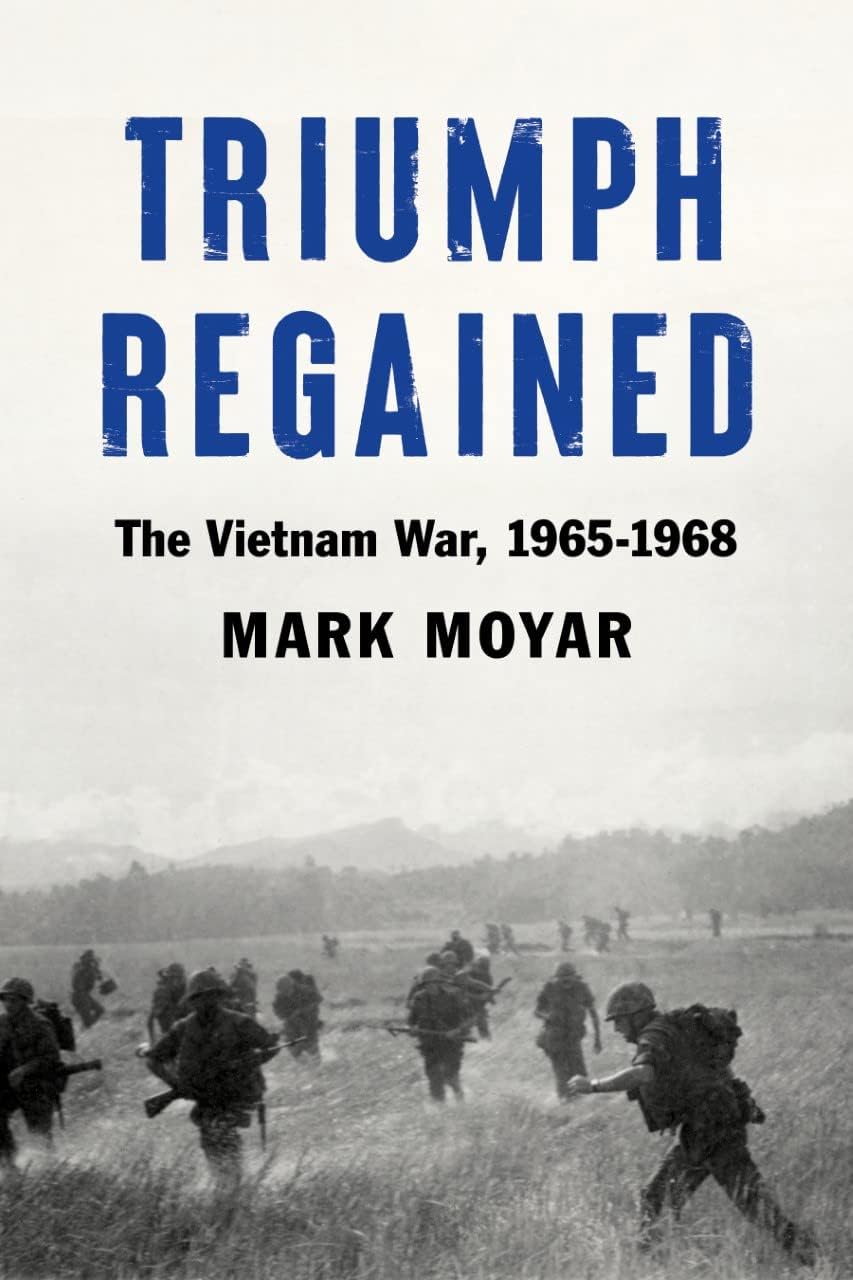
Triumph Regained: The Vietnam War, 1965-1968
Product ID: 626857048
📚Hardcover edition for durability
🔍Based on newly declassified and archival sources
🕰️Covers critical 1965-1968 Vietnam War period
Desertcart purchases this item on your behalf and handles shipping, customs, and support to Greece.
📖 Unlock the untold truths of Vietnam’s pivotal years — don’t miss the final word!
Triumph Regained: The Vietnam War, 1965-1968 is a meticulously researched hardcover book by Mark Moyar, published by Encounter Books in 2023. It offers a groundbreaking, well-documented account of the Vietnam War’s critical middle years, leveraging newly declassified US and Asian archives to challenge prevailing myths. Praised by veterans and historians alike, this sequel to Triumph Forsaken is essential reading for anyone serious about understanding the complexities and realities of the Vietnam conflict.
| Customer Reviews | 4.7 out of 5 stars 70 Reviews |
J**E
FINALLY!! The Truth!
Mark Moyar’s book about the Vietnam War during the period 1965 – 1968 is an excellent, well researched, and well documented history of that period of the war. I flew helicopters during the battle of Dak To in November 1967 and flew in support of the battle of Hill 875. I can attest to the accuracy of Mark’s work. I also flew Top Secret SOG missions into Cambodia and Laos in December 1967 through January of 1968. I was shot down in Laos and landed on the Ho Chi Minh Trail. I flew many missions in the Highlands of Vietnam during the TET offensive and witnessed the destruction of the Communist forces in the Pleiku and Kontum areas. Reading Mark's book, I was appalled by the incompetence of President Johnson’s administration in the prosecution of that war. My second tour, again flying helicopters, was during the Easter Offensive of 1972. It was a huge contrast from my first tour as President Nixon and General Abrams converted the war, through “Vietnamization,” to a war mainly being fought by the South Vietnamese with American advisors and American air power in support. The false narrative of that war has persisted for all these years, and Mark has done a great service to all of us who served in the war to set the record straight. Thank you, Mark.
A**N
The definitive work on the Vietnam War
Dr. Moyar is in my opinion the foremost historian of the Vietnam War and this, his second book on that war, confirms my opinion. It is beautifully written, deeply researched, and cogently presented, just like his first book, Triumph Foresaken. He lays bare the many myths and falsehoods so commonly accepted by academics and journalists, especially those who wrote about the war during and shortly after the end of American involvement. He uses newly developed sources from declassified US records, along with archive information from the North Vietnamese and other Asian sources to reinforce and expand on his brilliant analysis. Of particular value is his explanation of the fatal mistake the Americans made when they supported the coup against President Diem, an act of heinous duplicity that resulted in years of political instability that only helped the communist cause. He also describes another fatal mistake by the Americans - the failure of the Americans to invade Laos to cut the Ho Chi Minh Trail after the defeat of the communists in their 1968 TET Offensive. All in all, this a another triumph by Dr. Moyar and I predict this book will be considered the final word on the events that transpired during the tragedy of the Vietnam War for the years 1965 to 1968. No serious student of the Vietnam War can afford not to have this valuable and historically accurate work in their library. I look forward to his third and final book on the war.
B**K
Triumph of the Willing
Mark Moyar is a historian looking for a fight. The massive collection of books on the Vietnam War written over the years has cemented its mythology. But Moyar takes a far different tack, leading a school of thought that contends the Vietnam War was a worthy endeavor but hindered by its clumsy execution. Triumph Regained: The Vietnam War, 1965-1968, the second book in Moyer’s planned trilogy on the Vietnam War, continues to challenge long-held beliefs about the war. Through exhaustive research and its deft narrative arch, Triumph Regained makes a compelling case for questioning America’s understanding of its involvement in Vietnam from 1965 to 1968. In the process, Moyar’s work offers a roadmap for questioning historical orthodoxy on a conflict. Triumph Regained challenges some of the deepest-held beliefs about the war in Vietnam, including the importance of Laos and Cambodia, The Tet Offensive, and the American public’s support of the war following Tet. President Lyndon Johnson ignored advice from senior military leaders to send ground forces into Cambodia and Laos. At the behest of Secretary of Defense Robert McNamara and Secretary of State Dean Rusk, Johnson directed the bombing of Cambodia and Laos, rather than deploying American ground forces, to avoid provoking China. Sources discovered after the war showed North Vietnamese leadership feared the presence of US ground troops in Laos and Cambodia, which would cripple the Viet Cong’s ability to infiltrate the South. Moyar discovers that the Chinese showed no interest in fighting Americans in Laos, Cambodia, or Vietnam. Moyar reappraises the Tet offensive and its aftermath, casting the surprise attack as a massive tactical victory for America. Frustrated by the war’s slow progress, the North Vietnamese launched attacks during the Tet holiday to destabilize the South Vietnamese government. The attacks had the opposite effect, however, galvanizing South Vietnamese citizens against the communists. After Tet, President Johnson may have lost Walter Cronkite, but America did not lose the war. The anti-war movement distorted America’s collective memory of the public support of the war in Vietnam. Even after the Tet Offensive and the demonstrations in Chicago during the 1968 Democratic National Convention, most Americans supported America’s involvement in Vietnam, even if their support for Johnson’s handling of the war had waned. The revisionist histories of Vietnam raise questions on how the mythology of war forms, codifies, and crystallizes. Unlike historians, military professionals must conduct autopsies of conflict close to their coda. The need for the Department of Defense to initiate a frank, clinical study of America’s war in Afghanistan grows more urgent with each passing day as memories fade, documents disappear, and willingness wanes. Moyar’s intellectual courage and rigor exemplifies how to reassess a war that did not achieve its stated end. The recent events surrounding Moyar’s employment at USAID, the suspension of his security clearance, and his personal policy preferences ought not to obscure his work. During the Trump Administration, USAID terminated Moyar following accusations concerning his use of classified materials in his book on special forces. This past year Moyar accepted a position at Hillsdale College, a conservative college in Michigan. The reader should judge the merits of Moyar’s work on Vietnam based on his insight, not his politics. Placing himself outside the mainstream of academia, Moyar frees himself to continue to challenge, question, and debate the deepest-held beliefs about America’s most contentious war. The ongoing reappraisal of the Vietnam War is a triumph of Moyar’s extensive research, clear writing, and intellectual courage. The 15-year project has birthed a provocative, well-argued book that will continue to stimulate discussion of the Vietnam War and how collective memories of conflicts form.
J**H
get it!
This book will eventually be hailed as the primary + distinctive history of the war, including all 3 books of his trilogy. There are other good books on particular battles and history of a certain time period, but none offers such a detailed and objective history as these volumes. Mark takes you thru this period battle-by-battle, together with the behind the scenes machinations, both in the US and N. Vietnam--who's classified papers weren't available to earlier authors. My unit researched the VC infrastructure in each southern province and developed the info which later became Phoenix. Moyer's book details how these political cadre were effectively eliminated during Tet, which was the backbone of the VC fighting force--and is consistent with everything our unit developed. I deros'd near the end of Mini-Tet, returned home to discover the Big-3 networks managing just the opposite narrative. There was no alternative media then and for the vets that had been there, was very demoralizing. One fellow vet in my unit discharged but remained in country, working for various contractors: his last job was supervisor of the 'Yards' guarding Ton-Son-Nhut airbase near the end of the war, where he witnessed limos packed full of VA officers cruising around Saigon and flying the NVA flag. We reengaged years later over the internet to make our own history. Everything we developed is equal to Moyar's depiction of events A must- have book for everyone's library
D**N
The details on how the military was prevented from winning the war by politicians and journalists
Just finished this great book about the Vietnam War. Mark Moyar has pulled together an amazing amount of details about battles, political background and also data from the North Vietnam perspective. I read his first book Triumph Foresaken that i believe is the best history of the war I'v read. It Details the war from 1954 to 1964., this volume covers 1965 to 1968. I hope he follows up with another one covering 1969 to 1975. P.S., I'm a Vietnam Vet.
Trustpilot
4 days ago
1 month ago