Desertcart purchases this item on your behalf and handles shipping, customs, and support to Greece.
๐ ๏ธ Light as air, strong as steelโprint smarter, fly higher!
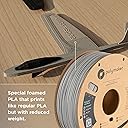
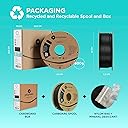
Polymaker PolyLite Lightweight PLA filament offers a revolutionary low density of 0.9g/cmยณ, delivering half the weight of standard PLA without foaming issues. Compatible with most 3D printers using standard PLA settings, it ensures high rigidity, excellent layer adhesion, and dimensional accuracy. Available in 7 vibrant colors with a matte finish, this filament is vacuum-sealed to prevent moisture and tangling, making it the go-to choice for RC plane enthusiasts and precision 3D printing professionals seeking lightweight, durable, and visually stunning prints.


| ASIN | B09H2SC1CX |
| Best Sellers Rank | #62,721 in Industrial & Scientific ( See Top 100 in Industrial & Scientific ) #207 in Filament 3D Printing Materials |
| Brand | Polymaker |
| Brand Name | Polymaker |
| Colour | 114 - 1.75mm Grey (Hex Code: #94918d) |
| Customer Reviews | 4.2 out of 5 stars 269 Reviews |
| Global Trade Identification Number | 06938936710295 |
| Included Components | Polymaker PolyLite LW-PLA - 1.75mm - 800g - Grey |
| Item Diameter | 1.75 Millimetres |
| Item Weight | 0.8 Kilograms |
| Manufacturer | Polymaker |
| Manufacturer Part Number | PA08003 |
| Material | Polylactic Acid |
| Material Type | Polylactic Acid |
| Model number | PA08003 |
| Number Of Items | 1 |
| Number of Packs | 1 |
| Special Feature | Lightweight, Non-Foaming, High Rigidity, Multi-Color, Matte Finish |
| Special Features | Lightweight, Non-Foaming, High Rigidity, Multi-Color, Matte Finish |
| Unit Count | 28.2192 Ounce |
K**I
Awesome customer service
I always buy from this seller because of the Great quality fast shipping and awesome customer service. Highly recommended
S**O
Tra i migliori LW-PLA
Ne ormai stampati diversi kg per i miei aerei, un po ostico da stampare, ma quando si รจ trovato i giusti parametri, stampa bene
A**N
Excellent material once you dial in the print settings
Very lightweight, and impressively rigid for its density, you just need to keep a few things in mind: - Print it slow, like no faster than 100mm/s, and ideally around 75mm/s even if your printer can do much faster like mine, keep it slow. - Print at a higher temperature like 225C . - Make sure to calibrate pressure advance (at the correct temp) for this filament specifically. - The filament itself is very brittle but don't let that scare you, the final parts that come out are excellent. - Parts that are somewhat hollow inside will experience a lot of stringing, but all you need is a bit of sandpaper to go over it a few times to smooth out the surface and it'll be just like the outer perimeters. Attached image is a partially finished UAV printed with this material using: - 1 perimeter - 5% infill (gyroid) - 225C nozzle temp, 60C bed temp (PEI) - 0.14mm layer height - 100mm/s perimeters and 20-30mm for bridges, and 50mm/s for supports and top solid infill, gap fill Note the smooth print lines and clean surfaces.
B**N
It took some dialing in but it is worth it!
The important bits: layer bonding and strength is incredible! very rigid and much lighter than PLA or PLA+ but heavier than foaming lightweight PLA. I am going to use this on all my future 3D printed planes! Now my long boring story :) Patience was the key with this filament! I have seen too many great reviews to think that there was an issue with the filament itself. I took the recommended approach of printing using PLA settings and increasing the retraction distance and speed to the settings recommended on polymakers website. My prints were completely unusable initially. I didn't have a lot of time after work to run calibration tests but I did what I could in my free time. I would change one setting and print a part, I didn't write anything down and I didn't keep track of my changes. The poor print quality was completely my fault for not taking the proper time to dial in the print settings. I even tried multiple slicers! I finally had a day off! no chores, no work... time to get this right :) I started with the basics, e-step calibration and PID tuning. Those were very close to perfect already so I knew that wasn't my issue. I started back with the defualt PLA settings and did a retraction test (two 10mm cubes spaced 40mm apart). I would do a print and take a picture, record the settings and results and then make only 1 change to 1 setting at a time until I got the setting dialed in. Then I would move to the next setting. Rinse and repeat until I got everything dialed in. About 10 hours later, a nearly perfect print with just the smallest amount of stringing! Don't do what I did and just get frustrated and start throwing different settings at this stuff! It took the perfect mix of speed, temp, retraction speed & distance as well as extra prime after retraction to get this stuff dialed in. A change to any one of those setting will throw off the print! Cura 5.10 Artillery Sidewinder X2 (love this printer!) Fulament magnetic flex PEI bed Temp 190 Bed temp 60 (I always run 60 for everything, just seems to work) Print speed 40mm/s Travel speed 250mm/s Retraction 3.5mm Retraction Speed 35mm/s Extra prime after retraction .36mm My issue was an extreme amount of stringing and oozing. I am printing a single walled print and it is important to have a strong Z seam. The loss of material during travel moves and layer changes made the Z seam very weak.
P**.
Polymaker PolyLite LW-PLA
Tudo ok. Obrigado
Trustpilot
3 weeks ago
1 month ago