Desertcart purchases this item on your behalf and handles shipping, customs, and support to Greece.
⚡ Stay ahead of the curve with the Archer BE550 — where speed meets smart security!
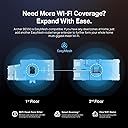
The TP-Link Archer BE550 (BE9300) is a cutting-edge WiFi 7 tri-band router delivering up to 9.3 Gbps speeds with 6 internal antennas and full 2.5G WAN/LAN ports. Designed for seamless whole-home coverage up to 2,000 sq. ft., it supports EasyMesh expansion and advanced security features including HomeShield and VPN. Ideal for professionals seeking future-proof, high-performance networking with easy app-based management and smart home compatibility.


| ASIN | B0CJSNSVMR |
| Antenna Location | Gaming, Home |
| Antenna Type | Internal |
| Best Sellers Rank | #112 in Computers & Accessories ( See Top 100 in Computers & Accessories ) #10 in Computer Routers |
| Brand | TP-Link |
| Built-In Media | Power Adapter, Quick Installation Guide, RJ45 Ethernet Cable, Wi-Fi 7 Router Archer BE550 |
| Color | Black |
| Compatible Devices | Gaming Console, Personal Computer, Smart Television, Smartphone, Tablet |
| Connectivity Protocol | Wi-Fi, Ethernet |
| Connectivity Range | 2000 square_feet |
| Connectivity Technology | Wi-Fi (802.11ac, 802.11ax, 802.11n, 802.11g, 802.11be), Ethernet, USB |
| Control Method | App |
| Controller Type | App Control, Push Button |
| Coverage | Up to 2000 square feet |
| Customer Reviews | 4.0 out of 5 stars 1,771 Reviews |
| Data Transfer Rate | 9300 megabits_per_second |
| Frequency | 6 GHz |
| Frequency Band Class | Tri-Band |
| Global Trade Identification Number | 00840030708367 |
| Item Dimensions L x W x H | 9.12"L x 2.99"W x 7.99"H |
| Item Weight | 2.5 pounds |
| LAN Port Bandwidth | 2.5 Gbps |
| Manufacturer | TP-Link |
| Maximum Upstream Data Transfer Rate | 5760 megabits_per_second |
| Mfr Part Number | Archer BE550 |
| Model Name | Archer BE550 |
| Model Number | Archer BE550 |
| Number of Antennas | 6 |
| Number of Ports | 6 |
| Operating System | IOS, Android, Windows, Mac OS |
| Other Special Features of the Product | Access Point Mode, Guest Mode, QoS, Remote Access, WPS |
| Recommended Uses For Product | Gaming, Home |
| Router Firewall Security Level | High |
| Router Network Type | Tri-Band |
| Security Protocol | WPA/WPA2-Enterprise (802.1x), WPA2, WPA3 |
| Special Feature | Access Point Mode, Guest Mode, QoS, Remote Access, WPS |
| UPC | 840030708367 |
| Unit Count | 1 Count |
| Voltage | 12 volts |
| Warranty Description | 2 year manufacturer |
| Wi-Fi Generation | Wi-Fi 7 |
D**.
Incredible Mesh Router at Excellent Price
If you are looking for a cost-effective router that will put you ahead of the technology time-line, this is it. I was a LinkSys/Cisco fan and I bought this router to replace a pretty decent LinkSys WRT 3200 ACM. The LinkSys acquired some deficiency in the past year of "half-connecting" to just one device, while perfectly connecting to every other device on its 2.4gz and 5.0gz bands. (Half-connecting allowed some, but not all URLs to load). I recently had replaced a LinkSys extender with a TPLink extender because it could not maintain a persistent connection with the LinkSys (another hint the router was going out) and was pleased with its ability to retain its connection... though it seemed I was frequently fighting over channels with my neighbors which was very annoying, having to change them every other week. After researching the market (I looked at Eero, too), I decided this was the one that was budget friendly and buying a more expensive model was not warranted as I'm not a gamer or an extreme streamer - I have 1gz service from Spectrum anyway. I did look for a router that supported USB as I have a couple of USB drives (12gb) for "cloud" storage of my files. This router comes with "Easy Mesh" which I did not pay that much attention to, since the new TpLink extender was doing a nice job (Yes, the two extra SSIDs were a little annoying when connecting devices, but I was OK with that). Setup was pretty easy, though I did want to get into the configuration to set fixed IP addresses for wired and non-wired devices in my home. All that worked perfectly fine. The only irritation I had was LinkSys uses the Gateway of 192.168.1.1 and TpLink chose 192.168.0.1. So all my fixed IP address devices had to be reconfigured (I have a WD Cloud and Canon and Samsung printers)... all of which were time-consuming to figure out how to get them reconnected to the BE9300. Then came the big surprise! I went into the setup on the TPLink "extender" and the BE9300 recognized it and "hijacked" it! The extender is no longer an extender (though it can be configured as one), but it turned out to be a mesh access point. All of a sudden, the 2.4gz and 5.0gz networks on the extender (TPLink RE550) were greyed-out! The BE9300 turned it into a mesh access point! Being a little skeptical, I cranked up m favorite WiFi phone app (WiFi Overview) and walked thru the house (3600sf). This app displays a graphical indication of signal strength in a parabola display of all SSIDs nearby. Since the extender was now a mesh access point, I only had TWO SSIDS (one for 2.4 and one for 5.0) and of course, two "sub" SSIDs. As I walked further away from the BE9300, I could see the signal strength of the mesh unit growing larger and larger. Like any mesh network, it apparently switched to the mesh access point seamlessly on my phone... as advertised without any degradation of visual download speed.. Additionally, a lot of reviews on this product indicated they were seeing increases in download speed, so I did quite a few speed tests with several different test sites. Since my Spectrum 1gz service is still copper, I knew I'd never see 1gz speed, but the top speed with the LinkSys on and off the wire was about 910gz-920gz... not quite a 10% "loss", but still respectable. With the BE9300, I am consistently seeing over 950gz, so yes, I'll agree there is a slight increase in download speed. Another plus here is the BE9300 is Wifi 7 enabled. Yes, currently, the only WiFi device is the iPhone 17 pro, but again, its nice to be ahead of the technology curve rather than be current or behind it. In summary, I have to admit, the BE9300 exceeded my expectations, as I was not really in the market for a mesh system, but almost, by accident, I have one (I glossed over the "Easy Mesh" part of the BE9300). Combined with the slight increase in speed and the WiFi 7 capability already being there, I highly recommend this guy if you want to stay in the $200 range (vs. $400 range) when looking at a new or replacement router. And I got this during Amazon's fall "sale" and it happened to have a $20 coupon from TpLink which made it a very nice deal.
C**C
Very Advanced; Very Nice!
UPDATE: 23 May, 2024 Now it's been awhile. I have to write: If something is messed up, it's NEVER the EAP225 WiFi units or this thing! It's been months since it's been rebooted! We have enough off-grid solar so the internet stuff and the comp room can stay off-grid all the time. It never gets rebooted nowadays and it's always there and it doesn't mess up! It has a gigabit (24 port) switch and two (8 port) 2.5 gigabit switches plugged into it. A total of 4 NAS's; three of them 2.5 gigabit dual LAN's; one with dual gigabit LAN's. And three computers, all 2.5 gigabit. And the Yeacomm 5G gateway is also 2.5 gigabit. Nothing bothers this thing. I'm still not using its WiFi, because of those EAP225's, which are also great. I read a few reviews, before, raving about this thing's WiFi, though and people write that it works great. The wife is Korean and she watches Korean soap opera's all day. We usually download way over a terabyte a month here. The Yeacomm connects at about 400 megabits down and 110 to 130 megabits up. ___________________________________________________________________ This runs a whole bunch of stuff - WiFi and LAN - typically about 15 devices. I'm not going to rate the Wifi because I'm not going to use it yet. 1) I have two EAP225's; they're VERY strategically located and they mesh with each other. Unfortunately they won't mesh with this thing. 2) I don't have anything else that will even do WiFi 7 yet. I got this mainly for the five 2.5 GbE ports - one WAN and 4 LAN's! I've also got a Yeacomm (Speednet) NR610 (also a very nice, but expensive device), and my internet is blazingly fast! Just very snappy. Internet tasks are usually as fast as doing stuff locally on the computer. You can easily tell when it's the website that's slow. That Yeacomm has a 2.5 GbE port and I was drooling at the thought of getting that 2.5 GbE speed to the LAN. (I also have a gigabit switch, a PoE switch [for the EAP225'sand the Magic Jacks that only do 10 MbE], and two 2.5 GbE switches.) Really nice that all my stuff plugs into this! The WEB interface on this device is a thing of beauty! Everything is very logically laid out, most changes, you don't have to reboot for, and if you know your network stuff, you'll find it nice and easy to use. If you don't know your network stuff, you're still in luck! It took its time communicating with the Yeacomm (LTE CPE Modem) (and a bunch of other devices) on the first boot - maybe 3 minutes or 4 minutes - but it configured itself very well! I have two Magic Jack lines and those didn't work right away. It took some hair-pulling-out time to straighten it out. But I've had one way audio problems with those before. This time, this router had the provisions to fix it (on one of them only.) That's not this router's fault; it's just the way it is. You need to forward a range of ports on two different devices and you can't. It took a very long time to get fixed. It was like a combination lock. Turns out the final step was some settings in the Yeacomm. The Magic Jacks now talk directly to the cell phone tower. One of them works perfectly and the other one only has one way audio when calling [mostly] cell phones. If I had another 2.5 GbE port on the Yeacomm, I could do it, I think, but as long as I can get calls on both lines and call out on one of them, I'm happy. Everything else worked like a champ with settings that this router came up with all on its own! The only thing I changed (not counting the Magic Jack settings) is making a bunch of MAC | IP reservations. When you set it up, you get a light show for awhile. Then the lights can be turned on or turned off with a WEBUI switch. You can also set up a night time mode and have them on in the daytime and off at night, specifying the times. You can plug a USB hdd into the USB port and use it as a very fast, very big network share. It's almost like having an NAS. It's been totally stable and reliable so far. It's a lot of money. I had to talk myself into it. I shopped for about a week. That should tell you something. Now that I've gotten to use it, I consider it well worth the money! I give their tech support 5 stars, not because of this thing, but because I've used their tech support in the past and I already KNOW it's exceptionally good! I have a lot of other TP-Link stuff. Advanced, hi-end stuff. Half of the 12 connected devices shown in the pic.
R**M
Super fast, range so-so, TERRIBLE reliability
(Note ... this review applies to both the BE550 and the BE900. I started with the BE550, and when it didn't work for me, I tried to upgrade to the BE900, but it had the same issues). My eero6 pro router died on me, so I decided if I was going to replace it, I might as well upgrade at the same time. I read good reviews about this router on WireCutter and the price was reasonable, so it seemed like a perfect fit. Setting up the router was easy, and the app to control the router is decent (I prefer it to Eero). I have gigabit fiber, and my iPhone 16 and M4 iPad Pro were both getting blazing speed. Initially, I was super happy. However, my wifi devices started dropping connectivity. My iPad would only drop for a few seconds at a time, but my iPhone would completely stop working for extended periods (my wife's phone too). It was not a range issue as I was 20 feet from the router with no obstructions. I could get it to work again by turning airplane mode on and off, so I initially ignored it. Then my internet connected devices started randomly disconnecting. My nano leaf devices would stop working completely. My HomePods would disappear from the network. About half of my HomeKit light switches and outlets stopped working as well. Another issue was at the end of the day when my iPhone battery was dying (I usually go to sleep with about 40% left). The culprit was searching for a cellular signal (I barely have cellular access at my house). I eventually got fed up and returned the router and bought a refurbished Eero 6 Pro and instantly everything started working again. It is a little sad to see my download speeds drop from 900MB/s down to 200MB/s, but the truth is that on my phone and iPad, it is really not noticeable at all. I am a computer engineer, and I am pretty good with computer equipment. However, I find dealing with computer networking to require a bit of black magic, and nothing is more frustrating than unreliable networking equipment. I would much rather have slower and reliable. I wonder if there was something specific about my home and devices that was causing the problem as I can't believe that these units really are that bad.
R**J
2024/2025 is the Year of WiFi 7
Review Update August 31, 2025: In recent months Apple has updated the iPhone 16 to use MLO [Multi-Link Operation] efficiently. This way, all three bands will be used as needed. When the iPhone 16 first came out in September 2024, there was only the 2.4GHz or 5GHz or 6GHz bands in use on the iPhone. Now, i couldn't be happier that I'm getting full functionality from the BE9300! Original Review August 29, 2024: I wanted to believe the hype for WiFi 7, because I was already in the TP-Link family with WiFi 6 TP-Link AX1800 Router. Installation was simple for me, like the majority of guys on here. However, there is probably a good explanation for why a large number of people have struggled with the BE9300. I cannot speak to that, but I’m sure the reasons are valid. I used the Tether mobile APP, and set the BE9300 up as a new device, using the SSID and password that came with the BE9300. However, I kept all my Tether mobile APP passwords, only updating the Local Network SSID and its password from the new BE9300. You won’t want to reuse Local SSID names and passwords for different routers 🤣. Tether Mobile APP is a powerful tool, use it first if you can. The overall improvement in my home network has affected everything that has a WiFi radio or Ethernet port. For example: I now have very stable connections, greater HDR color depth in streaming video, and deeper bass and more crystalline highs in streaming audio. In a sense, it’s like I have a new audio/video system. Also, my Withings Body+ Smart Scale linked to Apple Health APP, using TP-Link AX1800 router or Spectrum AX6E router, could NEVER display my Apple Health APP daily steps for more than 24-hours at a time, before they would disappear. And resetting the Body+ would be the only way to get the steps back, but only for another resetting cycle. Oddly, daily weather predictions were stable, as were the Body Composition metrics. Just the daily steps were constantly AWOL. Since installing BE9300 in my network, those Apple Health APP daily steps consistently display as intended into the smart scale. All this improvement, and I only have one WiFi 7 device 😂🤣🥲. I have the iPhone 16 Pro Max, which has a WiFi 7 radio. All iPhone 16s utilizes a Broadcom Wi-Fi 7 chip, supporting the full Wi-Fi 7 standard across all 2.4 GHz, 5 GHz, and 6 GHz bands, including Multi-Link Operation (MLO) functionality. Thus, iPhone 16 can enable the full performance of Wi-Fi 7 globally and optimize the potential of both the increasingly accessible 6GHz spectrum and regions with only 5GHz availability, leaving the 2.4GHz spectrum for legacy Wi-Fi, Bluetooth and IoT. All WiFi 7 devices will have this functionality in the BE9300. My main takeaway is that the BE9300, has increased bandwidth to my home network such that all my connected devices get the full signal requested without any throttling at all. Thus, everything is faster, fuller, brighter, clearer and more stable. I have noticed that iPhone 16 Pro Max alternates between 5Ghz and 6Ghz in the BE9300. It makes that decision based on moment-by-moment conditions in my home. Apple will probably tweak future iPhones to use 6Ghz more in the future. My main home theater is a Marantz SR6015 7.2.4 AVR with a 65” LG OLED TV. This system loves BE9300. I feel future-proofed for the foreseeable future, and the $300 cost is an excellent investment.
H**H
Good unit with a couple caveats
This review is for a TP-Link BE9300 WiFi 7 router. I purchased this because my existing router, a TP-Link Archer GX90, was not giving me maximum throughput from my cable modem to my devices, both wired and wireless. My internet connection was a 1.2Gbps connection, but my Archer was only capable of Gigabit speeds in the wired connection. My wireless speeds were even slower, despite the claim of 2+ Gbps on the WiFi 6 channel. Even right next to the router, my WiFi speeds rarely exceeded 900Mbps. The BE9300 didn't disappoint with wired speeds. I saw my 1.2Gbps connection maxed on my PC using Ethernet with the BE9300's 2.5Gbps ports, both WAN and all 4 LAN ports. Wireless I saw the same on my WiFi 7 channels... in the same room. As soon as I left the room my router was in, I saw a significant drop in speed, ESPECIALLY on the WiFi 7 channels. In my bedroom (which is upstairs, which definitely blocks signal on all channels), WiFi 7 usually doesn't even show up on my WiFi list, and when it did the speeds were abysmal. For any of you shopping for a new router, keep in mind that each channel's signal degrades at different rates. 2.4Ghz goes the furthest, but offers slowest speeds. 5Ghz offers more speed, but the further you are away, the faster it degrades. 6Ghz is even worse. If you're looking to upgrade to a WiFi 7 router and have a larger or two-story home, you will likely need mesh-net WiFi or access points that tie into your router. If you're in a smaller, single story home, this unit would likely work for you. I ended up using my BE9300 as my router, with my GX90 as an access point in my living room. I only use the WiFi for my BE9300 for my wireless doorbell, as my GX90 does most of the WiFi heavy lifting. It's more centrally located and gives me reliable speeds pretty much anywhere in the house. With both of these TP-Link units, I suggest turning the feature that combines all your WiFi into a single signal that "chooses the best one", as it never did for me. Both my GX90 and my BE9300 performed poorly with this option turned on. Keeping all the bands separate allows me to stay on the fastest band for my devices and keeps my speeds consistently high. For a small, single story home with the router centrally located, this unit alone would be fantastic paired with Gig+ internet providers. I downgraded it to 4 stars for two reasons. 1st, a feature that doesn't work as intended, which I mentioned earlier that chooses the band but gives your WiFi a single name. Secondly, my router inexplicably died on me out of the blue. I came home one day to no internet... the router was completely dead. TP-Link got me a new one very quickly and gave me a discount on the shipping, and I was able to get a faster option for $10 shipping (would have been more, but I can't recall how much). They sent me a replacement router in 2 days with a return label so I could send the defective unit back. Their customer service keeps this from getting dropped to 3-stars. Kudos TP-Link!
H**U
Stable and high speed performance internet ever since upgrading to the Archer BE550 WiFi 7 router!
I have enjoyed stable and high speed performance internet ever since I upgraded to this router. Over a year and a half ago, I changed from the last version of the Apple AirPort Extreme router, which was WiFi 5 (802.11ac). Since the upgrade, I have experienced little to no dropouts of all my smart devices which used to happen regularly with the older Wi-Fi system. I'm using the TP Link Archer BE 550 along with a Ubiquiti Unifi U7 Pro Wall access point, and they are a great team. set up was fairly simple, with the free apps, and after a day or two of tweaking the specific settings for my IOT devices, it has been working beautifully. My house is approximately 1700 ft.² and between the both of these devices, I have great coverage inside and outside the house, with a fair amount of 2.4 GHz, 5 GHz, and a growing number of 6 GHz devices. My WiFi 7 (802.11be) internet is working very smoothly with no issues. I highly recommend the TP-Link Tri-Band BE9300 WiFi 7 Router (Archer BE550)
A**R
Blazing fast WIFI, Great coverage
TLDR: I bought this router about a month ago when my older one started to stutter. After some initial issues with firmware and a round or 2 with TPLink tech support I got everything ironed out and now I am very pleased with the performance. For more details, please read on. I'm a Network Engineer who works from home. Internet access is critical to my ability to do my job. So, when my older Netgear wireless router started to show signs of failure (random WIFI network loss of signal and reboots) that I could not fix with firmware updates, I started searching for a new router. The BE550 is a slightly less expensive version of TPLink's top end router. It lacks the extra LEDs on the front that allow for it to display the weather and a few other cute features, and it only has 4 LAN and 1 WAN(Internet) connections, all of which are 2.5G. there are no 10G ports on this router. Since I don't need to move that much data, it wasn't a deal breaker for me. Install was pretty easy, but I was also taking the opportunity to upgrade my Cable modem to a newer model and to install a 2.5G NIC in my home PC. After initial bootup and configuration of my home and guest networks, I ran speed tests that showed significant improvement in throughput. I have Gigabit service and improved my wired speeds from 690Mbps average to 1.1Gbps average on my home computer. The 2.5G ports are really doing there jobs and keeping the data moving without a bottleneck. Unfortunately, after about 24 hours, the new router became unstable. The wireless signal would cut out, and even wired connections would lose internet access intermittently. As I tested components I ruled out the Cable modem and the new NIC and started to focus on the router. Constant ping tests to google would randomly time out for 20-30 seconds and then return. At the same time the LAN side access into the router would be lost, which shouldn't happen if the loss of signal is on the Internet side. I opened a ticket with TPLink and was surprised by how quickly they responded. After some initial testing with a tech on the phone, the ticket was kicked to the next level of support and all subsequent support was via email. The techs asked for log files and information about my troubleshooting and the analyzed that for about a day. They then sent me a firmware update (which wasn't available via the firmware update process in the router) and asked me to apply it. Once that was done, the router stabilized and hasn't shown any issues for about 48 hours. Like: Design - more like a book than something from a Star Trek movie. WIFI Coverage: Even with internal antennas, I have very good coverage of my 2000 sq. ft. house and my backyard. WIFI Speed: Phones and tablets are easily pulling 8-900Mbps from anywhere in the house. WIRED Speeds: My desktop (with 2.5G NIC) is able to pull 1.2Gbps easily Don't Like: GUI: Maybe I'm just picky, but I think the GUI needs help. It isn't as intuitive as the Netgear router I replaced Price: This is an expensive piece of kit at $300+ Overkill for a lot of people, but there are limited 2.5G capable wifi routers on the market
B**N
Sort of (really) expected more
I bought this to put in AP mode and replace one of my Asus AX86U units (that was also in AP mode for the last many years of its life). I had tested Wifi 6E in my home with a cheap Arris unit (the one that has the worst review of perhaps any networking device of all time) and concluded I could benefit from having 6E on both floors of my house. I only have one Wifi7 capable device that would be fine on a dialup connection, just a work phone, so the priority was 6E for my macbooks, mac mini, and iphones. I run this unit at 160mhz, same as the Arris. To fill the shoes of the AX86U this unit needed to do 2.4 for ~5 IoT devices that I'm too lazy to re-provision to my Unifi IoT APs, 5ghz for the legacy devices that can't do 6ghz (maybe another 5), and then 6e for my few apple products and that work phone I mentioned. The 6ghz performance was expected to be significantly better than the Arris unit, which thermal throttles and is fast when it wants to be, then abysmal. It missed the mark on all counts except maybe 2.4ghz being unchanged for those few clients. The 5ghz performance is noticeably worse than the AX86U (a 7 year old unit) and the 6ghz performance is not only below the lowly Arris unit, but actually.. inexplicably bad most of the time, less than the 5ghz was on the AX86U @ 80mhz. Even sitting directly across from this unit at 10 feet, my noise levels and MCS fluctuate heavily. I don't have any neighbors or competing devices aside from the Arris, miles away on the channel spectrum, but I even tried swapping the channels so the TP Link was on the Arris channel, which has been proven to deliver 1700mbps until it gets too hot. The performance followed the Arris, meaning it's sadly this unit being not very good. All of my APs are ethernet backhaul through 2.5gbe connections so there's really nothing more to explain it. The performance was like this with the original firmware it had when I received it a week ago, and with the latest firmware that I quickly updated to. I guess I'll keep it because I have seen times when it works better than a gigabit ethernet connection on peaks, and I was able to utilize some of the ports on it, but I would have been better off getting another 2.5gbe switch to give me the additional ports and an additional Arris unit. I would have spent about 1/3rd going that route. Just really bizarre watching one local (Open Speedtest) run go perfectly, flat curves the entire test. Then a second later it's bouncing all over the place and filling the graph with abrupt valleys. Even when my stats aren't changing (noise, MCS, supposed TX rate static in macOS) - Every test I do is stationary, within the very acceptable range of 6ghz, through zero obstructions, and it's simply inconsistent. I don't recommend it.
J**C
Não consigo configurar.
Falta atualizar os firmware? Deveria ter um "Manual Detalhado" para explicando as configurações? Configuro a wi-fi no modo SSD oculto, mas dá erro de senha(30 caractere alfanumérico)? Como sofresse uma interferência.
M**A
Amazing
Completely changed the game for our home WiFi. Could never go back.
G**O
BE550/BE9300 lo mejor
Archer BE550/BE9300 bueno es muy importante para mí platicarles mi experiencia, probé varios router de la marca TPLINK, entre ellos el BE900/BE24000, definitivamente el mejor es el BE550/BE9300, es un router de gran alcance rompe muros!! Gran velocidad, buen diseño y un software increíble, compré 4 para cubrir una superficie de 300m2 y uffff, el mejor rendimiento y velocidad, sin comparación, tardé un par de meses en probar varios de la marca también incluí a los DECO, en fin fueron más de 10, me quedé con los Archer BE550/BE9300 no tienen comparación, espero a muchos les sirva esta reseña, no me extiendo mas solo decirles que si buscan lo mejor este es el camino, a un precio aceptable, ni más caro ni más económico!! Un estándar razonable !!
A**H
Phenomenal
A truly excellent router in every sense of the word, both in terms of coverage and speed. Highlyrecommend 👍👌
A**.
Calidad -Desempeño- aspecto.
Este dispositivo es sublime. Tengo contratados 350 Mbits y con mi modem de entrada no pasaba de 50mbits. Con este dispositivo mi wifi se pone en wifi6 y la velocidad es 350mbits perfectos. Una maravilla. Vale cada peso invertido.
Trustpilot
1 week ago
2 weeks ago