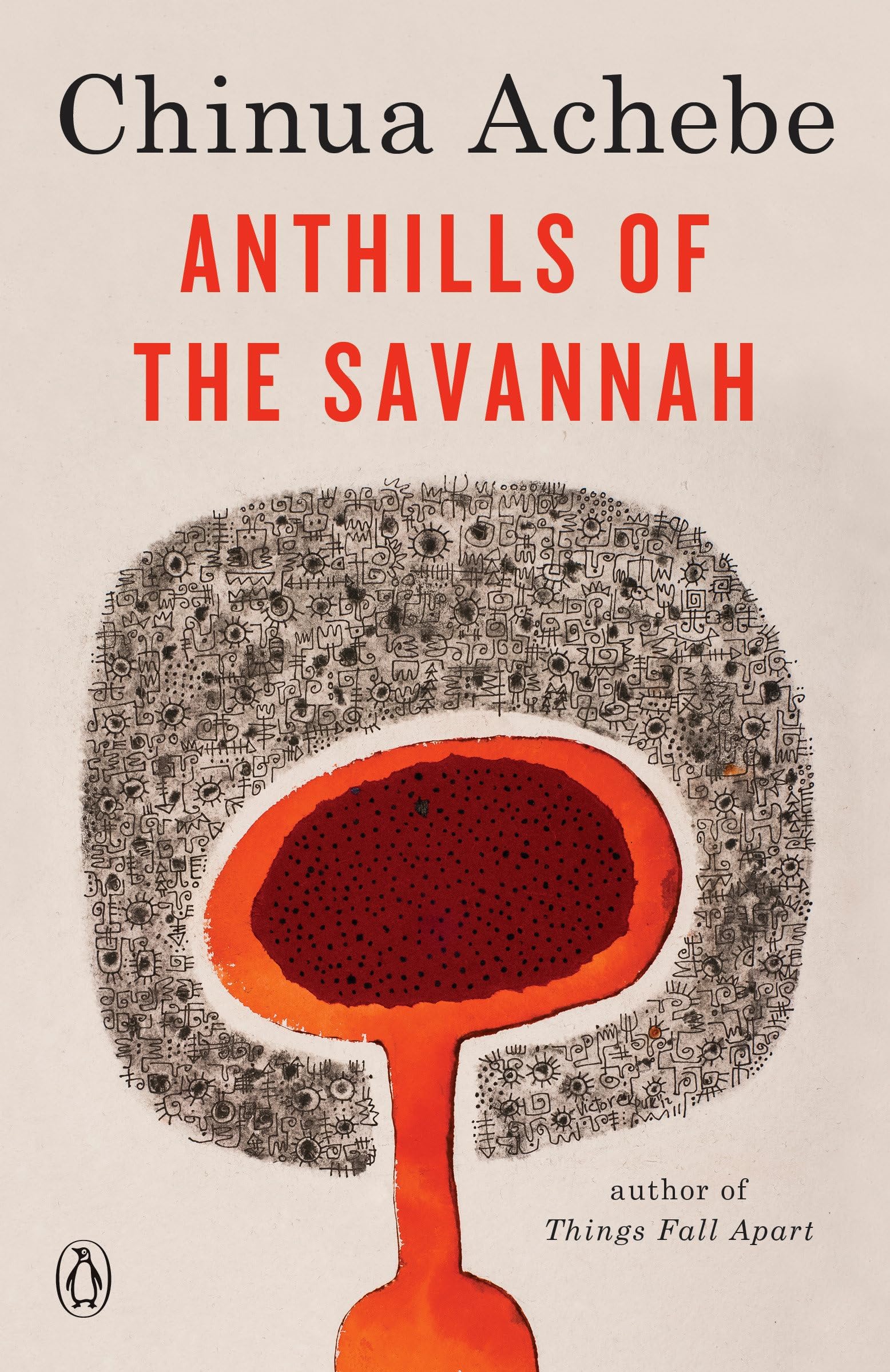
Anthills of the Savannah
Product ID: 5254356
Desertcart purchases this item on your behalf and handles shipping, customs, and support to Greece.
A searing satire of political corruption and social injustice from the celebrated author of Things Fall Apart "Achebe has written a story that sidesteps both ideologies of the African experience and political agendas, in order to lead us to a deeply human universal wisdom." — Washington Post Book World In the fictional West African nation of Kangan, newly independent of British rule, the hopes and dreams of democracy have been quashed by a fierce military dictatorship. Chris Oriko is a member of the president's cabinet for life, and one of the leader's oldest friends. When the president is charged with censoring the opportunistic editor of the state-run newspaper--another childhood friend--Chris's loyalty and ideology are put to the test. The fate of Kangan hangs in the balance as tensions rise and a devious plot is set in motion to silence a firebrand critic. From Chinua Achebe, the legendary author of Things Fall Apart , Anthills of the Savannah is "A vision of social change that strikes us with the force of prophecy." ( USA Today ) Review: Evolving dictatorship - I found the story an intriguing one as it gave the views of different persons associated with government officials. I liked the word play and the interactions with the 'common' citizen. It is always interesting to note the ways in which respect is shown in stories about African life. I liked the introduction of the dialect even though there were times I did not fully understand it but could get the idea of what it was about. I had fun trying to speak it out loud! The ending of the story was unpredictable for me but I could see why it evolved to the inevitable events. If you are intrigued by how external influences affect the government of third world countries, this is a good read. It begs the question, Can developing countries escape the corruption and greed that cause the people to suffer? What was also interesting was the divergent paths of three friends who now had different views of life and how they should interact with it. As in reality, power ultimately corrupted one and lead to his downfall sadly taking the other two along with him. The analogy to 3 green bottles from the ditty was profound. Another great novel by Chinua Achebe. Review: The Colonial Legacy - Although in my opinion this book did not seem quite up to the standard of "Things Fall Apart," the novel that made me fall in love with Achebe's writing, it was still an informative and clever piece of writing. It was well worth reading. Achebe sets the story in a mythical country in West Africa (Nigeria?) and the plot centers on a two bit dictator and his cabinet. I did find the beginning a bit slow and the book hard to get into initially, but the interaction of the cabinet, in retrospect, sets the stage for the happenings that occur later on. Achebe's critique of non-democratic rulers and their lackeys is piercing and thoughtful. The ending of the book is dramatic and hopeful but all along Achebe demonstrates how the British, the former colonial masters, left little for the people to hang on to after they left. The cabinet and the leader are satirical objects almost making the return of the English almost desirable. The one recurrent criticism of the book I would offer is Achebe's use of Pidgin English in the speech of the less educated characters. I had trouble understanding what they were saying, although I do understand his use of the language as a tool. Even when he is not totally on top of his game, Achebe is still worth reading carefully. He is a fine writer. Stanley C. Diamond, author of "What's an American Doing Here? Reflections on Travel in the Third World."
| Best Sellers Rank | #1,009,370 in Books ( See Top 100 in Books ) #229 in African Literature (Books) #1,534 in Political Fiction (Books) #25,922 in Literary Fiction (Books) |
| Customer Reviews | 4.5 out of 5 stars 291 Reviews |
J**L
Evolving dictatorship
I found the story an intriguing one as it gave the views of different persons associated with government officials. I liked the word play and the interactions with the 'common' citizen. It is always interesting to note the ways in which respect is shown in stories about African life. I liked the introduction of the dialect even though there were times I did not fully understand it but could get the idea of what it was about. I had fun trying to speak it out loud! The ending of the story was unpredictable for me but I could see why it evolved to the inevitable events. If you are intrigued by how external influences affect the government of third world countries, this is a good read. It begs the question, Can developing countries escape the corruption and greed that cause the people to suffer? What was also interesting was the divergent paths of three friends who now had different views of life and how they should interact with it. As in reality, power ultimately corrupted one and lead to his downfall sadly taking the other two along with him. The analogy to 3 green bottles from the ditty was profound. Another great novel by Chinua Achebe.
S**D
The Colonial Legacy
Although in my opinion this book did not seem quite up to the standard of "Things Fall Apart," the novel that made me fall in love with Achebe's writing, it was still an informative and clever piece of writing. It was well worth reading. Achebe sets the story in a mythical country in West Africa (Nigeria?) and the plot centers on a two bit dictator and his cabinet. I did find the beginning a bit slow and the book hard to get into initially, but the interaction of the cabinet, in retrospect, sets the stage for the happenings that occur later on. Achebe's critique of non-democratic rulers and their lackeys is piercing and thoughtful. The ending of the book is dramatic and hopeful but all along Achebe demonstrates how the British, the former colonial masters, left little for the people to hang on to after they left. The cabinet and the leader are satirical objects almost making the return of the English almost desirable. The one recurrent criticism of the book I would offer is Achebe's use of Pidgin English in the speech of the less educated characters. I had trouble understanding what they were saying, although I do understand his use of the language as a tool. Even when he is not totally on top of his game, Achebe is still worth reading carefully. He is a fine writer. Stanley C. Diamond, author of "What's an American Doing Here? Reflections on Travel in the Third World."
C**E
Beautiful!
I think I enjoyed this even more than the so-called African trilogy...a truly beautiful yet tragic reflection of the author's sadness and hope. A great warning not to ignore or underestimate the people, who are the true rulers of the world.
S**Q
Engrossing
I read everything and anything Achebe writes
O**M
This book exemplifies the inner workings of African dictatorships
This is a must read book for anyone that wants to understand post-colonial strongman African dictatorships. The concepts in the book still apply to modern day African governments. Achebe’s prose is rich with imagery, he definitely transports you to the anthills of the savannah.
E**S
second time around
I purchased this novel, Anthills of the Savannah, not realizing that I had read it years and years ago and was pleased to be able to re-read this story of Kangan, the fictional nation modeled on Nigeria. The narrowly focused military leader of Kangan and his boyhood friends, one an advisor unsure of his loyalties, the other a journalist sure of his commitment to a more democratic nation, give the reader a glimpse into the political dis-ease of modern west African nations. The two female characters contrast one another and invite the reader to consider a less stereotypical vision of African women. Mr. Achebe's use of language is dense and is sprinkled with words and phrases unknown to most American readers making slow going through this short novel. His writing, however, does present a nuanced tone that gives more than a cursory glimpse of West African cultures and sensibilities. aka Elizabeth Evans, author, Sanakhou
R**Z
Awesome fiction gives great understanding of reality
Wonderful book about the troubles in Africa. Achebe's fictional story gives understanding to post colonial Africa!
A**R
Excellent read
Brilliant writer with in-depth insights into tribal, colonial, and post-colonial Africa in his various books.
A**K
Still one of the best books on dictatorship ever written
Chinua Achebe has ample own experience on the topic writing about - namely how do dictatorships develop - and does a spectacular job of describing the subtle dynamics that will inexorably draw people together and subsequently apart in such a scenario. Set in a fictional African state of Kangan and told through various narrators - all of whom used to belong to a tightly knit group of friends before one of them became His Excellency - it presents a wonderful take on power, delusion and the mechanics of third world autocratic governments. The story revolves around Chris (commissioner for information), Ikem (editor of the most prominent newspaper in the country), Beatrice (Chris' girlfriend and an employee at the ministry of finance) and finally Sam (His Excellency) - all UK educated, all friends at some point in time - and their deteriorating relationship. The inexorable changes result from Sam slowly but surely losing his grip on reality and spiralling into self delusion. At the same time the country is rapidly approaching truly disruptive change in a development that is as terrible, as it is inexorable. Modelled on oil boom Nigeria, it is probably one of the more prominent of Achebe's works. Written much later than his early fiction (1987), it loses none of the vitality of works such as Things Fall Apart (Penguin Classics) or No Longer at Ease (Penguin Modern Classics) but adds perhaps a richer, more nuanced understanding of politics into the mix. If you are interested in a fictional yet insightful view of the development of dictatorship, you can hardly do better than Anthills. Updike's The Coup (Penguin Modern Classics) does not have the easy flow or the first hand insight, and books such as Naipaul's A Bend in the River are just not quite in the same league quality wise in my opinion.
Y**L
Excellent
Excellent
T**D
The great Chinua Achebe's "Anthills of the Savannah"
The great Chinua Achebe's "Anthills of the Savannah". it is a marvellous novel in so many ways. It provides a platform to put forward numerous philosophical approaches to the problems of the newly independent "Kangan" ( read Nigeria).As a novel it is more daring in structure than his earlier novels, using sparkling dialogue, multiple narrators ( the unannounced changes in narrator are a little difficult sometimes) and very extensive dialogue in "Broken".The last point becomes easier and easier to handle as one progresses. As always Achebe is providing the reader with a window on his beloved Nigeria and her very varied people, and political experience. His death in March last year at 82 yrs.spared him the spectacle of the country's continuing problems. Now I have to chase down his other writings including short stories and critiques of others - like all enthusiasts, I can't get enough.
P**O
Most important African writer
The writer shows the consequences of colonialism in the culture and history of people by having different types of characters and emphasizes the role of women to keep balance between tradition and social cohesion
E**A
Corruption remains Africa's curse
A great reading. A compelling revelation of how leadership finds its way to the heart of the African problem. The educated elite we would expect to stand up for the people is a bunch of self seeking spineless men who serve at the pleasure of a ruthless dictator. However there is hope at the end, the timeless optimism that the arch of history slants towards justice.
Trustpilot
1 month ago
2 weeks ago