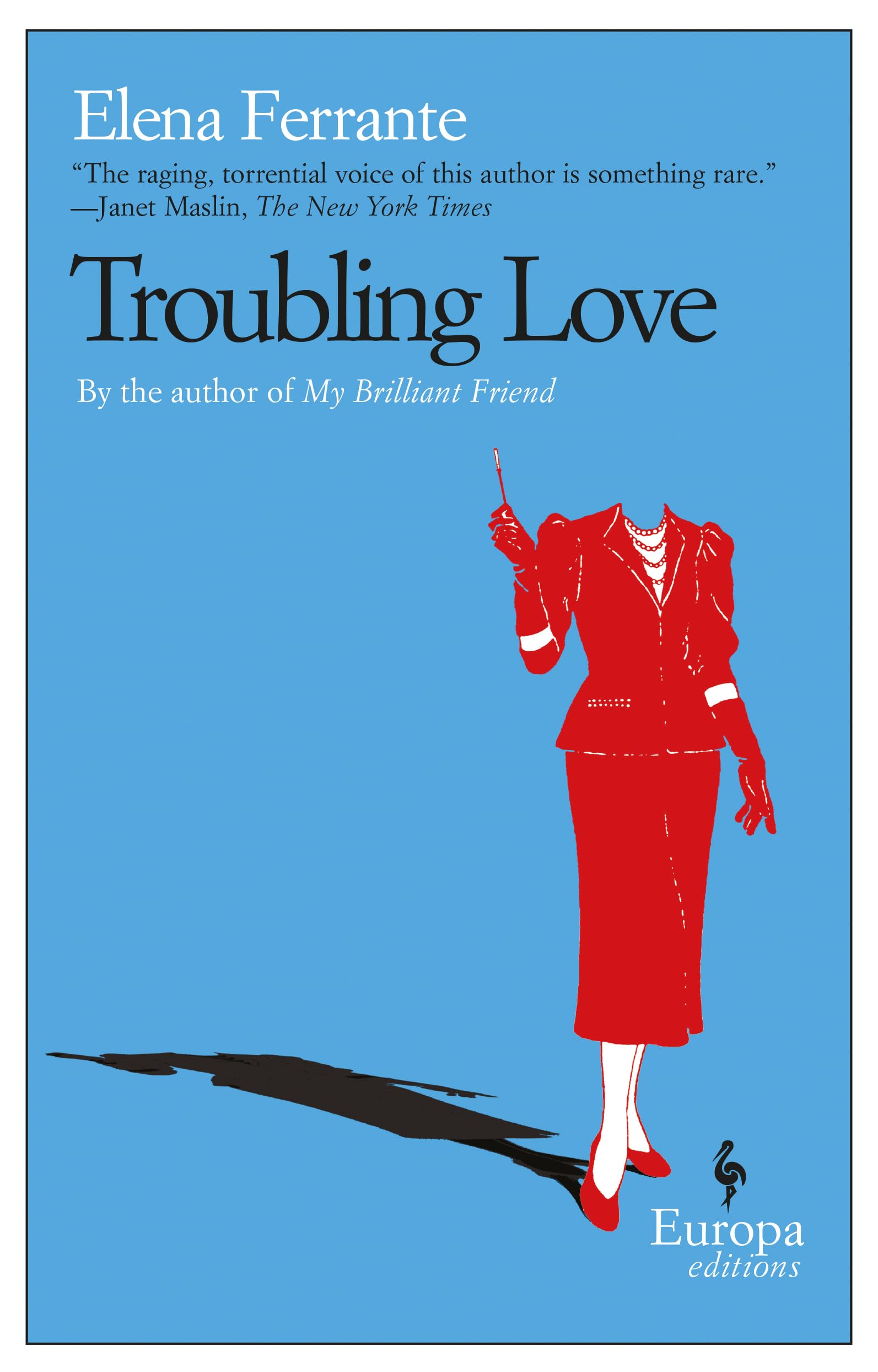
Buy Troubling Love: The first novel by the author of My Brilliant Friend by Ferrante, Elena, Goldstein, Ann (ISBN: 9781933372167) from desertcart's Book Store. Everyday low prices and free delivery on eligible orders. Review: A really enthralling read - I felt like I was right inside the protagonist's head - A really enthralling read - I felt like I was right inside the protagonist's head! Such great writing, great descriptions and characterisations! Review: Disturbing, unpleasant and unsettling; a surreal anatomy of loss - I have very mixed feelings about this book. Some scenes are so compellingly vivid and beautifully written the images just wouldn't leave my mind. The unexpected and unexplained loss of one's mother is enough to transform the world into something hostile and unfamiliar. Through the eyes of grief everything seems unreal, unstable and ugly, and this is how the protagonist experiences Naples and the people she encounters. A lot of very unpleasant details and sensory descriptions seemed designed primarily to evoke disgust. Of course, I recognise that Ferrante also wants to explore and expose the terrible vulnerabilty of women in a violent, patriarchal society, but I found this aspect overdone and slightly neurotic. The male characters are all horrific caricatures, ugly, violent and completely lacking in humanity. But the mother - who displays astonishing resilience despite her awful life story - is not terribly interesting or sympathetic. In the end perhaps she amounts to not much more than the old blue suit left on a hanger, and some sad pieces of ragged underwear. Since our protagonist is not very likeable either, I sometimes felt I was being dragged along to places I didn't want to go, and I just wanted it all to be over.
| Best Sellers Rank | 718,128 in Books ( See Top 100 in Books ) 1,186 in Later in Life Romance 1,351 in Women's Literary Fiction (Books) 2,788 in Psychological Fiction (Books) |
| Customer Reviews | 3.5 out of 5 stars 1,585 Reviews |
T**T
A really enthralling read - I felt like I was right inside the protagonist's head
A really enthralling read - I felt like I was right inside the protagonist's head! Such great writing, great descriptions and characterisations!
S**M
Disturbing, unpleasant and unsettling; a surreal anatomy of loss
I have very mixed feelings about this book. Some scenes are so compellingly vivid and beautifully written the images just wouldn't leave my mind. The unexpected and unexplained loss of one's mother is enough to transform the world into something hostile and unfamiliar. Through the eyes of grief everything seems unreal, unstable and ugly, and this is how the protagonist experiences Naples and the people she encounters. A lot of very unpleasant details and sensory descriptions seemed designed primarily to evoke disgust. Of course, I recognise that Ferrante also wants to explore and expose the terrible vulnerabilty of women in a violent, patriarchal society, but I found this aspect overdone and slightly neurotic. The male characters are all horrific caricatures, ugly, violent and completely lacking in humanity. But the mother - who displays astonishing resilience despite her awful life story - is not terribly interesting or sympathetic. In the end perhaps she amounts to not much more than the old blue suit left on a hanger, and some sad pieces of ragged underwear. Since our protagonist is not very likeable either, I sometimes felt I was being dragged along to places I didn't want to go, and I just wanted it all to be over.
A**A
Played false by memories
In this short, pacy novel of often overpowering intensity, “Troubling love” refers to the narrator Delia’s ambiguous feelings for her mother Amalia, a mixture of love and hate, brought to a head by her death by drowning, an apparent act of suicide. Delia is not only driven to find out how her mother died but also to make sense of the chain of confused, even false memories which have blighted her life. Was Amalia the innocent victim of violent abuse at the hands of a jealous husband, in a Naples where casual sexual harassment seems to be the norm, or was she responsible for provoking him with her flirtatious manner and possible adultery with his former business partner Caserta? Apart from her unlikely career drawing comic strips, and the fact that, approaching forty, she seems to be unattached and childless, we learn little about Delia’s adult life, but she appears to be mentally unstable. Apparently traumatised by her upbringing, did some childish action on her part make matters worse and how reliable a witness is she now? Part of the magnetic pull of the writing stems from the way in which the facts, which initially seem bizarre or dreamlike, are revealed or made clear, like the pieces of a jigsaw fitting into place. A strong sense of Naples is created: the heat, furious commotion, squalor, decay, and sea like a “violet paste”. The book has been made into a film, and I found it much easier to read once I grasped the cinematic quality of many of scenes, with their emphasis on visual detail through which deeper meaning may become apparent. For instance in a sustained incident in which various characters pursue each other through the streets of Naples and onto a funicular, there is a purely visual image of someone “as if… skating on the metallic grey of the pavement, a massive yet agile figure against the scaffold of yellow painted iron bars at the entrance to Piazza Vanvitelli”. Alighting at the “dimly lit concrete bunker” of Chiaia Station, Delia imagines or perhaps partly remembers how it was nearly forty years ago, with her mother waiting there, mesmerised by three figures advertising clothes, symbolising the freedom of another world, and wondering how she and her daughter could escape into it. Particularly for a first novel, this is original and brilliant, but bleak. It also repelled me in its gratuitous focus on the sordid side of life: too much about the mess of menstruation, masturbation and sexual beatings. What lies behind the author’s dedication of this novel “for my mother”? Is it a mark of admiration or a reproach? A reviewer’s humorous comment, “My money is on Elena Ferrante being male, with slightly perverted sexual tastes” also strikes a chord. The brutal passion and frankness of the writing may illustrate the cultural difference between Italian and British literary fiction. This compulsive read assaulted my senses, and left me feeling tainted.
W**R
Having thoroughly enjoyed the Neapolitan Quartet
Having thoroughly enjoyed the Neapolitan Quartet, I was looking forward to the back catalogue. However, this one disappointed. Translation was stilted, the plot laboured and the narrative flow did not serve to develop the persona on the protagonist in any way. I struggled to the end hoping to discover some redeeming resolution - but did not. How irksome. Maybe there are several Elena Ferrante's?? We should be warned!
D**O
Well written as usual but really boring.
I loved the Neapolitan novels but could not make any sense of this one. It was boring and tiring. I really did not understand what was going on. Was she imagining everything? I finished it because I don’t like to stop a book in the middle of it and, since it was short, I decided to go on.
D**4
Worth reading
I enjoyed reading this book. There are similarities to her other books and I feel that this one is not quite as strong as the Neapolitan novels but still well worth reading.
P**D
Bleak
Ferrante dedicates this book to hr mother. I don’t know why. It’s one of the bleakest books I’ve ever read. I have given it three stars because the sum of the beautiful words do not add up to a satisfying story. Indeed, I am baffled by it and would welcome any reader who could tell me why Delia’s mother, Amelia, wanted to kill herself. This is my version, and it doesn’t spoil the book to reveal the plot because the beauty of Ferrante’s writing is the way she uses words. We learn Delia’s mother, Amelia, has drowned on her way to visit Delia. Delia traces her mother’s last days and we are taken back to Delia’s childhood when Amelia was violently attacked by her father, and Amelia’s subsequent flit with her three daughters to live away from her abusive husband. Delia, therefore, does not know her father after the age of 5. However, Delia does know Caserta, a friend of her parents, who runs a sweet shop and then a lingerie shop. Delia finds a suitcase in her mother’s flat in a grotty part of Naples filled with beautiful silk underwear. It turns out to be a gift from Caserta in return for Amelia’s dirty, unwashed underwear. Amelia had planned to give the lingerie to Delia for her birthday, so Delia surmises. It turns out that when Delia was a child she had been sexually abused by Caserta’s father, an old man at the time, in the basement of the shop. Delia tells her father that Amelia and Caserta had stolen into the basement together thus raking in some kind of revenge. As a result, Delia’s father had almost killed Amelia and they had left. The friendship between Amelia and Caserta had reignited in old age and led to the final tragedy. But why Amelia decided to drown herself remains, for me, unanswered. As in each of Ferrante’s books, there is a bleak and sordid sexual encounter -one could say a Ferrante speciality - between Antonio, Corante’s son and Delia. And the domestic violence, father on mother, is told matter-of-factly as if describing something as mundane as bashing butter into shape. If this had been the only book that Ferrante had written, I doubt she would be the cause-celebre she now is (apart from the fact no one knows WHO she is!) Freak Out! My Life with Frank Zappa
D**E
See Naples - and live
Elena Ferrante was written up in two articles I saw as a 'must read' author, so I ordered this. Delia returns to her native Naples following her seamstress mother's sudden death from drowning in an apparent suicide. Investigating a mysterious figure from her mother's past, she also trawls her memory for clues to what might have driven her mother to such a step. The figure of her estranged, brutal father looms over both mother and daughter. This may sound like a thriller - and I suppose it is a "psychological thriller" - but Elena Ferrante is not writing a piece of crime fiction, she's writing a highly literary novel where style is as important as substance. Delia's 'journey' is full of visions in which past and present merge discomfortingly. Her cast of weird characters is vividly sketched, and the city of Naples, teeming and yet lonely, is as powerful a presence as any of the characters. I haven't read any literary Italian since Moravia decades ago. I think his novels were less challenging than this. Ferrante's prose reminds me of Anita Brookner - lucid and dense at the same time - but there's an attention to detail that also evokes E.M. Forser and Virginia Woolf. Not a book for someone looking for a Montalbano-style caper, but a very worthwhile read for anyone looking for a new pure vision of the Mediterranean mindset. [Reviewer is the author of THE BEXHILL MISSILE CRISIS]
Trustpilot
2 weeks ago
3 weeks ago