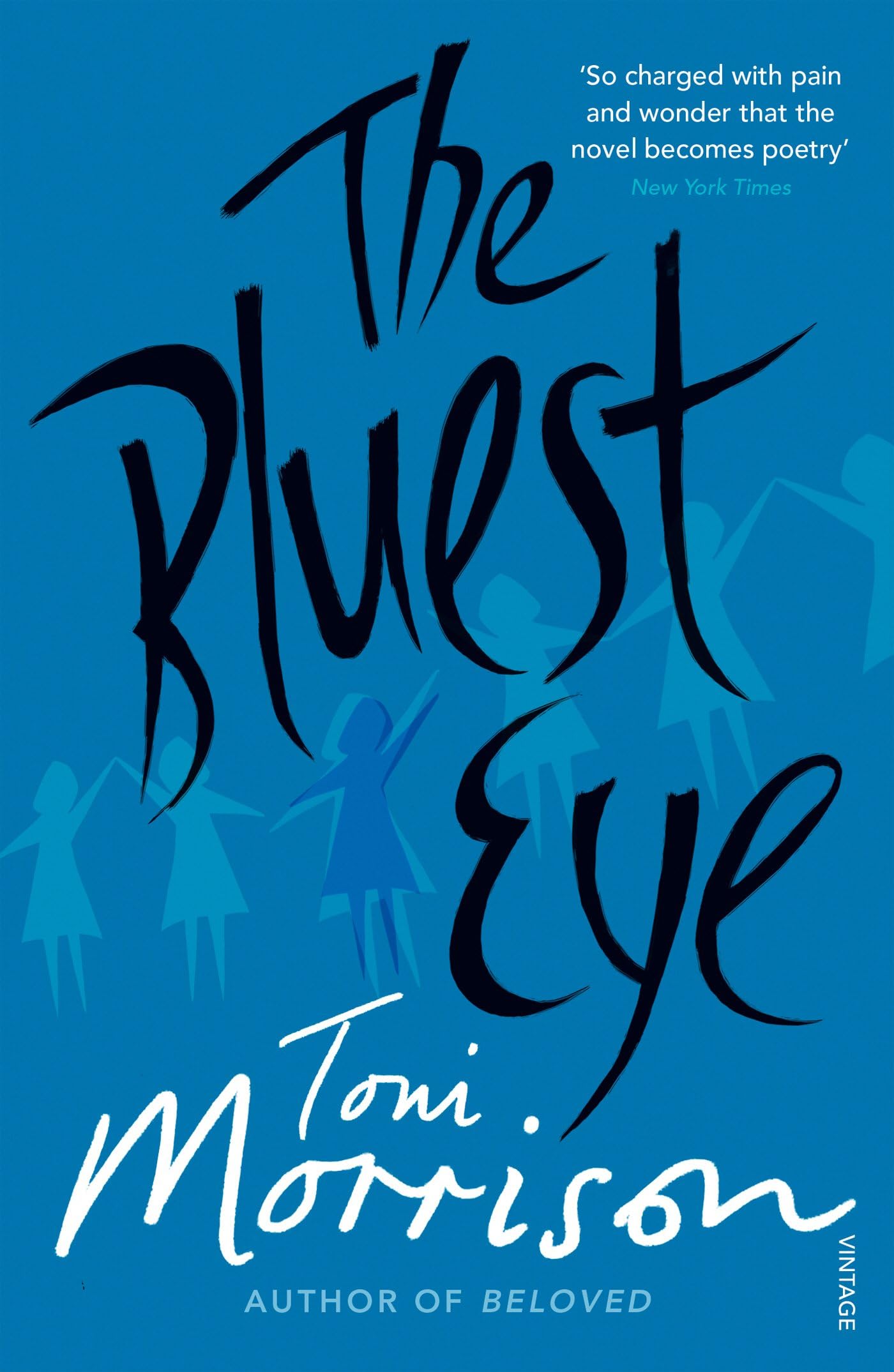
The Bluest Eye: Toni Morrison
Product ID: 50423011
Desertcart purchases this item on your behalf and handles shipping, customs, and support to Greece.
The Bluest Eye: Toni Morrison : Morrison, Toni: desertcart.co.uk: Books Review: Love Mary Jane. Be Mary Jane. - When you come across an author that you might like to read, it is sometimes difficult to know where to start when they have already written several books. There are two most likely options, depending on the author: one is to start from the beginning (especially if the author writes stories in sequence), the other is to jump straight to their most famous book. Toni Morrison won the Pulitzer Prize for her novel 'Beloved,' and arguably her most famous book is 'Song of Solomon;' most book lovers will come to Morrison's work through either of these. I much prefer to start with the author's debut most of the time, unless the book appears to have been completely forgotten. Authors fall here into two groups: those who take a few goes to develop their craft before delivering their best work, and then there are those who pull off something brilliant straight away (often never to match it again). If an author has a few "unknown" books before they hit their stride, I take it as a sign that I can probably skip over these (for example, Salman Rushdie wrote one book before his celebrated 'Midnight's Children' - it is seldom discussed). Toni Morrison's 1970 debut 'The Bluest Eye' has not been forgotten - it is regularly taught in American High Schools - as a result it is admired and reviled in equal measure; either way it is certainly talked about. The reason some first novels are a treat is because of the experimentation, the culmination of a life-to-date desire to write; all the best images and experiences from that era come together in one bold statement. 'The Bluest Eye' is a deeply passionate book, full of genuinely arresting imagery, and if I had not already known, I believe I would have guessed that it was a first novel, for its creative choices, its concern for childhood dreams and naiveties, and for its fearlessness with subjects many authors leave alone once they have a reputation to worry about. The novel takes its name from the life of the central character, an ugly black schoolgirl named Pecola Breedlove, who has a wish for blue eyes, because blue eyes are beautiful, and if she had blue eyes then she would be beautiful too. I say these things as if they were indisputable fact, because in Pecola's world, outcast among outcasts, that is what they are: she knows blue eyes are beautiful, because the little blue-eyed white girls make all the grown-ups coo when they see them, while they look straight through Pecola; she knows she is ugly, because, "when one of the girls at school wanted to be particularly insulting to a boy, [...] she could say, "Bobby loves Pecola Breedlove!" [...] and never fail to get peals of laughter [...], and mock anger from the accused." It is such a given that Pecola is ugly, that the narrator does not even question it, using the shorthand of describing her directly as such, showing that beauty and ugliness are neither in the eye of the beholder nor in the features of the blue-eyed dolls, but instead are so finely woven into the fabric of a society riddled with inequality and prejudice at all levels, that the characters who are marginalised and limited by this discrimination, readily accept and actively support the drawing of the line in the sand. Pecola's mother, working as a home help in a white household, is able to take great pride in keeping the house spotless, while placing no value in her own family situation, leaving it to stagnate and fall apart. Pecola is the central character in the story; however her presence in the novel reflects that of her character: she is the lacuna at the novel's centre, given little voice, and made available to the reader largely through the experiences and opinions of those around her. The short book takes leaps of focus, from classmates Claudia and Frieda MacTeer, to Pecola's parents and back, and even to other characters such as "Soaphead Church," the dream interpreter whose own sleep is dreamless, to whom Pecola comes finally to grant her wish for blue eyes. The novel is thankfully far more than Pecola's hopeless prayer; in fact it is very much in the background, only coming to the fore in the final passage, which is the weakest part of the book, and the only part with which I share the author's professed dissatisfaction with her early efforts at tackling these heavy subjects. 'The Bluest Eye' is disliked by some students for being a set text, but it is also controversial for parents because of some graphic scenes. It gives an extensive and desperate background story to Cholly, the man responsible for the book's most challenging scene, and perhaps raises the controversy even further, by not only depicting the act he commits, but also showing that the act is committed by a human being, something that many people prefer to forget when these terrible crimes are committed, instead labelling the perpetrator simply as a monster, and doing nothing to understand why these things happen, and to work towards stopping them happening in the future. In this way, our society reflects that of the story, by holding up and accepting our own powerlessness in the face of an injustice that is too pervasive to resist. The language of the novel, while rich in imagery and depth of feeling, is easy to understand; the reader is drawn in to the worlds of each of the characters in turn, although some readers may dislike the structure of the story, and the feeling of having to "start again" with each section, not only with another character but sometimes at a completely different point in time. In her commentary on the novel, Morrison says that she was striving for a "writing that was indisputably black," before admitting that she does not yet know "quite what that is". It is difficult to imagine a style of writing that could ever be "indisputably" anything, not least an attempt to represent so many diverse cultures and experiences under a single racial label. This is perhaps shown by some of the response to this novel from black readers, continuing into the present day with novels such as "Push" by Sapphire (after its film adaptation "Precious"), whereby the author is accused of reinforcing negative stereotypes about black people. This is a challenging stance in a number of ways, as it seeks to deny black authors the right to write as they wish, and to explore the full complexity and opportunity of literature, which usually deals with some form of conflict, instead wishing them to merely serve and represent a political purpose, and nothing more. One can only imagine the result of this sounding like the "Dick and Jane" narrative (the literary equivalent of the MacTeers' blue-eyed dolls) that runs through the book, with names substituted for ethnic variations. This is turn also denies authors such as Toni Morrison the ability to write honestly and in unflinching detail about the causes and effects of such persistent deprivation and persecution on a passionate and dignified community of people. That Morrison has elected to do so in spite of this potential for backlash shows the importance of an author pursuing the truth they want to put into their writing, as it serves a political purpose far more convincingly than if she were just to write what a portion of her audience wanted. Morrison states that she wanted the book to cause a reaction, but even so, she expresses disappointment with the result, saying that "readers remain touched, but not moved." When Pecola's mother was young, she went to the cinema often, and learned from Hollywood of "romantic love [and] physical beauty. Probably the most destructive ideas in the history of human thought." This to me is the central theme of the novel; however within this slim volume there is an encyclopaedia of human pain and tragedy, channelled through a small group of connected people in 1940s Ohio, which is capable of not only touching, but moving any reader to consider the way they look at the world, to understand where pain comes from, beyond the daily damage we do to each other, ingrained in all the furnishings of our modern, civilised society. However, this is not a relentlessly negative portrayal of these characters, from which we should infer any greater judgement than of the cruel acts of a few cruel people, and of the acceptance of conditions where such cruelty is allowed to take root. It is also a story of love and inner strength, of people in crowded and demoralising living circumstances, opening their doors to their neighbours when they fall on even harder times, for fear of their becoming "outdoors," instead of accepting the mistrust we are constantly told to feel for each other when living with scarcity and hardship. Human experience is at the fore, in all its light and dark, and indeed with all its urine, vomit, toejam, and much more besides, all left in here, the gaze unrelenting, showing us living people rather than ideas; real life rather than the sanitised and sensationalised liaisons of the cinema screen. 'The Bluest Eye' may not have lived up entirely to what the author hoped to achieve with it, but nonetheless it is a work of extraordinary power, that will stay with the reader, without being simply consumed, ticked off a list, and forgotten. Review: A Hard Read - I found this read hard to piece together and a little uneven to read. It is always sad , the lack of love, parental rejection, and emotional abuse towards a child - black or white. It's worrying and disconcerting to read and take in. The last third is horrible with sexual abuse rearing its ugly head. I can't say I enjoyed this read at all - quite depressing really, though some of the juvenile dialogue / banter is quite funny and lifts the gloom a little. A hard book to read and even more so to enjoy?










| Best Sellers Rank | 7,462 in Books ( See Top 100 in Books ) 36 in Multicultural Studies 310 in Women's Literary Fiction (Books) |
| Customer reviews | 4.3 4.3 out of 5 stars (16,781) |
| Dimensions | 12.9 x 1.7 x 19.7 cm |
| Edition | 1st |
| ISBN-10 | 0099759918 |
| ISBN-13 | 978-0099759911 |
| Item weight | 172 g |
| Language | English |
| Print length | 172 pages |
| Publication date | 4 Mar. 1999 |
| Publisher | Vintage |
T**R
Love Mary Jane. Be Mary Jane.
When you come across an author that you might like to read, it is sometimes difficult to know where to start when they have already written several books. There are two most likely options, depending on the author: one is to start from the beginning (especially if the author writes stories in sequence), the other is to jump straight to their most famous book. Toni Morrison won the Pulitzer Prize for her novel 'Beloved,' and arguably her most famous book is 'Song of Solomon;' most book lovers will come to Morrison's work through either of these. I much prefer to start with the author's debut most of the time, unless the book appears to have been completely forgotten. Authors fall here into two groups: those who take a few goes to develop their craft before delivering their best work, and then there are those who pull off something brilliant straight away (often never to match it again). If an author has a few "unknown" books before they hit their stride, I take it as a sign that I can probably skip over these (for example, Salman Rushdie wrote one book before his celebrated 'Midnight's Children' - it is seldom discussed). Toni Morrison's 1970 debut 'The Bluest Eye' has not been forgotten - it is regularly taught in American High Schools - as a result it is admired and reviled in equal measure; either way it is certainly talked about. The reason some first novels are a treat is because of the experimentation, the culmination of a life-to-date desire to write; all the best images and experiences from that era come together in one bold statement. 'The Bluest Eye' is a deeply passionate book, full of genuinely arresting imagery, and if I had not already known, I believe I would have guessed that it was a first novel, for its creative choices, its concern for childhood dreams and naiveties, and for its fearlessness with subjects many authors leave alone once they have a reputation to worry about. The novel takes its name from the life of the central character, an ugly black schoolgirl named Pecola Breedlove, who has a wish for blue eyes, because blue eyes are beautiful, and if she had blue eyes then she would be beautiful too. I say these things as if they were indisputable fact, because in Pecola's world, outcast among outcasts, that is what they are: she knows blue eyes are beautiful, because the little blue-eyed white girls make all the grown-ups coo when they see them, while they look straight through Pecola; she knows she is ugly, because, "when one of the girls at school wanted to be particularly insulting to a boy, [...] she could say, "Bobby loves Pecola Breedlove!" [...] and never fail to get peals of laughter [...], and mock anger from the accused." It is such a given that Pecola is ugly, that the narrator does not even question it, using the shorthand of describing her directly as such, showing that beauty and ugliness are neither in the eye of the beholder nor in the features of the blue-eyed dolls, but instead are so finely woven into the fabric of a society riddled with inequality and prejudice at all levels, that the characters who are marginalised and limited by this discrimination, readily accept and actively support the drawing of the line in the sand. Pecola's mother, working as a home help in a white household, is able to take great pride in keeping the house spotless, while placing no value in her own family situation, leaving it to stagnate and fall apart. Pecola is the central character in the story; however her presence in the novel reflects that of her character: she is the lacuna at the novel's centre, given little voice, and made available to the reader largely through the experiences and opinions of those around her. The short book takes leaps of focus, from classmates Claudia and Frieda MacTeer, to Pecola's parents and back, and even to other characters such as "Soaphead Church," the dream interpreter whose own sleep is dreamless, to whom Pecola comes finally to grant her wish for blue eyes. The novel is thankfully far more than Pecola's hopeless prayer; in fact it is very much in the background, only coming to the fore in the final passage, which is the weakest part of the book, and the only part with which I share the author's professed dissatisfaction with her early efforts at tackling these heavy subjects. 'The Bluest Eye' is disliked by some students for being a set text, but it is also controversial for parents because of some graphic scenes. It gives an extensive and desperate background story to Cholly, the man responsible for the book's most challenging scene, and perhaps raises the controversy even further, by not only depicting the act he commits, but also showing that the act is committed by a human being, something that many people prefer to forget when these terrible crimes are committed, instead labelling the perpetrator simply as a monster, and doing nothing to understand why these things happen, and to work towards stopping them happening in the future. In this way, our society reflects that of the story, by holding up and accepting our own powerlessness in the face of an injustice that is too pervasive to resist. The language of the novel, while rich in imagery and depth of feeling, is easy to understand; the reader is drawn in to the worlds of each of the characters in turn, although some readers may dislike the structure of the story, and the feeling of having to "start again" with each section, not only with another character but sometimes at a completely different point in time. In her commentary on the novel, Morrison says that she was striving for a "writing that was indisputably black," before admitting that she does not yet know "quite what that is". It is difficult to imagine a style of writing that could ever be "indisputably" anything, not least an attempt to represent so many diverse cultures and experiences under a single racial label. This is perhaps shown by some of the response to this novel from black readers, continuing into the present day with novels such as "Push" by Sapphire (after its film adaptation "Precious"), whereby the author is accused of reinforcing negative stereotypes about black people. This is a challenging stance in a number of ways, as it seeks to deny black authors the right to write as they wish, and to explore the full complexity and opportunity of literature, which usually deals with some form of conflict, instead wishing them to merely serve and represent a political purpose, and nothing more. One can only imagine the result of this sounding like the "Dick and Jane" narrative (the literary equivalent of the MacTeers' blue-eyed dolls) that runs through the book, with names substituted for ethnic variations. This is turn also denies authors such as Toni Morrison the ability to write honestly and in unflinching detail about the causes and effects of such persistent deprivation and persecution on a passionate and dignified community of people. That Morrison has elected to do so in spite of this potential for backlash shows the importance of an author pursuing the truth they want to put into their writing, as it serves a political purpose far more convincingly than if she were just to write what a portion of her audience wanted. Morrison states that she wanted the book to cause a reaction, but even so, she expresses disappointment with the result, saying that "readers remain touched, but not moved." When Pecola's mother was young, she went to the cinema often, and learned from Hollywood of "romantic love [and] physical beauty. Probably the most destructive ideas in the history of human thought." This to me is the central theme of the novel; however within this slim volume there is an encyclopaedia of human pain and tragedy, channelled through a small group of connected people in 1940s Ohio, which is capable of not only touching, but moving any reader to consider the way they look at the world, to understand where pain comes from, beyond the daily damage we do to each other, ingrained in all the furnishings of our modern, civilised society. However, this is not a relentlessly negative portrayal of these characters, from which we should infer any greater judgement than of the cruel acts of a few cruel people, and of the acceptance of conditions where such cruelty is allowed to take root. It is also a story of love and inner strength, of people in crowded and demoralising living circumstances, opening their doors to their neighbours when they fall on even harder times, for fear of their becoming "outdoors," instead of accepting the mistrust we are constantly told to feel for each other when living with scarcity and hardship. Human experience is at the fore, in all its light and dark, and indeed with all its urine, vomit, toejam, and much more besides, all left in here, the gaze unrelenting, showing us living people rather than ideas; real life rather than the sanitised and sensationalised liaisons of the cinema screen. 'The Bluest Eye' may not have lived up entirely to what the author hoped to achieve with it, but nonetheless it is a work of extraordinary power, that will stay with the reader, without being simply consumed, ticked off a list, and forgotten.
T**C
A Hard Read
I found this read hard to piece together and a little uneven to read. It is always sad , the lack of love, parental rejection, and emotional abuse towards a child - black or white. It's worrying and disconcerting to read and take in. The last third is horrible with sexual abuse rearing its ugly head. I can't say I enjoyed this read at all - quite depressing really, though some of the juvenile dialogue / banter is quite funny and lifts the gloom a little. A hard book to read and even more so to enjoy?
N**E
One of a kind!
At a first glance this story can come across as rather grotesque. But the truth is that there are few accounts of pain and reality that are as compelling, or that are told as poetically as Toni Morrison does. Trauma pervades this story on many levels, but ironically Morrison is still able to keep the plot, the characters and even the setting, in the story vastly relatable. This made me feel like I was able to take a stance on what was happening by getting a tasteful essence of the general experience for myself. She cleverly tells stories that are deliberately forgotten, and left unearthed, but that need to be to in order to compassionately introduce a fervent community to, firstly, its local society and the world. I was moved and impacted by the descriptions of issues that affected the young girls in this story, and the stark bullying and racism. Ths book was an eye opener. But, ironically, at the same time many of the controversial issues raised are matter that we know about, but choose to overlook. Toni Morrison's first novel is truly one of a kind. Outstanding work.
M**N
The first half was wonderful - Lost me in the second half
I loved, I Know Why The Caged Bird Sings, by Maya Angelou, and thought I'd try The. Bluest Eye, as it was recommended to me by a friend. The opening chapter is profound and heart-stopping, and as the book unfurls in the first half, I loved it. It describes the life of Pecola from the point of view of her friends, who are a similar age growing up in poverty in America in the 40s (or 50s?) as African Americans. It describes the racism and perils of familial, social and economic issues of the time. However, as the book flips into the second half, it becomes very sexual in nature - its graphic accounts of the rape of a small child made me feel sick, it went into great descriptive depth from the point of view of a paedophile and needless to say, I didn't enjoy it. Not only that, but it really loses its way entirely (in my opinion) The narrative changes and it feels rambling and overly descriptive. Not a fan. I had to skim the final few chapters to get through it, in the hope of regaining the original story. I thought I'd read Beloved, but I think I'll skip it. I really felt this book was overly hyped...
E**E
Read this book. Is all
Toni Morrison was one of those writers I'd always heard about but never got around to reading ... But I picked this up after being inspired and impressed by how articulate and dignified she was on a recent Imagine TV documentary. This is a beautiful book, a gem. Her writing is exquisite- finely polished, sharp, deadly - and all expressed in such vivid, evocative language. A compelling narrative, heartbreakingly real characters, intensely atmospheric descriptions, brilliantly funny dialogue. I don't think it's an overstatement to say thatToni Morrison defined a new kind of literature with her debut novel. So intelligent, so devastating, so sad, so real.
J**O
dramático e pungente
J**E
I read this book because it was banned. I was looking to see why it was given that sentence. What I found was a story that reflected something that was neither black or white but struggle in an awful world. As white man I feel shame as what men do to women and we hold the colour of our skin over others as if we somehow should be elevated over them. We are all humans and should act that way! The Bluest Eye should be read by everyone. You will learn the power of words.
F**A
Non semplice da apprezzare. Studiarlo per un esame di letteratura l’ha reso più fruibile e alla fine mi è piaciuto molto. Consigliato.
S**R
Synopsis: Nine-year-old Claudia lives with her parents and her ten-year-old sister. In her nine-year-old narrative, she remembers Pecola who was placed with them by child care services. Pecola, who becomes a woman from a ten-year-old girl while she lives with them. Pecola's life with her family is shown next, where her brand of life makes her wish that she had the bluest eye thinking that it may have made her more loveable and more acceptable. But life is not that simple, as there are more hardships in the life of that little girl with unimaginable consequences. Review: This is my second Morrison and it doesn't get any easier. But in this case, the first book written by her, the difficult thing was to read it without it devastating me. There's this sense of impending doom even with the little bit of innocence that there is. This one starts with a description of a family, in the midst of war and depression in the 1940s, and its way of narration reminded me of this (which seems quite silly now) children's song in Hindi - Aao Milo Seelo Saalo. We used to clap animatedly, after pairing up with another person, while reciting the rhyme in a complete sing-song voice. Of course, this is a story narrated by a nine-year-old child which at once drips with innocence while carrying a vat of pain. The beginning itself will numb you because it's evident that this story is going to be full of agony. But it is equally interesting to note how such a complex, 'grown-up' story was narrated in part by such a young child. Especially when we often refuse to believe them to be worldly-wise and aware, to the extent of having banned the book then, in schools and libraries. "Jealousy we understood and thought natural – a desire to have what somebody else had; but envy was a strange, new feeling for us." What is beauty? Most of us, in one way or other, can be accused of defining beauty through unnatural standards. I share the blame for being harsh on not only others but myself. And however much we speak about inner beauty is the only thing that matters, some of us also have tried the rub-de-dub once in a while, for that glowing, fairer skin. An unnecessary legacy that resurfaces in almost all the dark-skinned Indian households every once in a while. Was that magical realism when Pecola wished for herself to disappear? How sad I felt for her, even before her major problems began. To be living with constantly feuding parents, to be wishing for death. Either for self or the others. And to feel such an inadequacy that she ended up wanting blue eyes, it was all so heart-breaking. "All were engrossed in early-night reminiscences about dreams, figures, premonitions. Their stuffed comfort was narcotic and had produced recollections and fabrications of hallucinations." Pecola's experience with the White Mr Yacobowski reminded me of Untouchable by Mulk Raj Anand. Quite the same premise, where shame at being less than deserving morphs into anger for the inequality that is there in the world. I was astounded at the way Morrison not only wrote about Pecola's inferiority complex of being an African-American in a White community but also inserted internalised racism in the form of a mixed-race girl and how a scale is brought out to measure who is lighter in the skin and prettier than whom. The overbearing – will do what I want to, others (especially women) be damned – men of this story need to be mentioned too. Pecola's father's childhood doesn't let me hate him, while his deeds do not make me like him! This was a female-dominated story, with a major chunk of the characters being female, especially the three prostitutes who are a major part of the story even after them not being one of the central characters. But will I call it a feminist story? I honestly don't know, since this is such a sad story where women don't seem to understand the plight of a young girl, where apart from men, women are also bringing down others of their kind, be it conditioning or judgement. "He responded to his father's controlled violence by developing hard habits and a soft imagination." Divided into four parts, each a season, the squalor in which them Black people live is described in stark detail. While it is Pecola's story, the weight of the narration falls on young Claudia's shoulders which she does in the first-person. But, interspersed is Cholly (Charlie) and Polly (Pauline) Breedlove's story in third-person narration. (I wonder as to the significance behind their names?) It is followed by a dialogue at the end, the same dialogue that wrecked me. "We looked for eyes creased with concern, but saw only veil." Maybe Sula wasn't it for me since The Bluest Eye hit me right where it hurt. I remember Baishakhi's @thebooklizz Instagram Post where she mentions feeling unsettled after reading a Morrison. That is what I felt too, after reading this one. It made me uncomfortable with its truth. P.S. I read this book as a part of Toni Morrison Book Club by Aayushi @_penandpapers, where we pick up one book by the author every month. This was the February pick. This is also my entry for Prompt 18 of the Reading Women Challenge 2018: A Book by a female Nobel Prize winner. Originally posted on: My Blog @ Shaina's Musings
W**.
I had always wanted to read Toni so I thought I'd begin with her debut novel and was blown away. It is an original story that's insightful, intimate, powerful, tragic but also achingly beautiful.
Trustpilot
2 days ago
1 month ago