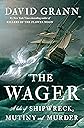
The Wager: A Tale of Shipwreck, Mutiny and Murder
Product ID: 502651217
Desertcart purchases this item on your behalf and handles shipping, customs, and support to Greece.
#1 NEW YORK TIMES BESTSELLER • From the author of Killers of the Flower Moon , a page-turning story of shipwreck, survival, and savagery, culminating in a court martial that reveals a shocking truth. The powerful narrative reveals the deeper meaning of the events on The Wager , showing that it was not only the captain and crew who ended up on trial, but the very idea of empire. A Best Book of the Year: The New York Times, The Wall Street Journal, The New Yorker , TIME , Smithsonian , NPR, Vulture, Kirkus Reviews “Riveting...Reads like a thriller, tackling a multilayered history—and imperialism—with gusto.” — Time "A tour de force of narrative nonfiction.” — The Wall Street Journal On January 28, 1742, a ramshackle vessel of patched-together wood and cloth washed up on the coast of Brazil. Inside were thirty emaciated men, barely alive, and they had an extraordinary tale to tell. They were survivors of His Majesty’s Ship the Wager, a British vessel that had left England in 1740 on a secret mission during an imperial war with Spain. While the Wager had been chasing a Spanish treasure-filled galleon known as “the prize of all the oceans,” it had wrecked on a desolate island off the coast of Patagonia. The men, after being marooned for months and facing starvation, built the flimsy craft and sailed for more than a hundred days, traversing nearly 3,000 miles of storm-wracked seas. They were greeted as heroes. But then ... six months later, another, even more decrepit craft landed on the coast of Chile. This boat contained just three castaways, and they told a very different story. The thirty sailors who landed in Brazil were not heroes – they were mutineers. The first group responded with countercharges of their own, of a tyrannical and murderous senior officer and his henchmen. It became clear that while stranded on the island the crew had fallen into anarchy, with warring factions fighting for dominion over the barren wilderness. As accusations of treachery and murder flew, the Admiralty convened a court martial to determine who was telling the truth. The stakes were life-and-death—for whomever the court found guilty could hang. The Wager is a grand tale of human behavior at the extremes told by one of our greatest nonfiction writers. Grann’s recreation of the hidden world on a British warship rivals the work of Patrick O’Brian, his portrayal of the castaways’ desperate straits stands up to the classics of survival writing such as The Endurance , and his account of the court martial has the savvy of a Scott Turow thriller. As always with Grann’s work, the incredible twists of the narrative hold the reader spellbound.
| Dimensions | 6.45 x 1.29 x 9.56 inches |
| Edition | First Edition |
| Isbn 10 | 0385534264 |
| Isbn 13 | 978-0385534260 |
| Item Weight | 2.31 pounds |
| Language | English |
| Print Length | 352 pages |
| Publication Date | April 18, 2023 |
| Publisher | Doubleday |
| Reading Age | 1 year and up |
User
An Extraordinary Tale.
“As a tale gets passed from one person to another, it ripples out until it is as wide and mythic as the sea.”The annals of British naval history abound with great and small adventures alike. None, however, captivates like the extraordinary tale of the HMS Wager. And no one can better recount such a hair-raising series of events than David Grann. With "The Wager," Grann tops his previous works of narrative nonfiction with this harrowing story of inconceivable hardship and the machinations of desperate men. To be sure, no incident contained in this book is without ample evidence proving it occurred.It is hard to imagine a more horrifying set of survival conditions than those faced by Wager's crew, and capturing those conditions accurately based on aging historical records and biased published accounts was undoubtedly tricky. Yet, Grann does yeoman's work on this story of the ill-fated Wager, part of a British squadron ordered to sea in August 1740 against the Spanish in the apocryphal “War of Jenkins’ Ear." Commanding Wager and at the center of Grann's book is Captain David Cheap, a deeply flawed and complicated skipper.Like Grann's other books, "The Wager" nearly requires one to suspend disbelief. The author carefully and patiently reveals the story's events, shocking the reader in the process. Moreover, upon completing Grann's 257-page account of Wager's exploits and those of its sister ship, HMS Centurion, the reader better understands the ruthlessness and cunning demonstrated by the British Royal Navy as it navigated the high seas in quest of Empire. Indeed, British imperial ambitions are fully displayed in "The Wager."Based mainly on seamen’s logbooks and trial records, many of which are over 250 years old, Grann pieces together the seemingly doomed Wager’s calamities while providing ample historical context. The author, for example, details the multitudinous threats facing British ships as they pursued the Empire's aims in the mid-18th century. He also describes shipboard conditions on a British man-of-war sailing the world's oceans during this era.Wager meets its fate while searching for a Spanish galleon laden with treasure and attempting to negotiate the treacherous seas off Cape Horn at the tip of the South American continent. The crew, already decimated by storms, scurvy, and sundry other trials, finds its ship dashed on the rocks off the coast of Patagonia, Argentina. Marooned in May 1741 with little hope of rescue, the men struggle to survive on a scabrous spit of land subsequently named Wager Island.Malnourished and desperate, Wager’s surviving company suffers a complete breakdown in discipline and decorum. Having lost confidence in the ailing and unpredictable Cheap, still in command, the castaways defy British naval law and flout regulations. A fulminant Cheap, for his part, opposes the indiscipline and enforces his authority at the end of a pistol. A mutiny takes shape, and eventually, a breakaway faction, led by Gunner's Mate John Bulkeley, abandons Cheap and his loyalists, leaving them to fend for themselves on Wager Island. By this time, subsisting on the meagerest of diets harvested from terrain that barely sustains life while withstanding storm after storm, Cheap and crew somehow endure.Sailing a small transport boat reinforced with scrap lumber harvested from Wager and equipped with makeshift sails and rigging, Bulkeley and his charges successfully navigate the Strait of Magellan to Brazil. Meanwhile, Cheap and the Wager Island stragglers experience an equally implausible outcome. Sailing on an eighteen-foot yawl salvaged from the Wager, they set off to reach the Chilean coast. Surviving their respective ordeals, the two parties return to London, providing their lurid accounts of mutiny, betrayal, abandonment, and murder to an incredulous British Admiralty and fascinated public. They alternately face scorn and approbation and, eventually, court-martial.It is the Wager leadership’s trial for which Grann saves his best narration and jaw-dropping, surprise ending."The Wager" asks which of the stories is harder to believe: the death-defying travails and travels of these indomitable seamen or the unanticipated result as the British Admiralty adjudicates their fate. Yet, Grann provides the reader with all the evidence necessary to confirm these events happened irrefutably. Relying on an abundance of journals, logs, diaries, and even letters, Grann demonstrates again his seemingly unquenchable thirst for the truth to inform his audience. His single-spaced bibliography alone exceeds 13 pages.Without question, "The Wager" is an astonishing naval story reminiscent of Charles Nordhoff’s and James Norman Hall’s “Mutiny on the Bounty.” Considering the inglorious actions of the Wager's crew, Grann's book is worth reading and rereading to comprehend the motives of desperate men. Experiencing the audacity and might of the 18th century British Royal Navy, particularly exemplified by Centurion as she squares off with the Spanish man-of-war Our Lady of Covadonga off the Philippines, provides immensely satisfying adventure reading. Grann's spellbinding account of the naval gunfight puts the reader in the crow's nest as though he is viewing the fight aboard the Centurion from the very mast top!"The Wager" offers an incredible piece of storytelling suitable for any devotee of narrative nonfiction or lover of naval lore.An extraordinary tale.
User
Thrilling account of a real voyage that reads like a novel
The Wager was an English ship that set sail from England in 1740 during an imperial war with Spain. It was the mid-1700s, and navigational tools were primitive. Diseases among the seafarers spread rapidly, and I was incredulous, realizing how little they knew about curbing nutritional deficiencies such as scurvy. It seems absurd that in addition to not knowing about the necessity for vitamin C, insufficient levels of niacin were causing psychosis and night blindness resulting from lack of Vitamin A. After shipwrecking on a desolate island off the coast of Patagonia, the story is as much about human nature as it is about surviving on an island and attaining its mission against the Spanish. It is fascinating to read about how they discovered new food sources and what they chose to learn and ignore from natives whose cultures had thrived in the areas where the Englishmen became castaways. If they were going to continue to survive and continue their naval mission, they had to build new boats without the technology available in their homeland, and there were myriad disagreements about how to proceed and also about which path to follow when it was time to embark on the dangerous waters again. Disharmony leads some groups to set sail in opposite directions eventually. When the survivors arrived back in England, the accounts of what happened were not in sync.The characters who are historical figures demonstrate the gamut of human emotions and an evolution of social mores. Without describing each character, I’ll point out that we meet a dominating captain with poor leadership traits. And, of course, we meet argumentative underlings who have smug independence. Then, we see ferocious workers and others with inherent leadership skills and charisma. All of the men are familiar with British naval order and ranking conventions. Yet, more hierarchies develop as the men struggle to survive and create social order. As the subtitle suggests, the fight for survival leads to becoming mutinous and murderous. Grann describes the basic human drives and terrors with admirable writing skills.Writing, in the eighteenth century, was an honorable thing to do. The men onboard the Wager kept written logs—some were required, and others were kept to document some of the mutinous decisions. David Grann had copious notes and records to use when piecing this story together. Rousseau and Voltaire cited the Wager’s expedition reports, as did Charles Darwin and Herman Melville. The seafaring journalists quote the Bible, poets, and famous writers. It is incredible how learned they were. Grann uses his well-honed investigative and research skills to weave a beautiful story of what reportedly happened and the eloquent analysis by those who experienced it. Grann’s ability to combine first-person accounts of the expedition with his summation of the events provides fabulous text about the seafarers and their exploits. Each creative, descriptive section title structures the book and shapes the voyage with metaphoric summaries: The Wooden World, Into the Storm, Castaways, Deliverance, and Judgment are the main sections, and Gran used these to develop the book so that it reads like a novel and keeps the reader riveted. I highly recommend this narrative to everyone, even those who prefer fiction to nonfiction.
User
Powerful Stuff
Let me begin with the answer to a direct question: is this book better than KILLERS OF THE FLOWER MOON? Yes, and by a wide margin. This is a historical tale that draws on the powers of fictional narrative. First and foremost, the story must be true. Hence, the success of the story rises or falls on the quality of the historical incidents themselves, because the resulting story will directly affect the elements of the narrative that are essentially novelistic: characters, themes, setting and plot. The story of the Wager satisfies each of those elements. In other words, David Grann chose wisely. And such choices are always guesses, to some degree. Once the commitment is made to sift through mountains of documents and other evidentiary material, the die has been cast: the resulting story could be a crashing bore; key questions might never yield satisfactory answers; plot lines could end in blind alleys; themes could prove to be maudlin commonplaces, and so on. Not in this case. We have an array of fascinating characters, a great adventure story, a novelistic plot, a riveting setting and a sobering set of lessons learned.Basically we are in the War of Jenkins’ Ear; a set of British ships under the great seaman George Anson is dispatched to intercept and capture a Spanish galleon loaded with treasure. The voyage involves the negotiation of the treacherous winds and waters around Cape Horn. One ship—The Wager—is crushed against the rocks and the men must attempt to survive hunger, disease, and, as we say, insuperable odds, to somehow return to England and stand trial for their actions in Patagonia.I purchased the book as a backup for other books in my reviewing queue that were about to ship. After being disappointed by KILLERS OF THE FLOWER MOON, but seeing the hype for THE WAGER, I decided to read it until more interesting books arrived. However, once I started to read it I simply could not stop. Only one small quibble: the book ends with what the author (SPOILER alert) considers a reflection on the evils of empire. In other words, a dash of seasoning from the Woke shaker. Ultimately, the story is relevant for our own times and our own preoccupation with colonizers/colonized/oppressors/oppressed, etc. It is worthwhile to point out that every thinking writer in the 18th century (especially the putatively most ‘conservative’ ones, Johnson and Burke) were opposed to the aspirations of empire, particularly as they involved self-interested motives. The book is being described as Master and Commander meets Lord of the Flies. Fair enough, but the brief, third act brings everything down to the seedy world of politics. The book does not end on some high, moral, virtue-signaling ground, but in the world that is simply all too familiar. Bishop Sheen said he gave up on politics after Pontius Pilate. Amen. That does not undercut the impact of the story. It simply reinforces the usefulness of James Ellroy’s category of ‘tragic realism’ and, in this case, the manner in which politics can dilute actions of heavily-compromised courage and determination and render them (publicly) mundane.
User
⭐️⭐️⭐️⭐️⭐️ A Gripping Tale of Survival — Brilliantly Told
The Wager by David Grann is an absolute triumph of narrative nonfiction. From the opening chapters, I was pulled into a harrowing world of shipwreck, survival, and the unbreakable (and sometimes breakable) human spirit. Grann’s descriptive techniques are masterful—he doesn’t just tell the story, he immerses you in it. I felt as though I was there with the castaways: shivering in the cold, starving on the desolate shores, and clinging to every thread of hope alongside them.What truly amazed me was the grit, determination, and heroic resilience of these seamen. Their story is almost unbelievable—how they endured such extreme hardship in that era is beyond comprehension. Grann captures the essence of man’s struggle with life and death in a way that is both heartbreaking and inspiring.Equally impressive is the ease with which Grann guides the reader through this intense historical journey. Despite the depth and complexity of the story, the book is remarkably well-written and incredibly easy to read. I finished it in just a couple of sittings—it’s a quick but powerful read that stays with you long after the final page.The Wager is the perfect summer read: thrilling, thoughtful, beautifully told, and impossible to put down. I can’t recommend it highly enough.
User
Highly readable account
As someone who was already quite familiar with the story of the Wager, I was curious to see what David Grann would bring to this re-telling of a story that was famous in its own time -- nearly 300 years ago. My conclusion was that there is little here that is new understanding of the events, but this well-written book does a good job of telling the story to a new and modern readership. Further, the description of the life of sailors of the times is well worth reading and the account is mostly historically accurate. Nearly the 1st half of the book covers events and background of Anson's expedition before the Wager becomes separated and then wrecked. For me, other than the excellent discussion of the British navy and its men at the time, using Byron as an example of a young midshipman, this is the weaker portion of the book because it suffers from inadequate context relevant to the story of the Wager. One point in particular is Anson's conclusion that the Falkland Islands had the potential to be a valuable location for ship repair before and after rounding Cape Horn. Just over 25 years later, the same John Byron who is involved in the Wager disaster will return in command of a Royal Navy expedition to investigate this possibility.With regard to the account of the Wager wreck and events following, it's well done, but for me, at times it lacked color and intensity. I also had problems with the fact that there is little mention of the other Anson expedition ship, the Anna, which had also had difficulties in the same area as the Wager, had narrowly escaped total wreck and been anchored nearby for several months while the men of the Wager struggled to survive. At one point, the Wager survivors even heard guns from the men of the Anna, but only realized after they had been rescued what they'd heard.The Wager story will be new to most readers today, but those who are interested in it and want a more intense and colorful version may want to take a look at Patrick O'Brien's 1959 fictional account, The Unknown Shore. It's also worth taking a look at O'Brien's 1956 novel about the Anson expedition as a whole, The Golden Ocean.
User
monoton storytelling
Things happen but are told in an even monotone style of writing. In some ways it reminds me of classoc literature in its descriptions but not in its interest. I woyld not recommend this book to anyone
User
This book will shiver your timbers…
This book, this book, where do I start! Loved every bit and devoured it like so much salted beef! Having sailed boats since childhood, I found myself getting tense and hollering out Don’t do that! And then having to take a break for a few minutes bc you get so invested in these people. Bravo and Arthur to Mr Grann!
User
Good read
A good story, well written and easy to read. I like stories about real people and what they went throug.
User
Cartivante.
Impressionante as dificuldades dos primeiros grandes navegadores.
User
The wager
A very enjoyable read !
User
Important reading.
Great historical read of life on the ocean for early sailors facing disease mutiny and shipwreck.I was so interested in this book that I then spent hours reading more online about the characters and events described therein.
User
大航海時代裏話。
可もなし不可も無し。
User
Un extraordinario recuento de el tipo de vida y sufrimientos que soportaron quienes construyeron las bases del imperio británico.
Me ha gustado lo bien documentado del caso y como este, sin necesidad de adornos novelados, resulta apasionante.Me ha gustado también el modo en que las extraordinarias trayectorias de todos los involucrados van entreteniéndose para crear esta increíble aventura
Trustpilot
3 days ago
3 weeks ago