

Desert Online General Trading LLC
Dubai, United Arab Emirates
Desert Online General Trading LLC
Dubai, United Arab Emirates
Full description not available
S**R
Confusion and/or Clarity of Mind
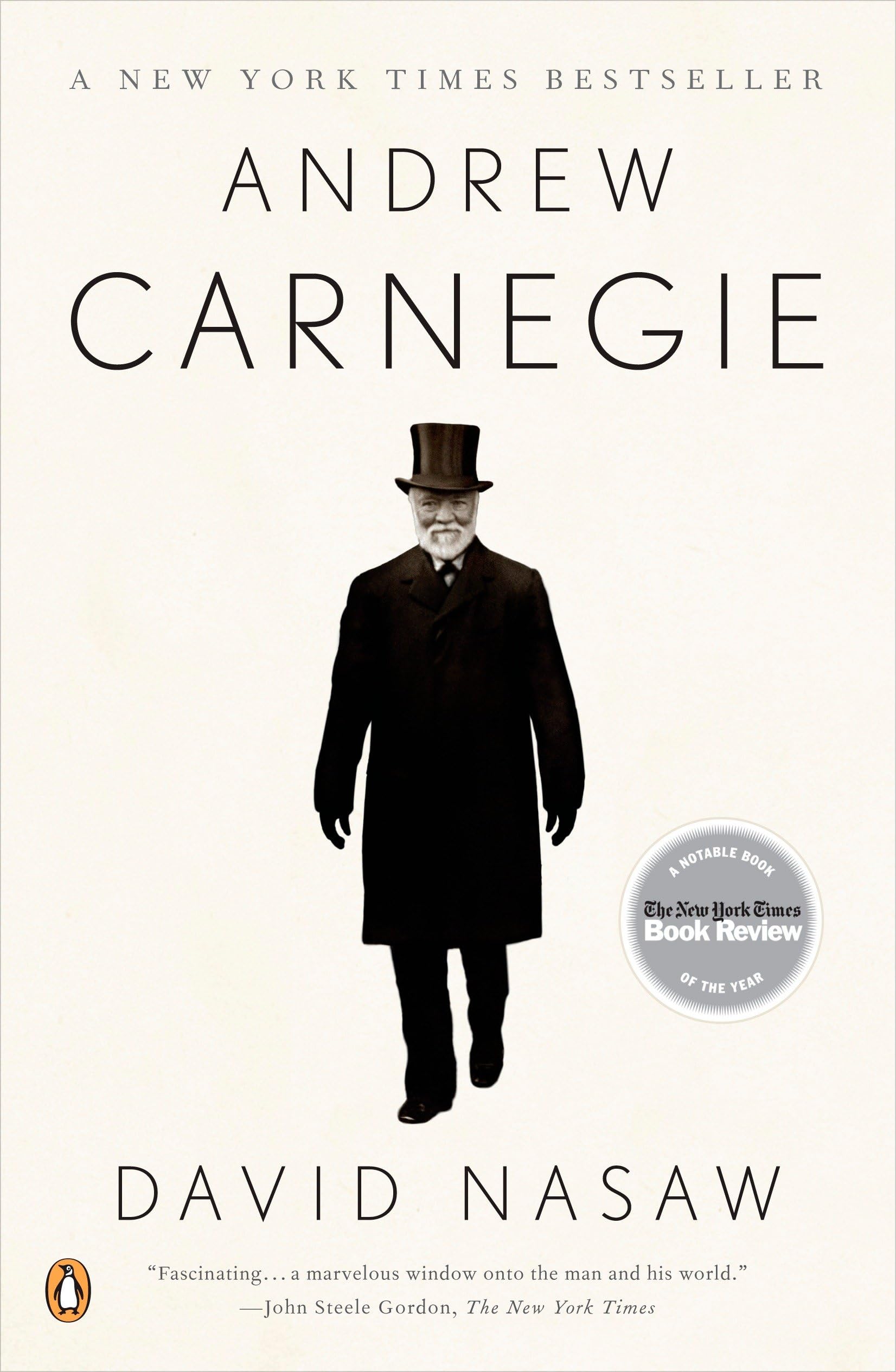
This biography of Andrew Carnegie by David Nasaw I found as intriguing as any biography I have read about the Robber Barons of the Gilded Age. The question that, I think, you must first ask yourself is "Who was Andrew Carnegie?". That is not easy to do - you encounter a very complex man whose life experiences molded a person that at times defies definition. It is hard for me to comprehend the massive wealth that he was able to accumulate. Wealth that continued to grow after he retired and then even more when Carnegie Steel was sold to the House of Morgan as it became US Steel. For me there was a dichotomy in A.C. as he was often called viewing him as business man then transformed into a philanthropist. His veracity can be questioned between what he did and then what he said about his business operations including his partners, employees and especially his competitors. He could be ruthless as well as being a kind friend. A.C. said that his success did not come from God or a Protestant Work Effort but simply being in the right place at the right time. He was also a man who made the decision to give away every penny he made before he died. A.C. did not believe in the concept of family wealth and inherited wealth. He saw a responsibility to give back providing for the general welfare of society. Yet, what he wanted to leave was not endowed social welfare programs but the means for individuals to improve their own lives. Andrew Carnegie is probably most famous for the number of public libraries he built across the country. He gave money to promote education and teaching - knowledge was the pathway to a better life. The diversification of his generosity can still be seen today. In the latter part of his life he became an advocate for world peace and the arbitration of differences to avoid violence and the useless loss of life. He invested large sums of money in foundations and organizations that failed to have the success he hoped to achieve. He lived through the destruction of World War I and the human cost of that war. He was not a perfect man though. He fell victim to his own bias and prejudice but I think he needs to be viewed in the context of his own time. He was not just a unique man for his time but a great man. It probably is not an overstatement to say for any time. I thought it was a great book.
G**M
A well written account of an exuberant tycoon and philanthropist
A fascinating biography of the exuberant Scottish-American tycoon and philanthropist.Nasaw covers all of Carnegie's life from early boyhood in 1830's Scotland, to ambitious telegraph boy in Pittsburgh, to iron and steel magnate, to philanthropist and finally to international peace advocate. Most of the 800 pages go swiftly. Nasaw writes well and I generally found his very detailed account valuable, especially for Carnegie's business adventures and for his final peace activities, although perhaps rather less so for all the details of his family life.In Nasaw's account Carnegie comes across as much more of a "businessman" than an "industrialist". His initial fortune was made in his twenties through insider dealings from his role as a key aide to railroad magnates who were making their own fortunes by tricks such as awarding lucrative contracts to companies that they themselves owned. But starting in his late twenties Carnegie did build a mighty iron and steel empire, with remorseless business logic.Carnegie in his middle age inevitably comes across as a great hypocrite. He had given speeches extolling the virtues of unions and of the need for employers to treat workers fairly, but he went on to mercilessly repress workers at his own plants, including cutting wages, extending hours, and suppressing all unions. He denied responsibility for the climactic Homestead lockout which was designed to break the steel unions, but Nasaw shows that he was kept fully informed and must have either made or supported the key decisions. Nasaw explains how Carnegie rationalized this harshness to himself, as a necessary part of business and of social evolution, but still his deeds fit poorly with his words.However in his later life, especially after selling Carnegie Steel, Carnegie became indisputably a genuine exuberant philanthropist. He lived well (very well indeed!) but he also gave away a vast fortune, founding an astounding 2500 libraries, plus many Institutions, the Carnegie Hall, various Hero funds, and many peace organizations.In his latter years, Carnegie's incessant lobbying for international peace is truly striking. Nasaw sometimes deprecates Carnegie's endless expressions of optimism in the face of repeated failures and his ceaseless lobbying of presidents, monarchs, and statesmen. But given that Carnegie believed war would be a disaster (as WWI proved all too well) and was committed to doing whatever he could for peace, then his behavior seems both entirely rationale and commendable. Yes, he was often grasping at straws and he did aggressively pester and "name drop" to try to move things forward, but given the stakes it is difficult to condemn his donning of a bold face and his trying again and again in the face of failures and cynicism. Alas, his efforts were probably inevitably doomed, but given his beliefs and commitment, it seems hard to criticize him for trying as hard as he did.Overall, Carnegie's life is a fascinating one, involving many contrasts and apparent contradictions. Nasaw captures it well and succeeds in making Carnegie a surprisingly sympathetic character, without concealing his flaws.
S**R
Magnificent Biography!
Nasaw lets readers draw their own conclusions about the rather insignificant question of whether we "like" Carnegie. Instead, he gives us the great gift of being able to understand Carnegie. This is one of the best and most moving biographies I've ever read, and I've read many.
Trustpilot
1 month ago
1 month ago