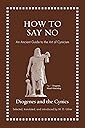
How to Say No: An Ancient Guide to the Art of Cynicism (Ancient Wisdom for Modern Readers)
Product ID: 469449963
Desertcart purchases this item on your behalf and handles shipping, customs, and support to Greece.
An entertaining and enlightening collection of ancient writings about the philosophers who advocated simple living and rejected unthinking conformity The Cynics were ancient Greek philosophers who stood athwart the flood of society’s material excess, unexamined conventions, and even norms of politeness and thundered “No!” Diogenes, the most famous Cynic, wasn’t shy about literally extending his middle finger to the world, expressing mock surprise that “most people go crazy over a finger.” When asked why he was called Diogenes the Dog, he replied “because I fawn on those who give, I bark at those who don’t, and I bite scoundrels.” How to Say No is a delightful collection of brief ancient writings about Cynicism that captures all the outrageousness, wit, and wisdom of its remarkable cast of characters―from Diogenes in the fourth century BCE to the column-stander Symeon Stylites in late antiquity. With their “less is more” approach to life, the Cynics speak urgently to our world of climate change, economic uncertainty, and psychic malaise. Although the Cynics weren’t writers, their memorable utterances and behavior were recorded by their admirers and detractors, and M. D. Usher offers fresh new translations of appealing selections from this body of writing―ranging from street sermons and repartee to biography and snapshots of Cynics in action. Complete with introductions to the volume and each selection as well as the original Greek and Latin on facing pages, this lively book demonstrates why the Cynics still retain their power to surprise us and make us laugh―and to make us think and question how we live. Review: The value of a simple and frugal lifestyle from the perspective of the ancients - "How to Say No: An Ancient Guide to the Art of Cynicism" by M.D. Usher is a fascinating and insightful book that explores the ancient Greek philosophy of cynicism with writings translated from the Greek. The Greek is on one page and his translation to English is on the opposite page. Usher's translations and writing style are engaging and accessible, and he presents the ideas of the ancient cynics in a way that is both informative and thought-provoking. The book is well-organized, with each chapter focusing on a different aspect of cynicism with both Greek and Roman perspectives, from the importance of self-sufficiency to the value of simplicity and frugality. Overall, "How to Say No: An Ancient Guide to the Art of Cynicism" is a well-written and insightful book that offers a fresh perspective on the ancient philosophy of cynicism. Usher's writing is engaging and accessible, and his translations are both informative and thought-provoking. This book is a must-read for anyone interested in philosophy, ethics, or personal growth. Review: Best anthology on the Cynics - You can read this cover to cover because the translations are smooth, the selections are interesting, and the book is beautiful. A great reading experience. The Greek and Latin also run parallel to the English, which is a nice touch.

| Best Sellers Rank | #299,733 in Books ( See Top 100 in Books ) #549 in Sustainable Living #568 in Ancient Greek & Roman Philosophy #1,180 in Philosophy of Ethics & Morality |
| Customer Reviews | 4.4 out of 5 stars 36 Reviews |
C**R
The value of a simple and frugal lifestyle from the perspective of the ancients
"How to Say No: An Ancient Guide to the Art of Cynicism" by M.D. Usher is a fascinating and insightful book that explores the ancient Greek philosophy of cynicism with writings translated from the Greek. The Greek is on one page and his translation to English is on the opposite page. Usher's translations and writing style are engaging and accessible, and he presents the ideas of the ancient cynics in a way that is both informative and thought-provoking. The book is well-organized, with each chapter focusing on a different aspect of cynicism with both Greek and Roman perspectives, from the importance of self-sufficiency to the value of simplicity and frugality. Overall, "How to Say No: An Ancient Guide to the Art of Cynicism" is a well-written and insightful book that offers a fresh perspective on the ancient philosophy of cynicism. Usher's writing is engaging and accessible, and his translations are both informative and thought-provoking. This book is a must-read for anyone interested in philosophy, ethics, or personal growth.
E**S
Best anthology on the Cynics
You can read this cover to cover because the translations are smooth, the selections are interesting, and the book is beautiful. A great reading experience. The Greek and Latin also run parallel to the English, which is a nice touch.
M**S
A great addition to this series
Something we all need to practice in this day and age. Simplifying our lives is an age old adage!
K**R
Impressive
Great piece of work. I'm looking forward to reading more in this series of books. Hopefully, the rest are as good as this was.
N**W
Great book
Like the other books in the Princeton Publishing series, this is a helpful tool using ancient wisdom to live our modern lives in a better way.
A**R
Fantastic compilation
This is one of those compilations I'll return to again. It's great to have the original languages and of course these are beautiful books as objects. Recommended.
N**!
No guide, just cut and paste
The author adds nothing nor says anything. It's just another collection of material and for the price not worth 1/4 of it.
Trustpilot
2 months ago
1 month ago