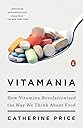
Vitamania: How Vitamins Revolutionized the Way We Think About Food
Product ID: 46669149
Desertcart purchases this item on your behalf and handles shipping, customs, and support to Greece.
“[An] absorbing and meticulously researched history of the beginnings and causes of our obsession with vitamins and nutrition.” — The New York Times Most of us know nothing about vitamins. What’s more, what we think we know is harming both our personal nutrition and our national health. By focusing on vitamins at the expense of everything else, we’ve become blind to the bigger picture: despite our belief that vitamins are an absolute good—and the more of them, the better—vitamins are actually small and surprisingly mysterious pieces of a much larger nutritional puzzle. In Vitamania , award-winning journalist Catherine Price offers a lucid and lively journey through our cherished yet misguided beliefs about vitamins, and reveals a straightforward, blessedly anxiety-free path to enjoyable eating and good health. When vitamins were discovered a mere century ago, they changed the destiny of the human species by preventing and curing many terrifying diseases. Yet it wasn’t long before vitamins spread from labs of scientists into the realm of food marketers and began to take on a life of their own. The era of “vitamania,” as one 1940s journalist called it, had begun. Though we’ve gained much from our embrace of vitamins, what we’ve lost is a crucial sense of perspective. By buying into a century of hype and advertising, we have accepted the false idea that particular dietary chemicals can be used as shortcuts to health—whether they be antioxidants or omega-3s or, yes, vitamins. And it’s our vitamin-inspired desire for effortless shortcuts that created today’s dietary supplement industry, a veritable Wild West of overpromising “miracle” substances that can be legally sold without any proof that they are effective or safe. Price’s travels to vitamin manufacturers and food laboratories and military testing kitchens—along with her deep dive into the history of nutritional science— provide a witty and dynamic narrative arc that binds Vitamania together. The result is a page-turning exploration of the history, science, hype, and future of nutrition. And her ultimate message is both inspiring and straightforward: given all that we don’t know about vitamins and nutrition, the best way to decide what to eat is to stop obsessing and simply embrace this uncertainty head-on. Praise for Vitamania : “Measured, funny, and fascinating. The only thing that Catherine Price is selling here is good reporting, engaging storytelling, and more than you thought you could possibly learn about vitamins. If you need vitamins to survive (you do), you should read this book.” — Scientific American Review: This book is fabulous. - The subject of this book is timely, interesting, and supremely well-handled. Price manages to make the history of the supplemental foods industry (including vitamins, supplements of various kinds, and pre-fabricated meals) utterly gripping and, if you'll pardon me, comestible. The book raises really important questions about the relationship between science, government, cultural practice, and public knowledge, questions that I think resonate eerily and strongly with our current day, even though many of Price's anecdotes date to the early part of the 20th century. (Not all: much of the book focuses on the 1970s and later, but the material on the *discoveries* of vitamins, and how they get engineered both materially and as a site of cultural meaning and virtue is super compelling, and largely takes place before 1960.) I learned a tremendous amount from this book, and I already thought I was pretty well informed about such matters. (Turns out I was wrong.) And finally, I want to note that Price's prose style is supple, clear, elegant, and balanced. My other favorite non-fiction cultural history books are Cadillac Desert, The Sixth Extinction, Mountains Beyond Mountains, The Spirit Catches You and You Fall Down, The Power Broker, and Can't Stop, Won't Stop. Price's book is better written than most of these. On par with Tracy Kidder and Robert Caro. Review: ... the secret in life is to eat what you like and let the food fight it out inside - “Part of the secret in life is to eat what you like and let the food fight it out inside.” Mark Twain Price’s book is nearly a perfect example of popular science writing. She wrote with élan throughout. That included some sensible humor at just the right time. Her prose was skeptically reasoned. Her research significant and found in the text itself but also in the appendices. It included a glossary that took a significant number of pages to complete. It would be rash to read the book and skip the appendices. It also provided an excellent science history naming the players and describing the events that led us to our current state of nutrition and the chemistry of it. Prior to getting into details a disclaimer is required. Most every stake that she laid was already believed in these quarters. Food and its science along with diet quackery is something that I continually research. In fact I even did an ad hoc study that was for my amusement several years ago. I went to health food and nutrition stores with a list of questions that I posed the clerk. They all had to do with supplements and vitamins. The specifics are lost to history but they were something like “which of these different brands of St. John’s Wort” is better?” “What are some of the possible interactions that one pill could have with another?” “Can you overdose on a supplement or vitamin?” What became clear was that the clerks were trained at selling the store’s products, but did not have product knowledge. I asked the same questions of pharmacists and they were more specific about potential issues that could arise. Sometimes they responded with enthusiasm but some redirected me away from these “natural” or “holistic” products and towards my doctor. I had anticipated the duality of responses from these two demographics and I got it. Price also suggested something else that is part of my dietary plan. That is to eat food that is lesser processed and get our vitamins from them. The body can handle “too much” spinach in its natural form. Michael Pollan suggested that when we shop for groceries that we ought to make our purchases only from the periphery aisles and skip the interior. It seems that Price would concur with that suggestion. So my disclaimer is to indicate that prior to picking Vitamania up I already had the same mindset. I was already in her camp but still learned much from the book. Initially it is her timeline of our nutrition history that was a value add. It is very informative for the historian and puts much in perspective. Price defined several very important parts of what a vitamin is. First and foremost is that science has yet to accurately clarify the details of the benefits of vitamins. There is a world of unknown out there. Then she gave clear descriptions of the thirteen vitamins that we do need and why we need them. She described the diseases that result from nutrient deficiencies and issues that could arise by overuse of some solutions. Then she goes into quite a long story about supplements and the chicanery involved in that realm. Neither the industry nor the FDA even test them prior to getting them to the shelves. Humans have to begin suffering prior to any action being taken. The health food industry is free from the strictures of regulation essentially. Were the pharmaceutical industry to put a product out without knowing the potential consequence of their product they would suffer huge financial losses when things go south. Not so for herbal and holistic supplements This is due to several laws enacted by some of the conservative icons of the US Senate. Orrin Hatch has greased the tubes for the “Holistic” industry which is very large in his Utah. The logic in his speeches has been that people have a right to use supplements and regulation would constrict the rights of citizens. With that, the supplement industry has been free to use false advertising and to even sell products that have none of the ingredients that are on their label. There is no bar for quality control. Many studies have shown this to be true and Price cites several of them. The supplemental industry is as large as the demonized “Big Pharma” and it has as much avarice as any big business. Despite new age and hippy styled, advertising there is nothing particularly good, healthy or moral about the products. Their adverts make it appear that they are such though. Yet it is not all their fault though. They may falsely advertise with the assistance of legislators who limit the regulation of supplements. It would not happen if people used some analytical thinking and approached what they ingest with some skepticism. As long as people buy the product, the longer the industry will thrive. Supplements are not alternatives to prescribed medicine. Price suggests we get the vitamins we need by maintaining a healthy diet of food and I agree wholeheartedly. Supplements are snake oil.
| Best Sellers Rank | #498,554 in Books ( See Top 100 in Books ) #190 in Vitamins & Supplements (Books) #475 in History of Medicine (Books) #755 in Gastronomy History (Books) |
| Customer Reviews | 4.5 out of 5 stars 172 Reviews |
A**R
This book is fabulous.
The subject of this book is timely, interesting, and supremely well-handled. Price manages to make the history of the supplemental foods industry (including vitamins, supplements of various kinds, and pre-fabricated meals) utterly gripping and, if you'll pardon me, comestible. The book raises really important questions about the relationship between science, government, cultural practice, and public knowledge, questions that I think resonate eerily and strongly with our current day, even though many of Price's anecdotes date to the early part of the 20th century. (Not all: much of the book focuses on the 1970s and later, but the material on the *discoveries* of vitamins, and how they get engineered both materially and as a site of cultural meaning and virtue is super compelling, and largely takes place before 1960.) I learned a tremendous amount from this book, and I already thought I was pretty well informed about such matters. (Turns out I was wrong.) And finally, I want to note that Price's prose style is supple, clear, elegant, and balanced. My other favorite non-fiction cultural history books are Cadillac Desert, The Sixth Extinction, Mountains Beyond Mountains, The Spirit Catches You and You Fall Down, The Power Broker, and Can't Stop, Won't Stop. Price's book is better written than most of these. On par with Tracy Kidder and Robert Caro.
C**L
... the secret in life is to eat what you like and let the food fight it out inside
“Part of the secret in life is to eat what you like and let the food fight it out inside.” Mark Twain Price’s book is nearly a perfect example of popular science writing. She wrote with élan throughout. That included some sensible humor at just the right time. Her prose was skeptically reasoned. Her research significant and found in the text itself but also in the appendices. It included a glossary that took a significant number of pages to complete. It would be rash to read the book and skip the appendices. It also provided an excellent science history naming the players and describing the events that led us to our current state of nutrition and the chemistry of it. Prior to getting into details a disclaimer is required. Most every stake that she laid was already believed in these quarters. Food and its science along with diet quackery is something that I continually research. In fact I even did an ad hoc study that was for my amusement several years ago. I went to health food and nutrition stores with a list of questions that I posed the clerk. They all had to do with supplements and vitamins. The specifics are lost to history but they were something like “which of these different brands of St. John’s Wort” is better?” “What are some of the possible interactions that one pill could have with another?” “Can you overdose on a supplement or vitamin?” What became clear was that the clerks were trained at selling the store’s products, but did not have product knowledge. I asked the same questions of pharmacists and they were more specific about potential issues that could arise. Sometimes they responded with enthusiasm but some redirected me away from these “natural” or “holistic” products and towards my doctor. I had anticipated the duality of responses from these two demographics and I got it. Price also suggested something else that is part of my dietary plan. That is to eat food that is lesser processed and get our vitamins from them. The body can handle “too much” spinach in its natural form. Michael Pollan suggested that when we shop for groceries that we ought to make our purchases only from the periphery aisles and skip the interior. It seems that Price would concur with that suggestion. So my disclaimer is to indicate that prior to picking Vitamania up I already had the same mindset. I was already in her camp but still learned much from the book. Initially it is her timeline of our nutrition history that was a value add. It is very informative for the historian and puts much in perspective. Price defined several very important parts of what a vitamin is. First and foremost is that science has yet to accurately clarify the details of the benefits of vitamins. There is a world of unknown out there. Then she gave clear descriptions of the thirteen vitamins that we do need and why we need them. She described the diseases that result from nutrient deficiencies and issues that could arise by overuse of some solutions. Then she goes into quite a long story about supplements and the chicanery involved in that realm. Neither the industry nor the FDA even test them prior to getting them to the shelves. Humans have to begin suffering prior to any action being taken. The health food industry is free from the strictures of regulation essentially. Were the pharmaceutical industry to put a product out without knowing the potential consequence of their product they would suffer huge financial losses when things go south. Not so for herbal and holistic supplements This is due to several laws enacted by some of the conservative icons of the US Senate. Orrin Hatch has greased the tubes for the “Holistic” industry which is very large in his Utah. The logic in his speeches has been that people have a right to use supplements and regulation would constrict the rights of citizens. With that, the supplement industry has been free to use false advertising and to even sell products that have none of the ingredients that are on their label. There is no bar for quality control. Many studies have shown this to be true and Price cites several of them. The supplemental industry is as large as the demonized “Big Pharma” and it has as much avarice as any big business. Despite new age and hippy styled, advertising there is nothing particularly good, healthy or moral about the products. Their adverts make it appear that they are such though. Yet it is not all their fault though. They may falsely advertise with the assistance of legislators who limit the regulation of supplements. It would not happen if people used some analytical thinking and approached what they ingest with some skepticism. As long as people buy the product, the longer the industry will thrive. Supplements are not alternatives to prescribed medicine. Price suggests we get the vitamins we need by maintaining a healthy diet of food and I agree wholeheartedly. Supplements are snake oil.
J**N
An omega-rich, gluten-free fun read
I love books about our crazy love affair with trends, so I'm already biased when I begin a book like Vitamania. I live with my Millennial son, who pops vitamin supplements, fish oil, omega-this and omega-that and eats at Burger King, KFC and pizza joints. The closest he gets to a salad is the tomato and lettuce on top of a fast-food hamburger. So I am besotted with credible authors like Catherine Price, who show scientifically why all this stuff is bogus. No proof. No facts. Just billions of dollars flowing into companies. The vitamin industry, uncontrolled by any scientific agency, can make claims and carry on, just as wrinkle removers can make claims and carry on -- all the way to the bank. This is a fun read -- unless you happen to be a pill-popper and eat your sandwiches on gluten-free bread. As an evangelical foodie, you will not like to look at these facts and laugh with your fellow faddists. In fact, I would bet that the vitamanians are lining up for the talk-show circuit already. There is something about us that WANTS to believe that life can be cured with a pill. Popeye had it right: Eat your spinach and love your Olive Oil.
D**.
Here is the best part: this book is not a dry read
This is a truly remarkable book. It is not only a fascinating explanation of vitamins and our obsession with them, but much more. It is actually a page-turning, utterly engaging history of nutrition as a whole. It goes through the history of how we began to characterize food into parts, starting with the macro-nutrients (like protein, carbs, and fat) and then the micronutrients (like vitamins). It also explains how food was reconceptualized as "medicine" and how food marketers (and industry players) cashed in on that. Finally, It shows how the misguided view that vitamins are a necessary component of being healthy led to our current obsession with all sorts of wonder foods and supplements. Here is the best part: this book is not a dry read. It is actually one of those rare "hard-to-put-down" pieces of non-fiction and often laugh-out-loud funny. If you like Bill Bryson's work, you'll love Vitamania.
P**K
Food As Chemistry, Chemistry As Food leaves so much Food for Thought!
Thank you for stepping us through the maze of the past and into the present; and a brief headsup to our future. I was fascinated by our nutritional history that lives on; and it’s startling affect on our disordered approach to our health. So many of my clients, who struggle with severe food issues, are being supported by this skewed industry. We’re getting back to the garden, to the farmer in the San Francisco Bay Area. Yet, Vitamania continues to hold hands with nature; and can cancel out its benefits. We’re also buying boxes of blemished organic fruits and vegetables, wholly nutritious, though imperfect. Why can’t our governments just give some to our underserved. Why can’t our military receive more nutritious, delicious foods for our military, when they’re on home soil? As you can see, Vitamania, which I recommended to our non-fiction Bookclub, left us inquiring and expressive. We’re multi-generational women with enough questions and comments for the sequel! So?
F**E
This is a history book, not a medical advice book.
This is a good book if you're looking for a historical text on the promotion and adoption of vitamin usage in this country. However if you're looking for medical advice on vitamins (as I was), then it's not for you.
A**W
Useful and educational in regards to vitamins
While useful and captivating this book is still pretty much a high level "study". It raises a lot of questions left without answers (not author's fault since the whole vitamins & supplements area is really so much "grey"). What I didn't quite like about this book was a couple of endorsements of the companies producing supplements. Some parts were unnecessarily lengthy too. Overall it's a nice book with a lot of work put in it.
D**M
A must read for those interested in vitamins.
This book has interesting info about the history of vitamins, but it's strength is its view of our pill-obsessed society with it's hope that taking vitamins will be a panacea for all ills. It is important to know enough info about what we put into our bodies so we can make informed choices about the efficacy of those pills. This book should be read with an open mind and attention to detail, as it contains a wealth of info. It is written in such an accessible and entertaining way, it is easy to be educated about a complex subject while enjoying the book. Highly recommended.
G**A
Thoroughly researched, skeptical, food for thought
I cannot recommend this enough. Thoroughly researched. Well written, entertaining, enlightening. This made me reconsider and change my diet for good!
M**S
great
lovely book great condition
G**R
Five Stars
great
C**U
Not All the Info is Correct
I am in the middle of listening to this on Audible and have purchased the hard copy. The history of the start of the FDA and regulating the drug industry is quite fascinating. Learning that manufacturers in the early part of the 20th century did not have to label all ingredients OR even prove efficacy is scary. I understand that FDA is contemplating doing this now with the vitamin industry in the US, over a decade after Canada did this. Which is a good thing. Now back to the book. The author has made a few inaccurate points. Yes, taking high doses of vitamin D can lead to calcium being deposited into the arteries instead of bones, BUT what she failed to mention is that by also making sure you get enough Vitamin K2 either in food or supplemental form, will make sure this does NOT occur, and the calcium will be deposited into the bones. Properly taken, no one has died from an overdose of Vitamin D. On fair skin, your body makes upwards of 20,000IU of vitamin D on a sunny day, at high noon, without sunscreen, every hour. If it were so toxic, people would be dropping in the streets in the summer. Another point she made was about Niacin. Yes, it can cause skin flushing, not deadly, and passes, but the form Niacinamide, does not cause flushing and this form has been proven to cure ADHD in children. As for the flush form, this can REPLACE the statins that over time, will deplete your brain of cholesterol (which the brain contains a large portion for a reason) and this in turn will cause your memory to disappear. I have studied statins and cholesterol and there is a lot of unnecessary fear. She makes no clinical reference of liver damage. As for the Vitamin C, she mentions kidney stones. This has been a rumor for decades, yet no one can produce a clinical study proving such. High doses HAVE cured cancer (I.V) form and there is a video on YouTube of a farmer in New Zealand that was cured of swine flu with IV vitamin C. He was on life support and the doctors said there was nothing they could do. The family fought in court to get the IV form. He is alive and well today because his family fought. Just search "NZ Farmer beats Swine Flu with Vitamin C" and watch. Done by 60 Minutes so you know they did their research. When you take high doses orally, yes, it can cause diarrhea because your body did not need the large amount taken. But take it as a cold or flu is coming on and diarrhea does not occur until 10 or 15 times the RDA. This is because your body NEEDS the amount taken. You cannot die from an overdose of Vitamin C as it is water soluble and the body will take what it needs and discard the rest. Throughout the last 2.5 years, I have taken a mininum of 25,000IU of D a day, 15ml of liposomal C a day (more if I feel a bit under the weather, and this was powdered form every 15 minutes to bowel tolerance) Vitamin K2 and Zinc. I have been healthy and my blood work proves it! I do take 500mg of Niacin every day-cholesterol is excellent. Yes, I do get the flush sometimes, if I have not taken it with enough food. But it passes. The author is a great journalist but in my opinion is a bit skewed against vitamins. I agree, they do need to be regulated but doctors also need to be more aware of their benefits and offer these to their patients where warranted. However, alas, no money in healthy people or supplements that cannot be patented. You need to do all your research with an open mind. I find this book very interesting and worth the read. I continue to do my research and share my knowledge with my family. I am not a doctor and make no claims that what works for me will work for you. Every medical history is different as is Every BODY. You need to work with your health care provider and DO YOUR OWN RESEARCH from multiple sources!!
K**I
Well researched and very informative book, could have done with slightly better editting.
Although I really wanted a book outlining how we use and consume vitamins and minerals, especially supplements, this book clearly outlines why such a book probably won't exist for a while. This is a well researched book looking at the history of vitamins and minerals (the two are differrent) and how they have become such a large, important and very confusing part of our lives. Although it is focussed on the USA market for supplements, there is a cross-over to the UK and especially the consumer realtionship with supplements. An interesting thought is whether fad diets are harming us and even future generations; e.g. is the new fad for veganism actually causing a B12 deficiency? The history is quite interesting, and there is a useful appendix which lists the main vitamins with about a page of text for each outlining heir discovery and what they are used for. It could have done with better editting as I found the book jumps about from history, to politics, to how we use vitamins and minerals today. Would have been helpful to separate this out a bit more and I found some of text was repeated but not enough to detract from the narrative.
Trustpilot
3 weeks ago
3 weeks ago