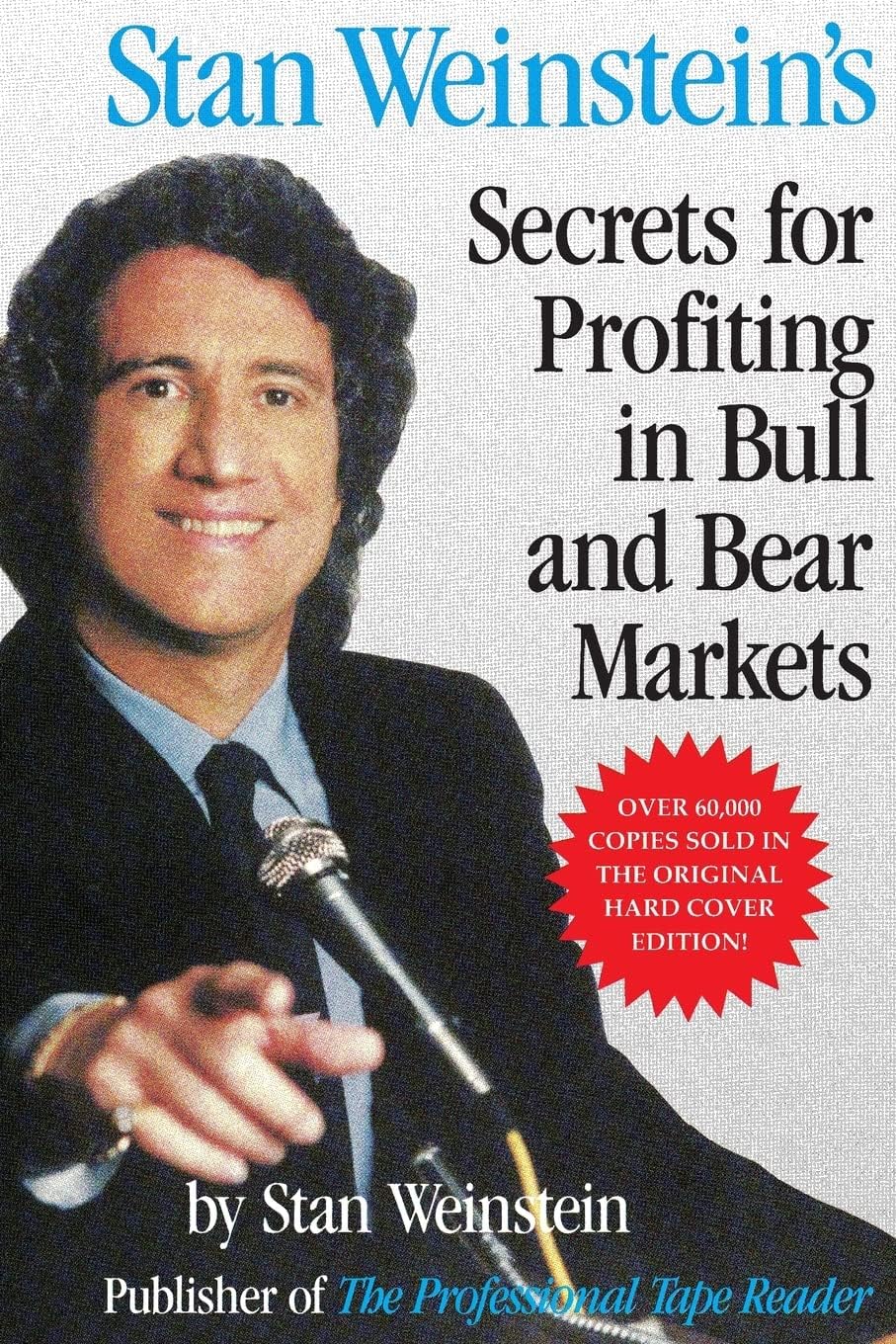

Stan Weinstein's Secrets For Profiting in Bull and Bear Markets
Product ID: 4658954
⏳timing buy & sell perfectly
📈4-stage market cycle mastery
🔍technical indicators & volume focus
Desertcart purchases this item on your behalf and handles shipping, customs, and support to Greece.
📊 Unlock the secrets to market timing and never miss the next big move!
Stan Weinstein's 'Secrets For Profiting in Bull and Bear Markets' is a definitive guide to mastering market timing through technical analysis. It breaks down the market into four distinct stages and teaches how to identify optimal buy and sell points using volume, relative strength, and trend indicators. Packed with practical rules and disciplined strategies, this book empowers investors and traders to navigate both bullish and bearish markets confidently, reducing emotional decision-making and increasing profitability.


| Best Sellers Rank | #29,972 in Books ( See Top 100 in Books ) #125 in Introduction to Investing #209 in Finance (Books) #338 in Economics (Books) |
| Customer Reviews | 4.6 out of 5 stars 1,594 Reviews |
O**H
THE Technical Analysis Reference!
Below are key excerpts from the book that I found particularly insightful: 1- "After having mad plenty of mistakes, I've learned how to decipher the very obvious clues that the market gives us and then tactically respond to a given situation. I'm going to teach you a new set of stock market rules that will make the market much less stressful and far more profitable for you. These rules won't have you pouring over balance sheets or listening to some company spokesman drone on about his firm's progress toward higher returns on shareholders' equity. These rules will require that you do two things: control your own greed and fear, and find and decipher the obvious clues that the market tosses your way." 2- "Therefore, your philosophy should be simple: 1. Never buy or sell a stock without checking the chart. 2. Never buy a stock when good news comes out, especially y if the chart shows a significant advance prior to the news release. Never buy a stock because it appears cheap after getting smashed. When it sells off further, you'll find out that cheap can become far cheaper! 3. Never buy a stock because it appears cheap after getting smashed. When it sells off further, you'll find out that cheap can become far cheaper! 4. Never buy a stock in a downtrend on the chart (I'll soon show you specifically how to define a downtrend). 5. Never hold a stock that is in a downtrend no matter how low the price/earnings ratio. Many weeks later and several points lower, you'll find out why the stock was going down. 6. Always be consistent. If you find that you're sometimes buying. sometimes selling in practically identical situations, then there is something terribly wrong with your discipline." 3- "Any stock has to be in one of four market stages, and the trick to be able to identify each one. The four stages of a major cycle. as illustrated in Chart 2-1 are: (1) The basing area, (2) the advancing stage, (3) the top area, and (4) the declining stage." 4- "There is never an investment—whether it be stocks gold, real estate, gems, or Naugahyde futures—that is a "buy it and forget it" situation. All investments go through cycles, and When you hold through the down part of the cycle (Stage 4) you suffer both financially and emotionally." 5- "After years of observing and studying market cycles, there is absolutely no doubt in my mind that sector analysis is just as important as overall market timing. In fact, in certain markets it is even more important." 6- "There definitely is! While no system will ever be a perfect forecaster of the future, we can learn some simple rules that will put the probabilities of success strongly in a our favor...THE LESS RESISTANCE THE BETTER...THE IMPORTANCE OF VOLUME..never trust a breakout that isn't accompanied by a significant increase in volume...IT'S ALL RELATIVE The next important factor to check out when narrowing down our list of potential buys is the relative strength (RS). This is a measure of how a stock is acting in relation to the overall market...If the relative strength is n good shape and improving and all other criteria are positive, then go for it. But absolutely never buy a stock, no matter how good the other factors, if the relative strength is in negative territory and it remains in poor shape." 7- "QUICK REFERENCE GUIDE ON BUYING...Check the major trend of the overall market. • Uncover the few groups that look best technically. Make a list of those stocks in the favorable groups that have bullish patterns but are now in trading ranges. Write down the price that each would need to break out. • iNarrow down the list. Discard those that have overhead resistance nearby. Narrow the list further by checking relative strength. Put in your buy-stop orders for half of your position for those few stocks that meet our buying criteria. Use buy-stop orders on a good-'til-canceled (GTC) basis. If volume is favorable on the breakout and contracts on the decline, buy your other half position on a pullback toward the initial breakout. If the volume pattern is negative (not high enough on breakout), sell the stock on the first rally. If it fails to rally and falls back below the breakout point, immediately dump it." 8- "STAN'S DON'T COMMANDMENTS...Don't buy when the overall market trend is bearish. * Don't buy a stock in a negative group. Don't buy a stock below its 30-week MA. Don't buy a stock that has a declining 30-week MA (even if the stock is above the MA). • No matter how bullish a stock is, don't buy it too late in an advance, when it is far above the ideal entry point. • Don't buy a stock that has poor volume characteristics on the breakout. If you bought it because you had a buy-stop order in, sell it quickly. Don't buy a stock showing poor relative strength. •Don't buy a stock that has heavy nearby overhead resistance. • Don't guess a bottom. What looks like a bargain can turn out to be a very expensive Stage 4 disaster. Instead, buy on breakouts above resistance." 9- "DON'TS FOR SELLING 1. Don't base your selling decision on tax considerations...2. Don't base your selling decision on how much the stock is yielding...3. Don't hold onto a stock because the price/earnings (PIE) ratio is low...4. Don't sell a stock simply because the PIE is too high...5. Don't average down in a negative situation...6. Don't refuse to sell because the overall market trend is bullish...7. Don't wait for the next rally to sell...8. Don't hold onto a stock simply because it is of high quality." 10- "This increased volatility in the stock market is a two-edged sword. On the positive side, it gives us a chance to make money even faster. The downside is that when a reversal occurs, your stock can move from Stage 2 into Stage 3 far more quickly. This is especially true if it's one of the overly loved institutional favorites. These issues can really change direction in a hurry when bad news comes out and the institutional herd starts to panic. The way to protect yourself is by using a sell-stop order." 11- "Don't waste your time trying to determine if trading or investing is the best way to make money. There is no one best way; either approach can lead to success if skillfully applied. Instead, give some thought to understanding the kind of person you are and which approach you'd be comfortable with. Use a little introspection to find out what cloth you're cut from, and then become the best damned investor or trader that you can be! It leads to disaster if you decide to invest, but then get so angry because your stock dropped six or seven points that you end up dumping it just before the next upleg. So have an honest talk with yourself. If you obviously belong in one area or the other, then get there. Interestingly, there really are a number of market players who are in the middle ind can adopt either approach. If you fall into this category, I suggest a mixed approach." 12- "SUMMARY OF SHORT-SELLING DON'TS Don't sell short because the P/E is too high. Don't sell short because the stock has run up too much. • Don't sell short a sucker stock that everyone else agrees must crash. • Don't sell short a stock that trades thinly. Don't sell short a Stage 2 stock. Don't sell short a stock in a strong group. Don't sell short without protecting yourself with a buy-stop order." 13- "When a truly one-sided opinion really grabs the Street, it becomes so heavy you can almost cut it with a knife. One other word caution: I disagree with those who believe that contrary opinion alone is enough. Not true. I view CO as a psychological potential. just as the price/dividend ratio represents a value potential. Neither one should ever make you buy or sell stocks if all the timing gauges disagree. When CO gets the agreement of the other technical tools, then get set, because a big market move is getting ready to unfold." 14- "Here are the proper ways to increase your probability of success (Options)...Buy a call option only on a stock that is in Stage 2 or is moving into Stage 2...2. Buy only an option that has big potential...3. Give yourself a reasonable amount of time before expiration...4. Buy an option that is close to the striking price and, if possible, in the money...5. Use a very tight protective stop on your option positions."
T**7
masterpiece of trading
Of course! Here’s a polished review for Stan Weinstein's book that reflects your positive experience: Review: A Masterclass in Trading from Stan Weinstein Stan Weinstein's "Secrets for Profiting in Bull and Bear Markets" is nothing short of a masterclass in trading. This book dives deep into the art of market analysis, presenting stage-specific strategies that are crucial for both buying and selling. Weinstein’s explanations on identifying the right points to enter and exit the market are delivered with exceptional clarity, making complex concepts accessible to traders at all levels. Beyond the practical trading strategies, this book stands as a paragon of educational material in the trading world, packed with actionable insights that empower the reader to discern and capitalize on market trends effectively. Whether you're a novice hoping to make your first foray into the markets or a seasoned trader aiming to refine your strategy, Weinstein’s work is indispensable. I highly recommend this book to anyone eager to master trading. It’s a standout resource that promises to educate and transform one's approach to navigating both bull and bear markets.
E**M
Old but still applies
Weinstein's writing style is excellent. This book covers so much material it answered just about any stock question I had. It's like having your own tutor. Evey time I had a question I soon found the answered to it. This guy knows how to convey his knowledge. The book reads easily and quick even though there are 340 small print pages. For the first time I'm able to pick winners on my own. No longer do I feel the need for a newsletter, radio show or the talking heads. I'm independent now and will never again be at the mercy of someone else. The book covers both trading and investing. The trading techniques apply just as well today as they did when he wrote them. These are shown to work during any time in market history and will still work in the future. I'm not just excited about what this book is doing for my trading account though but also for my company retirement account. My long term investing if you will. What to do when you only have a hand full of funds to chose from. Well now I know. This has revolutionizing my thinking with this limited account. Even if you never trade this book is well worth it for handling retirement funds effectively. I only wish I had read this book before the market collapse a little over a year ago. Lastly I've been able to apply his pencil and paper charting techniques using modern day computing power with ease. I'm re-reading the book now and find it just as captivating as the first read. Captivating? Yes, strangely enough, yes. It not only instructs it encourages. The irony of it all is this book is long forgotten and can be purchase for a few dollars.
T**.
Good, straight-forward pure TA system presented
The skinny: This is a purely TA 'top-down' trend-following breakout system presented. Explained below.. This book is fairily basic and as such will be especially useful to those new to the 'game.' While it will be tedious for experienced market participants to brush through explainations of what a moving average is, etc--I believe we can all learn something from the straight-forward TA employed by Stan Weinstein. For example, you wont see Elliot Wave defended or charts with pitchforks drawn on them--but rather a focus on moving averages (the simple logic being that MAs cut through volatility to give a better idea of the trend,) a top-down approach (i.e. Market --> Industry Group --> Security,) etc. While I hold less faith than Stan in breakout systems, it's presented here in a easy to understand manner with examples and answers to test how well you are following his instruction. This man is a good teacher, and reminds me of William O'Neil in the way he gets his ideas across. Particularily useful--at least for me--were his half-dozen or so favorite indicators he gave for guessing the future trend of stock markets. Stan also gives his view on when to take profit on an equity you own, when and how to cut losses, and position sizing: i.e., the other 3/4 of your investing success. I don't pretend to know a lot--but from what I've seen in my short experience, there is a lot of nonsense and questionable ideas used by some people under the TA banner, but Stan focuses on the simple, logical, common sense anaylsis. Being sophisticated--rather than demanding common sense--in many things in life including TA I believe causes more trouble than good; people want to believe they can figure something out and often vainly connect sophistry with (investor) wisdom.
S**S
Truly incredible. The absolute best do-it-yourself guide to trading equities there is.
As someone who does not generally write reviews for things on the internet, I felt so compelled at the sheer raw value offered to me by this book in exchange for so little money that I had to come here and write about it myself. The quintessential essence of Stan Weinstein is that it's concepts are both generalized yet hyper specific. He doesn't care what sector, what stock, what software, what formula, or what cycle, but he teaches you fundamentally the four stages that publicly traded assets go through. His hyper specificity lies in his ability to show you how to identify which stage a stock is in, and which stage it is heading to next. And he does it using formulas and calculations so simple they can be done with any modern trading software. And it is brilliant. The intelligence of this book is actually applicable outside stock-picking, although it is presented in that context. Larger economic, social, and fundamentally-human trends follow the same hilariously simple yet mind bending 4 damn parts of a pattern. I've read every page of this book and it's turned me from shooting blind in a losing portfolio to consistent gains. As with any learning process, it takes time. The steps are simple. Set your self up with the requisite software. Read every page of this book, vigorously, deeply understand it, memorize the techniques, and take the quizzes over and over until you can recite the chart-reading ruleset by heart. And you will see my friend, the truth is out there.
G**.
The Most Valuable Investing Book I have read
I just finished reading Stan Weinstein's book, Secrets for Profiting in Bull and Bear Markets. I have been investing in stocks since 1995. I have read numerous books on investing in stocks, all on the fundamental aspects. This is my first book on technical analysis. It made so much sense to me, and I found the theory so logical, and easy to apply. I have made mistakes in the past, which I would not have made, if I had read this book first. I think Stan is a really good teacher. He gives you the theory, gives you an example, then another slightly different example, then a few more, which enforces the idea, and makes it stick in your mind. Then, at the end of most chapters, he gives you a quiz, which helps you learn the parts you missed, or glazed over. The graphs are terrible quality, but he explains it all so well, that I forgave him. After all, it was 1988. He didn't have the amazing, free graphs, that are available today. But the logic is concrete and still applicable. After reading the book, I realized that two of my major holdings had peaked, and were going down, and I sold them. I feel that I have learned more from this book, that will help me with investing, than I did from all the previous books. I will re-read this book. It is that good.
D**O
A must for your Investment education
If you think a 24 year old book cannot help you in today's market, think again. Stan Weinstein's information is as relevant today as it was 20 years ago as it will be 20 years from now. His straight forward approach to the market is a must follow for anyone managing their own investments. This book is not a short term get rich quick trading book. Stan's approach is designed for the long term investor. If you follow his advise you will get in the early stages of a new bull market and will know when to get out at the earliest part of the next bear market. If you still doubt this book can help you then I would ask you to look at a long term chart of the DOW, Years 61&62 . The DOW put in a bear market top then a hard sell off. This example of a bear market top can be found in chapter 8. Now look at a chart of the Dow for 2011. The top and sell off is almost identical to that form 50 years ago. And if that is not eerie enough for you, look at the bull market rally that followed in 1962 and compared this to the currently rally that began Oct. 2011 again the movement is near identical. Price action patterns do repeat and examples of actual market tops and bottoms are through out this book. I manage my own investments and this book along with those of William O'Neil ( founder of Investor's Business Daily) form the basis for my successful Investing. Dennis S Orlando, Fl
J**Y
Best at Explaining Market Cycles
This book is really good for people who don't understand market cycles or how to indentify them. This book gives a clear and easy to follow method to really know what stages of a market's cycle is in and than gives methods to follow. It is a great book and it's on the cheap side. However, it's also an old book and the indicators arent up to date. If you were in the crypto market, really need to mess around with the moving averages. The 300 moving average explained in this book will not work. But the method this book teaches is still relevant and can be used. Also, if anyone had read this before the crypto crash in December 2017. They would have been out of the market before the crash following these methods. While I don't think this book's method will work with every stock, it definitely isn't rubbish and it's worth having this method and way if reading charts on hand. This should not be your only technical analysis book. It is a good complement to have with other trading books.
S**)
En iyi kitaplardan biri
1988 basım tarihli bir kitabın ne kadar güncel olabileceğinden emin değildim. Ancak içindeki bilgiler günümüz dünyasının realitesini açıklar nitelikte. Okuduğum en in trading kitaplarından biri. Tavsiye ederim. Not: Sadece baskının çok eski olmasından dolayı grafikleri okuması biraz zor. Ancak grafiğin genelinden zaten ana fikir anlaşılabiliyor.
G**I
tutto ok
testo un po' datato ma illuminante su alcuni principi fondamentali degli investimenti
S**O
Essencial!!
Claro, direto , fácil de entender! Escola do Mark Minernivi!! Recomendo ler e estudar vale cada orientação!! Quem quer levar a sério vale ler!
C**M
Tout est affaire de cycle et moyennes mobiles
Un classique intemporel qui explique d'une part les cycles de marchés et d'autre part l'importance des moyennes mobiles pour avoir une vision de marché moyen / long terme.
D**I
Classic on Technical Analysis
Stan Weinstein's classic teaches investors to ignore the fundamentals and buy on the right technical analysis. In brief, he advocates buying when a stock price is above the 30 week moving average (note the 30 week and not the 30 day moving average), and on high relative strength. In other words, the stock price should be rising faster than the index relevant to that stock. He also advises selling when the stock price falls below the 30 week moving average: no exceptions. The style is simple, direct and authoritative: These are my rules, do what I say. If you don't like being told what to do, don't buy the book. Criticisms: the charts are smudgy and old fashioned, but clear enough to amplify the teaching. Also some people question whether the 30 week moving average is as relevant today as it was in the 1970-2000 era. But in the absence of any firm evidence to support a different moving average, most of Weinstein's followers will be happy to stick with the 30 week guideline. A great book. Strongly recommended for all investors, including the fundamentalists.
Trustpilot
2 weeks ago
5 days ago