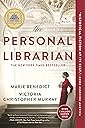

📖 Get lost in a story that’s more than just a book!
The Personal Librarian is a captivating novel selected by GMA Book Club, featuring over 300 pages of rich storytelling and unforgettable characters that resonate with the millennial experience.


| Best Sellers Rank | #1,642 in Books ( See Top 100 in Books ) #2 in Biographical Historical Fiction #4 in Biographical & Autofiction #9 in Black & African American Women's Fiction (Books) |
| Customer Reviews | 4.5 out of 5 stars 49,516 Reviews |
B**L
A Captivating & Superb Read!
The Personal Librarian is one of my most favorite books of 2025! I had no idea what was awaiting me in the pages of this book about Belle da Costa Greene and her amazing life. The Personal Librarian is a rich, multi-layered treat filled with history, love, tension, family relationships and so much more. Not only did I read it, but I listened to it as well. And the voice actress, Robin Miles, who voiced Belle was simply stunning. I highly, highly recommend The Personal Librarian. I hope you love it as much as I did! 🙂
D**T
A Good Historical Read!
I listened to the audiobook, narrated by Robin Miles (also narrated “Just as I Am” by Cicely Tyson), and enjoyed it. This was the March selection for my book club (AAABDG). An historical account of Belle da Costa Greene. Genevieve, Belles' mother, having to create a Portuguese grandmother to disguise their Black heritage was a covert operation for the entire fate of the family. Teaching was the most common and revered profession for blacks during the time period, Belle’s mother was pro advocate for her becoming a teacher while her father envisioned Belle as a historian or arts scholar. It was her father that laid the groundwork for her career as personal librarian to J.P. Morgan. Belle taught herself Latin, and became very knowledgeable in an exclusively male world of art and rare book dealer. The chapters are short which makes for faster reading. I had moments of elation, sadness, joy, awe and admiration. I asked myself why was Belle a personal librarian and not titled a curator or dealer of antiquities, paintings, manuscripts and artifacts, and did J.P. Morgan feel about Blacks the same way he felt about Jews? The story takes place in 1905-1948 and follows Belle from city to city and country to country. Belle’s father sides with the views of Booker T. Washington, regarding his strategies with business owners and politicians and Willie DuBoise, in his views on his plans for the advancement of NAACP, in which mirrored his stance. The comparison between Booker T. Washington and W. E. B. DuBois. This was also mentioned in “A Pair of Wings” by Carole Hopson, in which blacks were siding with the philosophy of one or the other to determine their path of equality. It is a true and honest fact that many blacks owe their light skin to the sexual violence inflicted on enslaved black women by their white masters, and chose to pass as white as the best option to enhance their lifestyle for better housing, better jobs and pay, and equality. It meant estrangement from their families. I was not particularly pleased with Belle's romance with Berenson (a Lithuanian born Jew) whom harbored secrets of his own, as they were involved in a long term relationship. I was conflicted in whether he was truly in love with Belle or was he using her intellect and insights to gain advantages to his own art dealings. This novel was written during a pandemic, and racial injustice with the murder of George Floyd in 2021 in which the Civil Rights Act in 1883 that ushered in Jim Crow segregation and gave white supremacy and racial discrimination legal cover, the ramifications of which are felt to this day in 2022. There are still few opportunities open to blacks or anyone classified as nonwhite. As of 2022 we are striving to vote the first African American female Judge in the highest court of the land, the Supreme Court, but with much opposition. Overall, I learned a lot about the are world, travel to other countries during this era, especially for blacks, the culture during the Guilded Age Era, many historical places and people. I will value this read as a learning experience and highly recommend this book to bibliophiles, art historians, and history buffs. I look forward to doing more research into Belle da Costa Greene's life by reading some of the recommended material: "Am Illuminated Life: Belle da Costa Greene's Journey from Prejudice to Privilege" by Heidi Ardizzone, and "The White Problem" by Belle's father, Richard Greener.
C**K
An unexpected level of historical accuracy for a novel.
The Personal Librarian is a fictional account of the life of Belle da Costa Greene, who managed the acquisition and collection of books and art for J. P. Morgan - his personal librarian, as it were, continuing with his son until her death in 1950, of cancer. During her life, she was most notable for aggressive style in the acquisition of books and art for Morgan, at a time when doing this as a woman was considered highly unusual. But there was another aspect of her life that only came out 49 years later, when a photographer noted that she had spent her entire life passing for white, while in fact, her father was the first black Harvard graduate, and a leader in the civil rights movement, which had regressed profoundly after the civil war, thanks to The Great Compromise of 1877, which led to Jim Crow. Marie Benedict, upon realizing the implications of this, enlisted a co author for the book, Victoria Christopher Murray, to try and concoct a fictional account of Belle da Costa Greene life, with some level of plausibility. I would say they succeeded admirably, even though of course we will never really know what her thoughts were at the time. I will say, much to my surprise, all the basic plot lines are tied nicely to historical facts. In fact, as historical fiction goes, Greene's thoughts notwithstanding, this book seems to have a historical accuracy that I have not experienced in many decades. What an amazing individual.
Z**T
Who Built J.P. Morgan’s Wealth?
And at what price did she build it? By choosing to heed her mother’s advice, Belle chose to risk identifying as being a white woman in public, during post the Reconstruction era. To any non-black person, Belle’s light skin, anglicized name, and her love of art history played into the elite white psyche. They blindly decided that she is one of their own. During the time capture in this novel (1905 to 1924), and after the Dyer Bill was filibustered in 1877, blacks who tried to have agency were deemed disrespectful, out of their place and only worthy of being lynched. In particular, the filibuster argument was that they needed to be able to lynch the freed blacks to protect their white women from being raped. So, when Belle’s mother insisted that they all change their name, and identify in every way to the public as having a Portuguese heritage, Belle’s fate was chosen for her. And because a daughter’s first mirror is her mother, Belle studied who she needed to be, how she needed to maintain decorum, and how to talk in a way that black women weren’t and aren’t free to talk amongst wealthy businessmen. She studied how to be coquettish, how to think on her feet, and to deflect whenever necessary. Each successful business transaction and interaction became a cause set in motion towards her simultaneously being more visible to society and more at risk for getting caught. The price of which would impact not only her livelihood, but also that of her mother and siblings. It was interesting to “watch” the struggles that she went through over her question of whether she should have followed her mother’s path, or that of her father, which was the antithesis of her mother’s focus. Her father fought for civil rights, because he believed that some day black folks would be judge by their character. Yet, her mom, based upon witnessing every day blacks being lynched to death for their desire to be integrated socially, politically and economically, in her mind, it was only possible to be successful and free if their entire family takes advantage of looking white by choosing to be white. While reading this book, at first, I wanted to side with Belle’s dad, because to me, owning your voice, being your authentic self gives you peace of mind. Identifying as someone who you are not has always meant to me as lying to myself and destroying the chance of align your personality with your soul. I also saw the pressure Belle lived with when her father left the family because he could no longer live in the dichotomy of “Choose to be white to be successful”, or “Choose to be black to own our right to matter” that existed. Of course, my mindset was based upon living in a freeing society that 1877 to 1924 did not know. Also, we have the benefit born out of the Belle’s in our history, to speak up and be heard. Yet, one hundred years later, June 2024, black women, or any person of color, much modulate their approach to success according to societal unspoken rules. Yes. Belle built the J.P. Morgan wealth by choosing to be white, at the price of her own peace of mind. As a white woman, she could name a price of art, negotiate with old cronies, and close the deal as if she just bent her arm. That wouldn’t have happened had she identified as a black woman, back then. The wealth that she amassed for the Piermont Librarian counted upon her ability to not only study art, network with the best in the business, but also study what it meant to be an influential white woman. If she was going to have to abandon her ethnicity for the sake of her immediate family, she was going have to perpetually study being who she needed to be, and who, as a white woman, she would have licensed to be. She wasn’t free to look a black servant in the eye, for fear that they would report her to the public as being one of them. The only way she saw her biological family was through carefully planned trips that were out of the view of the socially elite. Ultimately, she mastered the public persona, though she struggled with the lie she had to continually nourish and preserve. Like “The First Ladies”, this was an excellently written book that truly helped me to be part of U.S. History. One hilarious moment that reading this book in public was: after waiting a bit for my banker to be available, seeing me reading this book in my hand, she asked, “What are you reading?” My enthusiastic response was, “Oh this is a great historical novel about how a black woman 100 years ago made J.P. Morgan’s wealth.” The look on her face was priceless.
K**Z
Educational and great peek at the past
I found The Personal Librarian to be both enjoyable and educational, which in my opinion is what historical fiction should be. The book’s protagonist is a most remarkable woman, Belle da Costa Greene. Why was she remarkable? In 1905 at age twenty-six she became the personal librarian of J. P. Morgan for his new Pierpont Morgan Library. Morgan had at the time one of the world’s premier collections of rare books and illustrated manuscripts. Ms. Greene soon became much more than a librarian for Morgan, becoming his agent at auctions in the U.S. and overseas. Her drive, intelligence, determination, and Morgan’s money soon made the collection one of the best in the world. This was at the time when women were rare in the rare book world. But, Belle da Costa Greene was even rarer. She was born Bell Marion Greener to a black father and mother. Her father, Richard Theodore Greener, was the first black student and graduate of Harvard in 1870. Upon her parents’ divorce, her mother chose to pass as a white of Portuguese heritage. Her fair complected sisters could do this easily. For the somewhat darker-skinned Belle this was more of a challenge. Much of the book deals with the social and emotional costs of passing for white, including her relationship with black family members. The events of the book take place against the regression away from racial equality that occurred during this time period, a regression of which I was only vaguely aware. Other interesting aspects of the book were the portrayal of J.P. Morgan, and the intricacies and duplicities of the artworld. An ongoing theme of the book is Greene’s evident romance with art historian Bernard Berenson, who, ironically, was a Lithuanian Jew posing as a Catholic Bostonian. I gave the book four stars, instead of five, as it seemed it could have been more alive and visceral. By all accounts when you were in a room with Belle, you knew she was there. Reading about her, I didn’t get the same feeling. The third person approach used was a little too distant for me, and I think the story would have benefited by a first person narrative. I visited the library many years ago, and didn't then fully appreciate it. A return visit is now in order.
J**L
Amazing Story
I knew nothing about this story when it was chosen for one of my book club's monthly read. I could not put it down! As tired as I was each evening, I had to find out more about Belle. What an amazing woman! It made me smile, laugh, cry and gasp as I got to know her. I am looking forward to our club's discussion next week. Thank you for sharing this amazing story with us. This is a must read book.
C**T
Not that great, poor dialogue, slim character arc
While I find the true-to-life details of real-life Belle to be very interesting and unique, I found the book and its writing to be a bit monotonous and almost simple in its storytelling. The dialogue was stiff and unnatural and boring, There was little character arc for any of the characters. The first person narrative never went too deep, the book was a series of incidents that skipped the surface like a stone skipping across the water. It was as if the co-writers made a list of what should be included in the book prior to commencing, and they jammed a bunch of incidents and points into the storytelling, but I never felt that the character had anything unique about it. The information about the various illustrated manuscripts and other pieces seemed like they were pulled from a website. I admire a well-researched piece, but I missed the feeling of a truly well-written piece of art, one in which the characters voice thoughts or reactions that that communicate the human condition in a unique or well-articulated manner. However, it was a quick and easy read for my book club.
K**S
Fantastic Read!
Fantastic story. I couldn’t put it down.
Trustpilot
2 days ago
2 weeks ago