We remain fully operational. Our teams are working around the clock to ensure your deliveries continue safely.

DOWNLOAD THE APP


Customer Services
Copyright © 2025 Desertcart Holdings Limited
DOWNLOAD THE APP
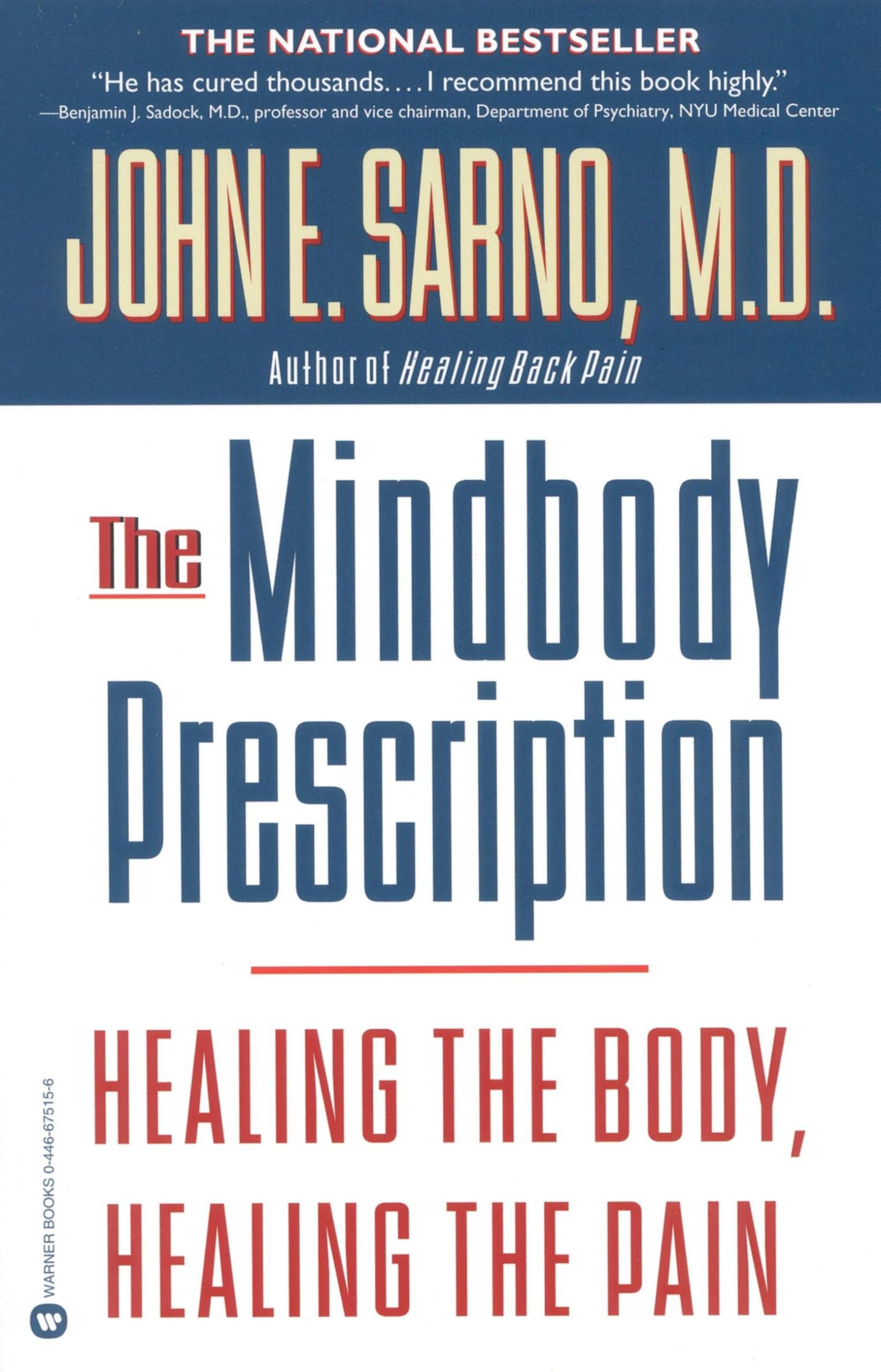
🧠 Unlock your mind’s power to heal pain — don’t miss out on this life-changing read!
The Mindbody Prescription by Dr. John E. Sarno explores the groundbreaking concept of Tension Myositis Syndrome (TMS), linking chronic pain to subconscious emotional stress. With over 3,800 positive reviews and a top ranking in Pain Management books, it offers readers a scientifically backed, practical approach to understanding and overcoming persistent pain through mind-body awareness and self-healing techniques.


| Best Sellers Rank | #11,960 in Books ( See Top 100 in Books ) #15 in Pain Management (Books) #23 in Healing #24 in Mental & Spiritual Healing |
| Customer Reviews | 4.5 4.5 out of 5 stars (3,821) |
| Dimensions | 5.25 x 0.85 x 8.05 inches |
| Edition | Reprint |
| ISBN-10 | 0446675156 |
| ISBN-13 | 978-0446675154 |
| Item Weight | 8 ounces |
| Language | English |
| Print length | 210 pages |
| Publication date | October 1, 1999 |
| Publisher | Warner Books, Inc. |
A**W
fascinating, yet so simple
I am in my early 30's and my acupuncturist was puzzled as to why I was struggling with sciatica and nerve pain in my arms. She encouraged me to begin taking omega-3 and tumeric supplements, change my diet, take stretch breaks at work, etc. She finally had me get blood work done because she was so concerned that I had some potential health issue that I was unaware of. Well, the blood work proved that I was quite healthy and balanced. So, needless to say, she was still confused as to why I was continuing to have pain day in and day out. I finally found this book by accident on Amazon and found that it really works. I read it in about two days and just started journaling when I was angry since he discusses how our pain is linked to repressed anger that our subconscious wants to release. So, I just continued to do it...in the morning before going to work, during work when no one was around for a few minutes, when I got home after work, etc. I just became very aware of my thinking when I was in pain and I started to also not give my pain as much attention as I previously did since it was "a harmless condition" for the most part. Over time, along with doing some other things, I found that my pain started to diminish. I then started to notice that the minute I got really stressed, or my boss was acting like a total jerk, etc. I would all of a sudden be in a ton of pain. I then realized that Dr. Sarno had a point - it really is connected to what is going on in our lives and what we can and cannot control. I can't say that the pain 100% gone, but I can say that it has diminished greatly (perhaps by 90%) and gives me hope that I can actually heal myself if I put my mind to it. I am pain free almost daily which is so incredibly nice. Along with reading his book, I also did the following: - gave up gluten - gave up dairy (except for 1/8 cup of yogurt in daily veggie/fruit smoothie) - started to limit refined sugar (I am not perfect on this one, but working on it!) - started and continued to take omega 3, ginger root and tumeric supplements - used (and still use almost daily!) the Rumber Roller to help loosen my IT band so it doesn't pull on my hip - took Rhus Tox and Arnica homeopathic pellets - started taking glucosamine with chondroitin daily - became conscious of my computer set up and my computer use - started getting into EFT (emotional freedom technique) from youtube videos Thanks Dr. Sarno!
M**M
A necessary read for those with pain
If you have suffered from back or neck pain, then this book is a must read. Dr. Sarno has practiced at NYU for many years and has helped numerous patients overcome these physical ailments. The book is clearly written with many examples, which helps the reader to understand the principles and identify whether these apply to him/her. Dr. Sarno works with the concept TMS, tension myositis syndrome, which is used to explain how pain (or other sensory problems) can occur in various parts of the body for no clear (conscious) reasons. He reviews the details of TMS repeatedly throughout the book, again using many examples from actual patients. Dr. Sarno explains that many people experience relief of the pain through insight and coming to understand that their mind (brain) is responsible for the pain. Essentially, unconscious anger (and other emotions) create the physical response by decreasing blood flow and oxygen to the painful areas of the body. As the mind heals, so does the body. Dr. Sarno helps to heal the mind through this book by educating the reader about TMS and this process. Furthermore, he helps the reader understand that the pain is real (not imagined) and has an actual physical cause (i.e., reduction of oxygen) which is not dangerous or permanent. By reading the book, the mind's process for causing the pain is exposed and now rendered useless in distracting the patient from the underlying causes (i.e., anger). Therefore, the pain should decrease and stop altogether once this genuine insight is gained by the reader. In summary, Dr. Sarno's book is extremely helpful for those experiencing real day-to-day pain. He provides hope for those who have suffered from pain, in some cases for years, and he helps to end the pain where others have failed.
L**V
Opening our powerful minds
The mindbody prescription The best thing about this book is Dr. Sarno's evident compassion for his patients and people in chronic pain. It is also clear how brave he has been in sticking to an approach that deals with a fluid interpretation of things, the psychological influences on the genesis of disease. Psychology depends somewhat in interpretation, and that is something that can change from one observer to the next. Doctors normally have to be good diagnosticians; they have to deal with facts and data. Psychologists have to deal with emotions, either well based on reality or not, just on the perception of it. So it is understandable how hard it can be to try to join the two areas. Nevertheless humans function within both areas, so it is irrational to think we can dispense either or the influence one has on the other. I do not believe doctors are so unaware that emotions can cause disease, as Dr. Sarno states; I just think they might not be aware of how frequent this can be, or how to deal with it. After all, patients don't come into their office with an emotional complaint, but a physical one; doctors do the best they can with the knowledge they have. When doctors sense a strong emotional state, they usually refer the patient to a psychologist- they pass it on. That can be frustrating for them, and even more to the patient, who feels his symptoms are not being taken seriously. So this is another great quality of Dr. Sarno's book: spread awareness to doctors and patients. Unfortunately, even with this awareness, there are not enough professionals specialized in mindbody diseases; you either go to a psychologist, or a doctor. Unusually, he is a doctor who uses a psychological approach: be aware of your unconscious feelings and the pain will disappear. Here comes the problem: he is not a psychologist. And the works he bases his psychological explanations are old, if not outdated. Most of the works cited are from the nineties (the most recent ones), some of the seventies, and even a lot of importance given to Freud's theories developed more than eighty years ago. Whenever I remember Freud and his penis envy theory, I feel like laughing- what a narcissistic sexist! I believe it is much more probable, if women are to envy anything on a man, is his power, not his penis. That flabby little thing that only becomes alive every now and then... be serious, guys, we know how much you love your second selves, but jealous? Naw. Your biceps could cause more envy, always big and strong. So I had to curb my impatience while reading outdated terms such as "hysterical" symptoms. Besides, "narcissistic rage" is only applicable to narcissists, according to Dr. Kohut, who coined the term, but Dr Sarno spreads it out to include anyone who has hurt self-esteem. Actually he cites it is as being universal in Western society ( why different in Eastern?). Also, perfectionism and goodism might not always be related to low self-regard; it might just be a learned behavior from children with good self regard but over-achieving parents. There is no importance given, for example, to gender differences. The hidden feeling is mainly interpreted as anger. Anger is a very testosteronic emotion. Women have testosterone too, just as anger, but I do not believe all the repressed feelings we have are linked to anger. He says loosing someone you love and depend on causes anger; well, for me it causes fear and sadness. Personally I have experienced a lot of traumatic events, and have been into psychotherapy for many years ( my uncle studied with Jung ). Being in my fifties, I have also had a chance to observe human behavior for a while. I have noticed how men are more prone to anger and women more prone to fear. If it is due to the amount of testosterone, or cultural, or both, I cannot say. Even when women get angry, after the initial release they end up falling in tears - at least I do. So our anger might be covering our sadness, frustration, feelings of powerlessness. That can come from fear too. Besides, women have been trained, culturally and emotionally, to have fear. This gender difference on the underlying feeling that might be causing the disease, which I believe is crucial, is not considered. Nevertheless, it is interesting to note that his treatment includes dealing with fear. So that might explain how it works for women too. It is very important to note that he has a high success rate that can also be linked to the screening process. He purposely selects the patients he believes will be able to be open to his kind of therapy. In this case, I think he should be more careful in generalizing hidden emotions as cause for disease in so many diseases, as he does. His good results might be making him biased. I did get a strong feeling he might be exaggerating in some cases, such as Epstein-barr and fibromyalgia. But it is clear he gets it right many times in others. My favorite phrase from the book: "Further, it is demeaning to patients to suggest that they are deriving benefits from the malady". As someone who has suffered a long time with fibromyalgia, THANK YOU DR SARNO. Being sick can only, if at all, be slightly nice at the beginning, IF you have a very good support group. Still, people's affection can just counteract the unpleasantness, but not make it disappear. People tend to go on with their lives when they see they can do little to help you or it becomes unbearable for them to see you uncomfortable for so long. There is nothing fun or advantageous in depending on others for a long time, of being in pain for a long time. Not fun at all, and very scary. Chronic pain sufferers already have a good amount of guilt to deal with, by having many times to depend on others. Dr Sarno makes it very clear that the somatization of strong emotions is not a voluntary action, but an automatic reaction of the brain. Ahh, good to know. Life keeps teaching us on and on to not judge people, and judging sick people is especially cruel. Was this book worth reading? Yes, absolutely. Would I consider it the ultimate book on the matter? No. now I am looking for others with a similar view but more recent data. But that is me; I like to dive deep. If you have chronic pain, buy it, it might help. It might be exactly what you need. If I lived in the States, I would make an appointment with him and discuss my questions in person. If you have someone who should have supported you and has instead undermined your pain, buy another and send it with a tissue, so they can wipe their faces after the truth has been rubbed on it...he he he. Gee, I am angry- now, was this the cause of the disease or consequence of how people reacted? More mysteries of the mindbody connection. Good luck.
P**V
Great book, helped to understand psychology behind neck pain during studies. Helped to understand reason behind every pain. Thanks a lot
A**E
Dr John E. Sarno war ein Genie. Mithilfe seiner Bűcher heilte mein Bandscheibenvorfall aus.
M**Y
If you suffer lower back pain read this book before all the rest!
S**I
amazing way ahead of its time
L**N
A great read, very in depth. It helped me deal with chronic pain issues that come and go.
Trustpilot
2 months ago
2 weeks ago