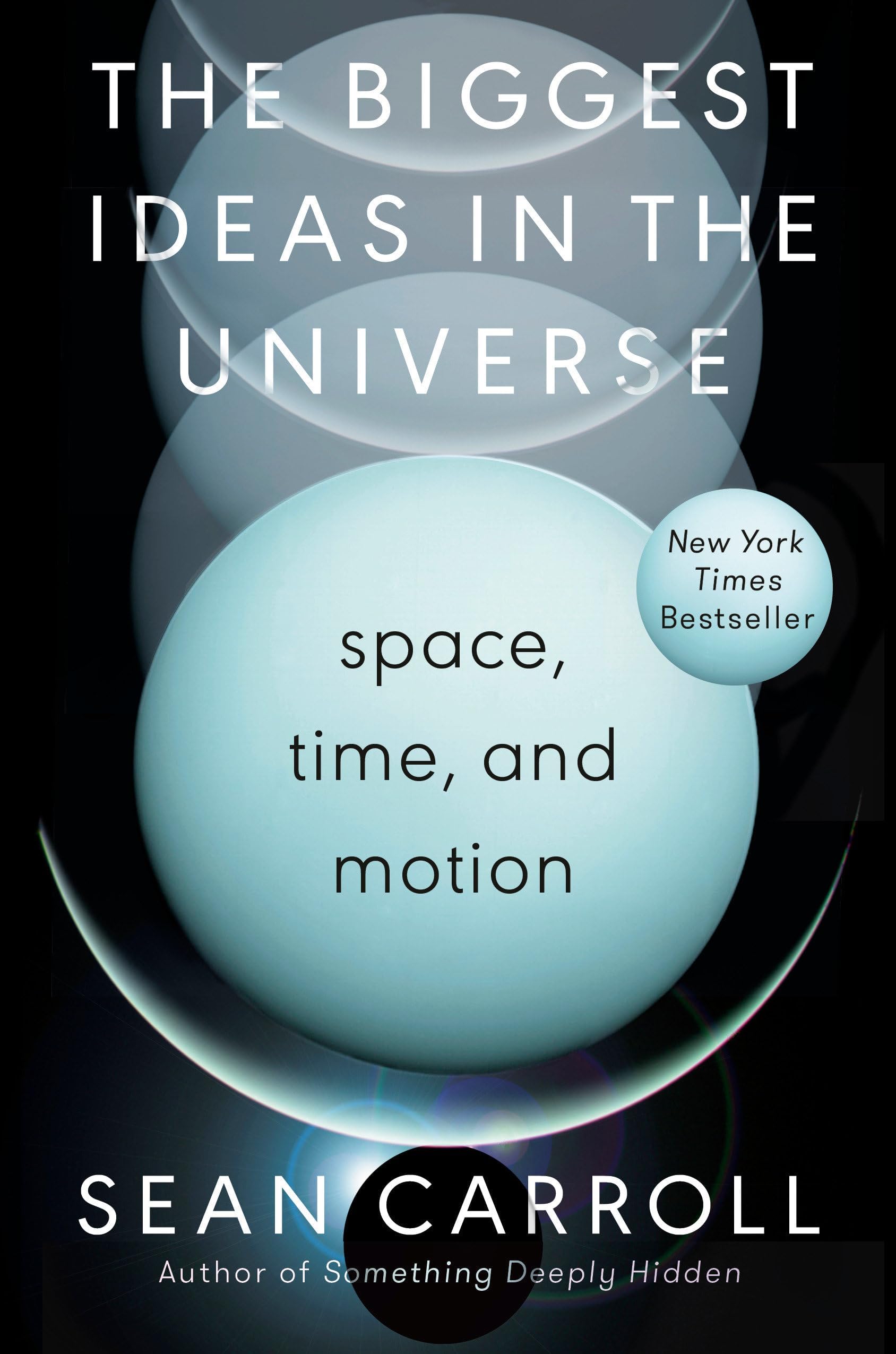
The Biggest Ideas in the Universe: Space, Time, and Motion
Product ID: 399082833
Desertcart purchases this item on your behalf and handles shipping, customs, and support to Greece.
INSTANT NEW YORK TIMES BESTSELLER “Most appealing... technical accuracy and lightness of tone ... Impeccable. ” —Wall Street Journal “ A porthole into another world. ” —Scientific American “ Brings science dissemination to a new level. ” —Science The most trusted explainer of the most mind-boggling concepts pulls back the veil of mystery that has too long cloaked the most valuable building blocks of modern science. Sean Carroll, with his genius for making complex notions entertaining, presents in his uniquely lucid voice the fundamental ideas informing the modern physics of reality. Physics offers deep insights into the workings of the universe but those insights come in the form of equations that often look like gobbledygook. Sean Carroll shows that they are really like meaningful poems that can help us fly over sierras to discover a miraculous multidimensional landscape alive with radiant giants, warped space-time, and bewilderingly powerful forces. High school calculus is itself a centuries-old marvel as worthy of our gaze as the Mona Lisa. And it may come as a surprise the extent to which all our most cutting-edge ideas about black holes are built on the math calculus enables. No one else could so smoothly guide readers toward grasping the very equation Einstein used to describe his theory of general relativity. In the tradition of the legendary Richard Feynman lectures presented sixty years ago, this book is an inspiring, dazzling introduction to a way of seeing that will resonate across cultural and generational boundaries for many years to come. Review: Makes big physics ideas approachable - This book does a wonderful job making deep physics concepts accessible without dumbing them down. The explanations are clear and the author's enthusiasm is contagious, and I appreciated that it doesn't shy away from the actual equations. It's engaging whether you're a curious beginner or brushing up. Arrived in great condition and a genuinely rewarding read. Review: A very useful book - The author has explained the subject in a very clear and comprehensive way and also shown the path to the future usage of relativity theory in cosmology and particle physics. I highly recommend this book.


| Best Sellers Rank | #29,548 in Books ( See Top 100 in Books ) #3 in Physics of Gravity (Books) #9 in Relativity Physics (Books) #12 in Cosmology (Books) |
| Customer Reviews | 4.5 out of 5 stars 1,339 Reviews |
S**N
Makes big physics ideas approachable
This book does a wonderful job making deep physics concepts accessible without dumbing them down. The explanations are clear and the author's enthusiasm is contagious, and I appreciated that it doesn't shy away from the actual equations. It's engaging whether you're a curious beginner or brushing up. Arrived in great condition and a genuinely rewarding read.
S**L
A very useful book
The author has explained the subject in a very clear and comprehensive way and also shown the path to the future usage of relativity theory in cosmology and particle physics. I highly recommend this book.
G**R
The money line: “We don’t know the final laws of physics..."
In reading the professional reviews of Carroll’s books I get the impression that he is the Carl Sagan of physics. His enthusiasm is palpable, his desire to bring physics into the mainstream is obviously sincere, and he makes a laudatory attempt to explain that physics is often, but not always, as advanced as the mass audience is often led to believe. Contrary to what the Wall Street Journal writes in its Amazon review, however, this book is not “reader-friendly,” assuming, of course, you do not have an advanced degree in physics or some variation of advanced calculus. For the rest of us, it is a very challenging read. And while that is not meant with any disrespect to the author, who is obviously brilliant and sincere, it is a warning to any potential reader looking for a comfortable winter read in front of the fire. I will, however, give Carroll great credit for not over-playing the hand of physics. He openly admits that physics, and by implication, science in general, is not the hard, granite-like “truth” that contemporary society often portrays it to be. “The science says” is often used today, with great exaggeration, in many news articles attempting to reinforce a conclusion that is far from conclusive in any final sense. Science is not like the ancient bone we dig up at an archeological dig. It is more like the conjecture we assign to that bone. Science, in fact, is not a body of knowledge at all. It is a methodology, or the outline of one, for discovering knowledge. But it is the equation, not its solution. And it is an equation that can take many different forms. There is not one equation, or very, very few, that rise to the level of “law.” Mathematics is no different. We didn’t “discover” it buried deep in the earth somewhere. We – humans – developed it. As the author notes, equations are “just a way to compactly summarize a relationship between different quantities.” And “A function is simply a map from one quantity to another quantity.” Mathematics, in other words, is simply a system or notation used to attempt to understand the world around us – emphasis on attempt. As a result, there are several models of reality, all mathematically “sound”, but often burdened by gaps and even contradictions between models. As Carroll notes, “We don’t know the final laws of physics, so we should be open to different possibilities while we think about what they might be.” And that, to me, is the money line of the book, which extends far beyond physics itself. “Science is empirical and fallibilistic – any of our scientific theories could be wrong, no matter how much evidence we have so far accumulated for them.” Which is why so many, and I do mean many, scientific theories are ultimately proven wrong and why things like clinical drug trials are often impossible to replicate. I attribute this to the infinitely broad umbrella of context. Nothing that we can observe or measure exists in total isolation. Context cannot, and in my mind never will be, reduced to notation, no matter how complex that notational language may be. Context is of infinite breadth and, perhaps more importantly, depth. Which is why I believe the title itself, with its use of the concept of “ideas”, is a bit inappropriate. Spacetime, to me, is not an idea. Beauty is an idea. Spacetime is a system for explaining one component of reality, but not, of and by itself, a piece of reality we found while hiking in the mountains. Ideas, to my way of thinking, are like shiny objects we discover in the rumpled fabric of reality. Having said all that, this is a very sound book for the right reader. If you are not already proficient in the notational language of calculus and physics, however, you will find it a difficult read. I will confess, however, there are moments of entertainment if you define entertainment as anything that brings anything positioned “beyond” us down to our very human level of understanding. Perhaps its greatest contribution, however, is that it does distill the greatest “laws” of physics posed to date into one modest-sized book. And it makes a valiant effort to tie them all together with a bow. That’s no small undertaking given that tomes have been written about most of them individually. For that the author is deserving of our thanks and our admiration and, if you’re up to it, our purchase.
A**R
Very in depth
Very in depth presentation of the history and further developments of mathematics, physics and technology.
D**.
Sean Carroll, the great explainer
I want to preface this review by saying that even though I love math, it's only basic math. I saw Sean Carroll explain from this book the Complicated mathematics of e=mc^2 from this book in a lecture from The Royal Institute. He did it so well that I actually understood it that I bought this book. It did not disappoint. This is now one of my favorite authors in explaining hard concepts in mathematics and physics.
B**R
Excellent intermediate step between popular science writing, no math, and math only texts.
I am an avid science reader and enjoy science writing aimed at the general population on topics such as Higgs Boson, theories on the existence of time, cosmology topics, particle physics, etc. But...I have always wanted to develop a deeper understanding of these sorts of topics. Unfortunately, I am unable to digest a text written solely in the language of physics, nor do I really have a need to devote a significant amount of time in learning the language of mathematics. This book offers a bridge I have been wanting to find: an explanation that includes formulas and math, as well as an explanation of the terminology, aimed at a deeper understanding of the concepts behind the math. This book is very well done by a master educator. I now await the next volume, which I have already purchased.
F**R
The book starts with concepts: math, and drawings or graphs that help your understanding.
Carrol is a well known physicist and generally an excellent communicator. The book starts with fairly straightforward concepts, math, and drawings or graphs that help your understanding. I was pleased at first that his explanations were similar to ones I developed for myself over the years. If you are comfortable with algebra, trig, matrix math and tensors this should be an excellent book. If not you will at least get an idea of how a top physicist thinks and solves problems. He does have a site with a number of short videos over various topics in the book where he explains concepts in different modes. This site is called the biggest ideas in the universe. Here are a few of the areas he covers. He suggests for general problem solving: first ignore as many complications as you can. Then get the answer to the simplified problem, next put the complications back in one at a time. Calculate the answer and compare the answer to the simplest form of the problem. Newton was lucky that he lived at a time when people of his ability could find time to use their unique minds. He also had available some excellent experimental data on the positions of the planets over periods of time. This allowed him to come up with his famous three laws of motion, and mathematical tools such as calculus using derivatives and integrals. Basically taking the derivative of a function is the same as taking the slope of that function. Getting the area under a function corresponds to integrating it. Derivatives can be thought of as a way of making sense of zero divided by zero, an integral can be thought of as a way of making sense of infinity times zero. Infinity is the number of skinny rectangles under the curve and zero is the area of each rectangle. The effect is taking a huge number of extremely small rectangles and adding the areas together. Einstein showed that the geometry of space is affected by energy and can change over time. Imagine a uniform mass that extends a gravitational field equally in all directions. Imagine this mass being encompassed by increasingly larger spheres, then the total surface area on successive spheres increases as the distance from the mass increases and is given by pi radius squared where you are measuring at the radius, r, of the imaginary sphere. Since the same amount of gravity is being spread over a larger surface area the amount of gravity decreases per unit area of the imaginary sphere. Electrical fields, magnet fields, and electromagnetic energy have the same relationship between intensity and the distance between the observer and the source as gravity. The strong nuclear force and the weak nuclear force do not follow the same law for different reasons. These laws are based on Newtonian physics. We also have interpretations fr om Lagrangian mechanics which uses the principal of least action assuming the one with the least action is accurate. The third way is the Hamiltonian mechanics where we elevate momentum to a constant with an existence of its own which is independent of velocity. The Hamiltonian method is particularly useful in quantum mechanics. Einstein is frequently interpreted as not allowing instantaneous action at a distance. Quantum mechanics however allows a new kind of action at a distance which is shown experimentally from measurements of entangled quantum particles. No one has found a way to use this phenomena to have useful information travel faster than the speed of light. We have various ways of measuring time. For instance a pendulum clock acts like a simple harmonic oscillator. The time to do a full oscillation is independent of the displacement of a pendulum when you first start it. Our measurements and sense of time appears to only travel towards the future. Naturally occurring processes always cause an increase in entropy. A low entropy State has a small number of possibilities. A high entropy State corresponds to a large number of possibilities. Since there are more possibilities in a high entropy state , one of these is more likely to be picked. Therefore the natural tendency is having increased entropy for spontaneous events. General relativity shows that gravity is caused by the fact that the universe is dynamic and curved. Special relativity is based on the speed of light being constant when it is measured in a vacuum irregardless of the relative motion of the source and the observer. In three dimensional Space is a straight path describing the shortest distance between two points. In space-time a straight path gives the longest elapsed time between two events. This is the main difference. It turns out distances and times are both measures of displacement in space-time. . The Lorentz transformation is the relationship between two different coordinate frames that move at a constant velocity relative to each other. It is √(1−v2/c2). From the arithmetic this factor is only important when the velocity(v) involved is close to the speed of light (c) otherwise, it is like multiplying by one. It also gives Einstein's most famous equation E = mc2. In many circumstances gravity and acceleration of a mass have the same affect on the mass. If you want to accurately predict the change in distance traveled you have to take into account time and motion in three directions. So it is a four dimensional universe. This is sometimes summarized as ‘space-time tells matter how to move; matter tells space-time how to curve.‘ Einstein's final equation accurately predicts results in many areas that we did not even know existed during Einsteins’ time. Physicists today are still finding applications of Einstein's theory to current research.
A**R
Yes, would buy again
excellent, also purchased audio book, very much like a course in modern physics, well worth the price
T**S
Paper quality is really poor
I’m sure the book is wonderful, but the hardcover version of the book is printed on thin toiletpaper… The paper quality is terrible
G**E
Così si spiega la fisica!
Il miglior testo 'divulgativo' che abbia mai letto, anche se definirlo divulgativo è riduttivo. Rispetto ai soliti, che lasciano sempre un po' insoddisfatti, una geniale analisi delle formule, che non richiede mai più dell'algebra di terza media, fa comprendere a fondo i concetti. Sarebbe ideale come testo per le scuole superiori o, meglio ancora, come supporto agli insegnanti.
A**S
A genial travel guide from flat space to black holes
Sean Carroll is a genial master at making real physics accessible to non-specialists. This first volume in his Biggest Ideas series is aimed at any bright and motivated reader who can handle high-school mathematics. From classical Euclidean geometry through Galilean relativity and Newtonian mechanics to the neoclassical cosmology that peaks in Einstein’s cosmological equation, Carroll presents the real math behind the curved spacetime we now know we inhabit in such an honest and perceptive way that its meaning is clear. A confession: As a lazy reader who tends to skim over any math he can’t do in his head, I had never befriended tensor calculus, differential geometry, and the like to the level where I could quite get the hang of the various four-dimensional tensors that feature in Einstein’s equation. Most of the dazzling detail in Misner, Thorne, and Wheeler’s beautifully crafted blockbuster Gravitation was a closed book to me. But now, with Carroll’s brilliant new book as a primer, its thickets of Greek superscripts and subscripts make more sense. Carroll explains all the formulas in his story lucidly and transparently, so much so that the big ideas behind them shine through. His book is not about the math, but it does show how mathematics is the natural language to use when the ideas in play are as big as space, conservation, symmetry, mechanics, and gravity, and how those all fit together. If you want to understand our modern theory of the expanding universe from its hot Big Bang origin to its fate in a cold night of black holes at more than the mythic level, read Carroll. The book offers a dramatic narrative, with such heroic characters as Copernicus, Kepler, Newton, Leibniz, Laplace, Gauss, Hamilton, Riemann, Maxwell, Einstein, Minkowski, Hilbert, Schwarzschild, Penrose, Hawking, and many more to animate it. If any of these names mean something to you, and you like simple math, and you want to understand how Einstein’s glorious update of Newton’s law of gravitation really works, this is the book for you. Then follow it with Cox and Forshaw’s recent book on black holes.
L**A
Divulgación de alto nivel
Sean Carroll es uno de los mejores divulgadores sobre cosmología y, en esta ocasión ha escrito un libro para todos aquellos que busquen un mayor entendimiento y comprensión de las bases físicas de los fenómenos descritos. Sin ser un libro académico per se, si que es necesario una base en cálculo para manejarse con el texto. Explica conceptos complicados de una manera simple y rigurosa para profundizar si el lector lo desea más adelante. Es un excelente libro de física.
G**O
Commentaire
Très bon
Trustpilot
5 days ago
1 month ago