
Desertcart purchases this item on your behalf and handles shipping, customs, and support to Greece.
๐ Unlock the timeless mystery of Christโs beginnings โ donโt miss this theological gem!
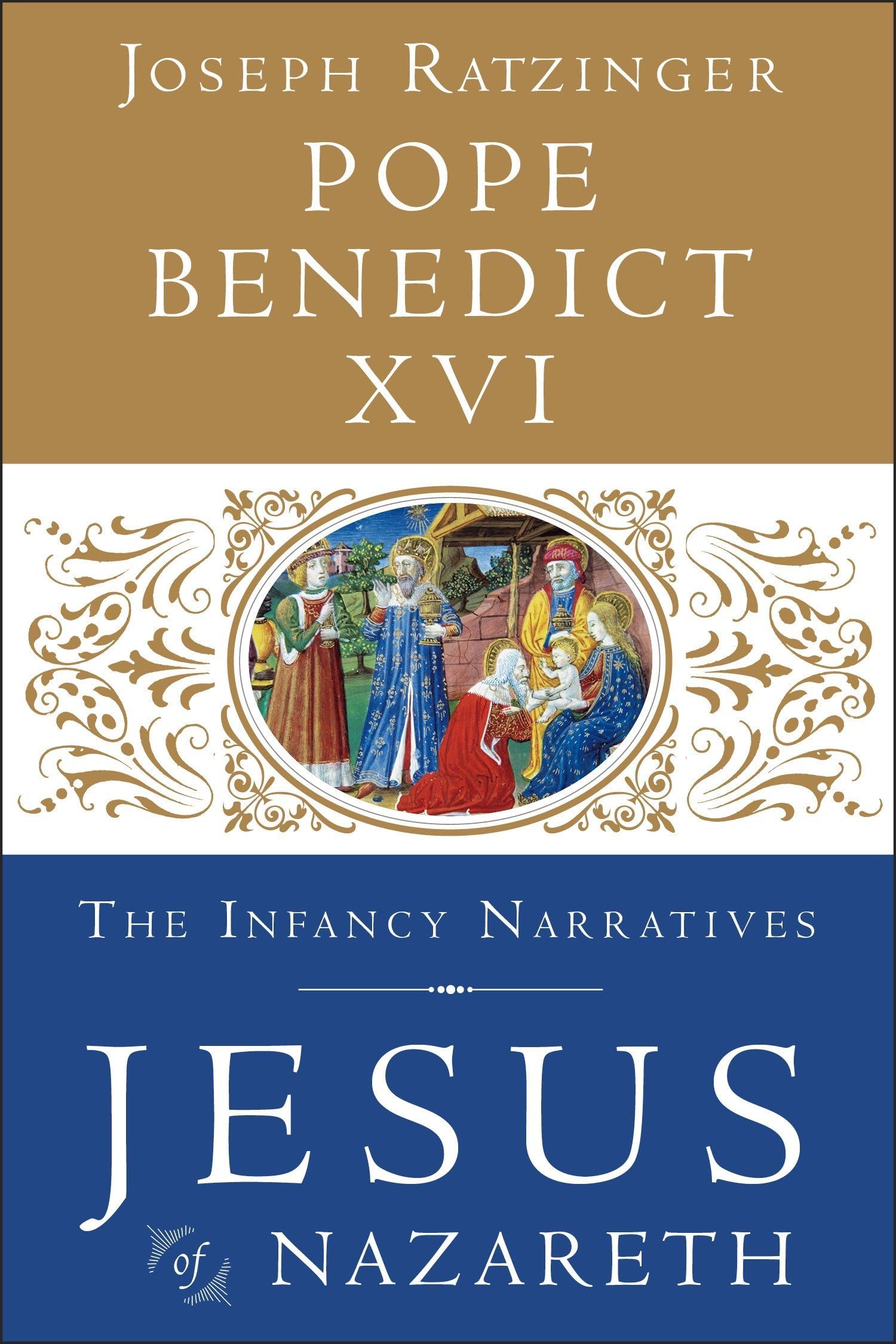
Jesus of Nazareth: The Infancy Narratives by Pope Benedict XVI is a concise, scholarly yet accessible exploration of the infancy stories of Jesus, blending patristic tradition with modern biblical interpretation. Highly rated and essential for anyone seeking a deeper, reflective understanding of Christโs early life and its theological significance.

| Book 3 Of 3 | Jesus of Nazareth |
| Dimensions | 5.2 x 0.63 x 7.76 inches |
| Isbn 10 | 0385346409 |
| Isbn 13 | 978-0385346405 |
| Item Weight | 7.6 ounces |
| Language | English |
| Print Length | 144 pages |
| Publication Date | November 21, 2012 |
| Publisher | Image |
User
Jesus of Nazareth - The Infancy Narratives by Joseph Ratzinger, Pope Benedict XVI
Recently I have had the honor of delving into this much awaited book. Before beginning I had completely read the New Testament several times, making it my Lenten study for a number of years. But I really hadn't thoroughly studied the Old Testament.Pope Benedict XVI's analysis all through the text gave me a greater understanding of how events before the birth of Christ were preparing and leading up to the moment of Jesus' birth and mission on earth for us for all time.Chapter I gets right to the heart of Jesus coming to earth with the question titled "Where Are You From? (John 19:9). Pope Benedict XVI goes into specific detail to answer this question and likewise all through the book by using biblical sources from the Old Testament and New Testament.In Chapter II - The Annunciation of the Birth of John the Baptist and the Annunciation of the Birth of Jesus, I learned the most about the genealogical background of John the Baptist and Jesus of Nazareth from reading and studying this chapter. It brought together in my mind how events of Jesus' birth were predicted in Old Testament text.Chapter III - The Birth of Jesus in Bethlehem expounds on the nativity story in Luke's Gospel in the New Testament - history, theology, and presentation of Jesus in the Temple. Pope Benedict XVI begins by pointing out that for the first time in history there is a common form of communication in the world - the Roman language, and therefore diverse peoples can talk with one another. Pope Benedict XVI points out that the word ecumene (with horizontal accents over the 2nd and 3rd letter e) is used in the text to describe this expanded government and Roman empire.Chapter IV - The Wise Men from the East and the Flight into Egypt describes the historical setting and geographical location. The chapter traces back the lineage of King David as being born in Bethlehem, which Pope Benedict XVI considers to have a theological significance. Then there are the questions of who The Magi were, the significance of The Star, about Jerusalem - Stopping Point On The Journey, and two more subtitles - The Worship Of The Wise Men Before Jesus, and Flight Into Egypt And Return To The Land Of Israel.The Epilogue called The Twelve-Year-Old Jesus in the Temple shows us that Jesus took his role of Son of God seriously, even though his mission was to open a new avenue for us to feel close to our Heavenly Father. To me it is poignant to hear the words of Jesus to his parents after they had been looking for him "I am in the very place where I belong - with the Father, in his house."I like that Pope Benedict XVI has chosen to delve into the early childhood of Jesus and help us better understand his role as both human and Divine, and how Jesus, too, at this age understood his role.I recommend this book to sincere followers of Jesus of Nazareth.Take a page for your daily meditation and reflect on its inner messages. Relish and learn. Signed: Susan Helene Kramer, BellaOnline Meditation Editor.
User
Infancy Christology of Pope Benedict XVI
Pope Benedict XVI, who as Joseph Ratzinger was one of the brilliant theological lights of the 20th century, offers an exegesis on the infancy narratives in this installment of his three-part series of books on Jesus Christ. As with the other two books in this series, we get here a high Christology rooted in an allegorical interpretation of scripture that is deeply patristic in its roots. As with all of Benedict's writings, this book is written in a style that is both academic and accessible (albeit not exactly exciting) for the popular reader who wants a deeper understanding of who Jesus was and how we understand him in the biblical text. Without dismissing the historical-critical method that has emphasized studying the historical context of these texts in many universities during the past century, Benedict offers a breathtaking contemporary synthesis of an older tradition -- rooted in the Church Father like Augustine and Jerome -- that gives us a more metaphorical and less literal interpretation of the texts. The book's goal is to create a better image of "the face of Christ," helping readers to know Jesus of Nazareth more intimately than what the deconstructionist treatises of certain historical-critical theological circles offer for reflection. This installment of the three-volume series is a very slim book, but is packed with wisdom and insight that will give the thoughtful reader much to ponder. If you're a student of Christology either amateur or professional, it's impossible to overlook this book and its contribution -- one might even say corrective -- to current scholarship on the person of Jesus Christ. I recommend it, particularly as bedside reading at Christmastime.
User
Another great book by Papa Ratzinger
I thoroughly enjoyed reading the Pope's reflections on the Infancy Narratives. Perfect, as I was preparing for the Christmas homilies. Many great insights, e.g.:on the dream of Joseph:"Once again Joseph is presented to us, in quite practical terms, as a โjustโ man: his inner watchfulness for God, which enables him to receive and understand the message, leads quite spontaneously to obedience. Even if hitherto he had puzzled over his various options, now he knows what the right course of action is. Being a just man he follows Godโs commands, as Psalm 1 says."Or on Caesar Augustus:"Luke intends to say that what Caesar Augustus claimed for himself is realized in a loftier way in the defenseless and powerless child born in a Bethlehem cave and visited by poor shepherds. Reiser rightly emphasizes that at the heart of both messages is peace, and that the Pax Christi is not necessarily opposed to the Pax Augusti. Yet the peace of Christ surpasses the peace of Augustus as heaven surpasses earth (cf. Wie wahr, p. 460). Hence the juxtaposition of these two forms of peace need not be seen in a one-sidedly polemical way. Augustus truly brought โpeace, security of law and prosperity for 250 years, which many countries of the former Roman Empire can only dream of todayโ (ibid., p. 458). Politics retains its own sphere of competence and responsibility. And yet when Caesar claims divine status and divine attributes, politics oversteps its boundaries and makes promises that it cannot deliver."The kingdom that Jesus proclaimed, the kingdom of God, is of another kind. It applies not just to the Mediterranean region and not just to a particular era. It applies to man in the depths of his being, and it opens him toward the true God. The peace of Jesus is a peace that the world cannot give (cf. Jn 14: 27). Ultimately, the question here is what redemption, liberation and salvation actually mean. One thing is clear, though: Augustus belongs to the past, Jesus Christ on the other hand is the present and the futureโ he is โthe same yesterday and today and for everโ (Heb 13: 8)."And on Christ as a sign of contradiction:"We are not talking about the past here. We all know to what extent Christ remains a sign of contradiction today, a contradiction that in the final analysis is directed at God. God himself is constantly regarded as a limitation placed on our freedom, that must be set aside if man is ever to be completely himself. God, with his truth, stands in opposition to manโs manifold lies, his self-seeking and his pride. God is love. But love can also be hated when it challenges us to transcend ourselves."
User
Short but profound and likely to become an advent classic
Though the shortest and final volume of the Jesus trilogy, once again the Holy Father has found a way to challenge unbelief and strengthen the faithful both intellectually and spiritually. This volume is an exposition and discourse on the infancy narratives of the gospels. Through Old Testament parallels and historical background these seemingly mythic stories are affirmed as historically reliable and spiritually encouraging. Once again Pope Benedict does not shy from acknowledging the questions raised by those who have challenged the historical reliability of the gospels. But with that acknowledgement he once again brings their methods into question and demonstrates the shaky foundations on which the criticisms have been built.But, it is not just critics and apologists who will find intellectual food in this volume. Those everyday mystics who pray the rosary will find new food for meditation on the joyful mysteries in particular and for Marian devotion in general. Evangelists will find fresh insight into sharing the joy Pope Benedict finds necessarily linked to grace.This work has been one we have anticipated for some time and though it is short it is no less profound and fulfilling than the preceding volumes. I will be re-reading this one often. And, I suspect it will become a favorite advent devotional for many readers.
User
insights and perspective from a great thinker
Here's what the Pope writes in the forward:"It is not a third volume, but a kind of small "antechamber" to the two earlier volumes on the figure and the message of Jesus of Nazareth. I have set out here, in dialogue with exegetes past and present, to interpret what Matthew and Luke say about Jesus' infancy at the beginning of their Gospels."So, the third volume of the Pope's wonderful work, but as he says, not really a volume; more a short monograph or extended essay. The book is only 128 pages long.The infancy narratives are more controversial than the body of the Gospels (Mark and John have no infancy stories) because they are not based on the apostolic witness, and many interpreters view them as more theological constructs with a goal of linking the Hebrew scriptures (Old Testament) to the body of the Gospel witness.Benedict offers his insights as he looks at various interpretations, and spells out his own academic opinions, which he makes clear are not dogmatic statements - simply his own reflections.The Pope covers everything, from the two annunciations (to Mary in Luke and Joseph in Matthew) to Luke's story of Jesus being lost in the Temple. I found his insights and thoughts on Mary especially interesting.He will often sum up his reflections with a preliminary statement, like this one, on page 118, after his discussion of the Three Wise Men (The Magi):"... the question arises, how are we to understand all this? Are we dealing with history that actually took place, or is it merely a theological meditation, persented under the guise of stories?"He then states, in quoting another scripture scholar (and he agrees with this sentiment):"'No foundations would be shaken if it were simply an invention of Matthew's based on a theological idea.'"What is the Pope's personal opinion on this? Well, get the book.I am going to dig out some of my old books by the American scripture scholar Raymond Brown and compare the two men's thoughts, which will agree on some points and disagree on others.
User
A surprisingly good read especially for the Christmas season
Pope Benedict XVI's book on Jesus up to his visit to the temple, is a surprisingly enjoyable and insightful read. While having the thorough approach of a well-researched work it is very readable and brings fresh insights into Jesus's early life on earth as well as the amazing faith of Mary and Joseph. Whether you are a member of the Catholic Church or not (I am not) this book is excellent reading and provides some fresh insight.Whether pointing out Mary's faith in accepting the Holy Spirit's blessing or the timing of Jesus presenting his message during the Roman Empire's greatest expansion, The Infancy Narratives pragmatically present the historical significance of Jesus as well as the spiritual and religious aspects of his life. All of this is wrapped in an enjoyable reading format.An excellent example, typical of the whole book, is the context of how the wise men would have found Jesus: "In our story both elements can be seen in the first instance, the star leads the wise men as far as Judea. It is quite natural that their search for the newborn king of the Jews should take them to Israel's royal city and to the king's palace. That, surely, is were the future king must have been born. Then they need the direction provided by Israel's sacred Scriptures-the words of the living God-in order to find the way once and for all to David's true heir."I would highly recommend this short book to anyone who would like to reflect on Jesus. The focus on Jesus and the faith of those around him is during a period of his life frequently given just brief attention. An especially relevant read for the Christmas season.
User
You'll Love Reading Benedict's Books
I started reading Pope Benedict's books a few years ago, the first one being "Light of the world".I have this and the other two volumes of his "Jesus of Nazareth" series.Not only would I have enjoyed having him as a college Theology professor, but I sure would have liked to be a personal friend of his, not because he was the Bishop of Rome, but his books show him to be a very personable and practical man.The books are written in an easy-to-read manner, yet packed with a tremendous amount of Theology. They are interesting. I think these books can be enjoyable reading for anyone, whether they have only a basic understanding or is someone with a graduate degree in Theological studies. Whether a person is Catholic or of some other faith, this is a great series on finding " the Jesus of the Gospels as the real, 'historical' Jesus in the strict sense of the word." They are a great source to build a deeper and richer relationship with God.I have and will continue to recommend this "Jesus of Nazareth" three-book series.
User
The Infancy Narratives' Grit
The pope discusses every major incident of the Infancy Narratives (though with only a couple references to Mary's visitation to Elizabeth) with such clarity and depth, while at the same time revealing the historical and theological significance of each event, that not only does the historicity of the narratives become increasingly more palpable, but the reader begins as well to get to bite the narratives' raw grit. The pope does not linger much at all in the sentimentality oftentimes associated with the events surrounding the Lord's birth, but nonetheless sows a deeper appreciation for them through masterful teaching and articulation of their significance then, now, and always. If the reader is looking for warm and fuzzy consolation of feel good stories, the pope will disappoint, as he offers nothing less than a taste of the reality of the quiet coming of God made man to Earth, subtle in His lowliness, yet shocking in the demanding awe His presence elicits.
User
Grazie
Grande comprensione delle scritture espresso in parole semplice. Dividendo cosรฌ con noi la grande gioia che รจ Jesรน. Traduzione eccellente. Mi sento nutrito.
User
A wonderful exploration of Pope Emeritus Benedict's search for the "face ...
A wonderful exploration of Pope Emeritus Benedict's search for the "face of Jesus". It will undoubtedly change your view of this retired Pontiff. He uses his own exegetical technique to bring you closer to Christ. As one of the top theologians of his era and often portrayed by the media as rigid and uncompromising, this book is surprisingly gentle and personal.
User
and very easy to read
This book is very well written, it is clear and precise in its descriptions, and very easy to read. Quite obviously written by one of our leading theologians, Pope Benedict XVl; it is clearly written with the reader in mind. This is the first book of Pope Benedict's I have read, will not be the last. His detail is so good a real pleasure to read.
User
Pope benedict XVI's writing is perfect
If you want to get to know Jesus more intimately you should of course start with the gospels etc but here the late Pope emeritus offers an exegesis of the infancy of ChristThe print itself is very good its a large print and is easy to readAnd the book itself is easy to understand it isn't to complicated but it is very rich with knowledgeI highly recommend this book ( note it's one in a trilogy )
User
The third in a wonderful series.
Benedict XVI is a great theologian. After the first two books in this series he said that he would write a shorter work on the Infancy narratives of Jesus' life in the gospels of Matthew and Luke. Like the two previous volumes this work is a real eye-opener in that it gives insights into the gospels that had never struck me before. Benedict not only carefully explains the texts and their historical contexts in order to reveal their meaning but never loses sight of the fact that he has to be a meticulous historian; he is also ready to criticise the strengths and weaknesses of his findings and theses. Neither is he reticent upon drawing upon the work of theologians of other religious traditions, chiefly German Protestants. In this he either agrees and expands their work or draws attention to possible weaknesses. Nor does he avoid criticising Catholic theologians. All quotations and references to other works are completely and fully indexed. The three books are not only enlightening but also pleasurable and easy to read; this being in no way a diminishment of their scholarship. Finally one gets the impression that this is a labour of love and not just of scholarship and although the work is authoritative there is never a feeling of reading a Pope who feels he is automatically infallible.
Trustpilot
1 week ago
1 month ago
2 months ago
1 month ago