Desert Online General Trading LLC
Dubai, United Arab Emirates
Desert Online General Trading LLC
Dubai, United Arab Emirates
Full description not available
B**N
A powerful book and series
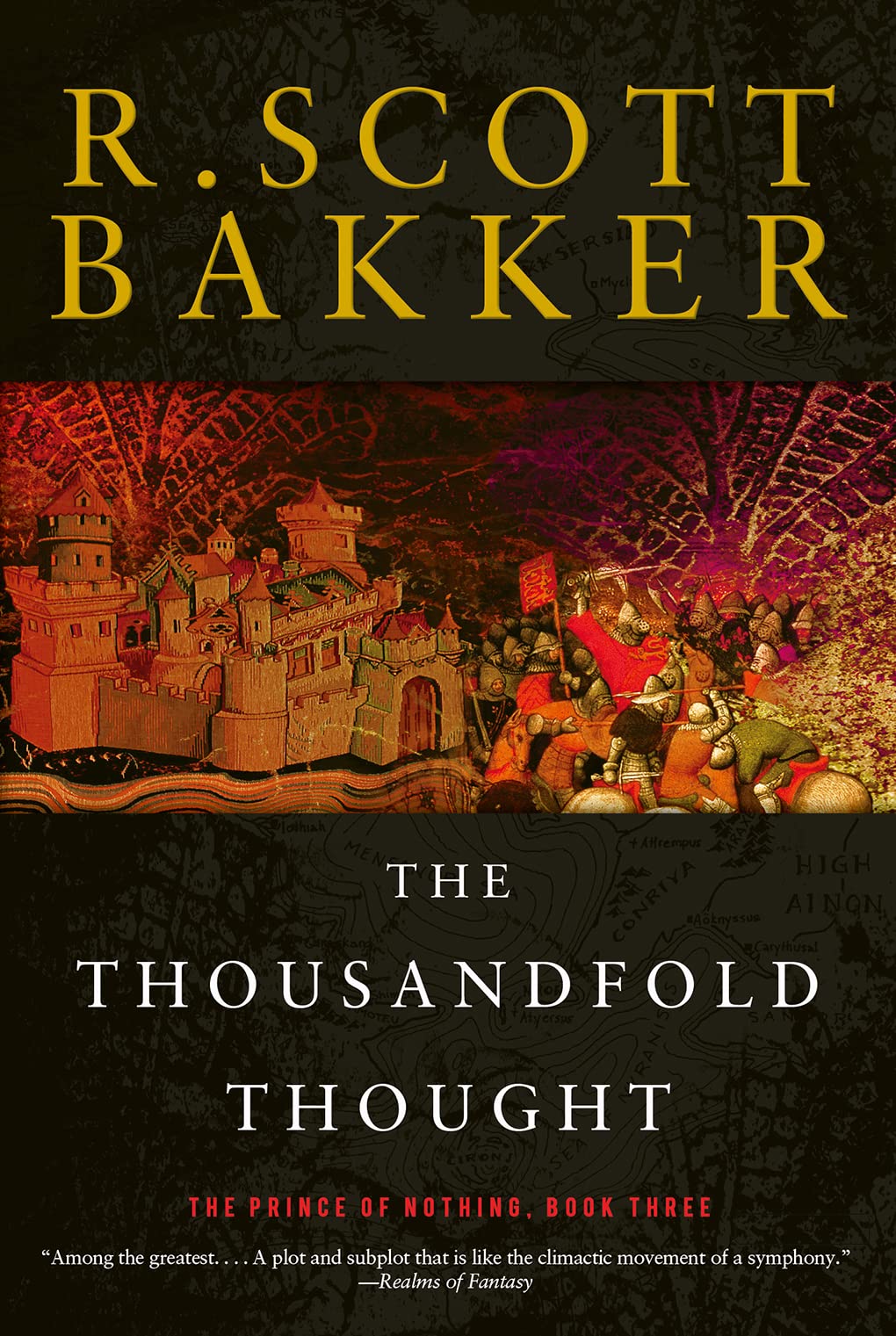
Bakker is a breath of fresh air in a genre where good authors are hard to come by. He doesn't drag things out. He is to the point and you know what is happening. He starts the third book so different from the norm, in that he doesn't spend the first 100 pages retelling everything as though you hadn't read the first two books. Best of all, he is a fantasy author who can actually finish his series in three books, rather than 10 or 12.This his third book is amazing. Bakker writes with such grace that you want to keep reading late into the night, and the storyline is not predictable, it doesn't follow a scripted set of rules. The storyline follows a very succinct path, one that is complex and yet simple to follow. Bakker seems to have thought of everything, which leads to an altogether well rounded book. The last quarter of the book, particularly, is fast paced and well structured. We get to see the full might of the Scarlet Spires and the Cishaurim, a quick glance at the Saik, and of course of Achaimian and the Gnosis. This is perhaps something that sets apart Bakker from other fantasy authors. His "magic" is more real and powerful because he doesn't cheapen it by trying to explain it too much and, for the most part, doesn't use it too often (with the exception, of course, at the end, where it is inevitable). The battle at Shimeh is detailed and told amazingly, leaving over the feeling of a real battle, reminiscent of the crusades of course (Shimeh/Jerusalem, Swords/Christians vs. Scimitars/Muslims). Combine the sorcery with the battle and you have a finale to a book that is memorable.Finally, all the storylines are wound up and completed, yet still Bakker was able to leave enough wiggle room to venture into a new series with the same world. Bakker, to me, has eclipsed Martin and Williams with this his final book of the trilogy. I would definitely recommend Bakker to everyone, no matter their genre preference. If you are looking for a great fantasy author, Bakker is your man.
S**R
A great conclusion to a great trilogy
As the stakes and scope grow higher so is the philosophy. A rewarding conclusion to the epic journey of 3 men and a woman.
B**S
A masterpiece!
They say "never judge a book by it's cover", but if I had followed that statement I would have never picked up the first book in R. Scott Bakker's amazing "Prince of Nothing" trilogy.Like the first two books in the series, "The Thousandfold Thought" continues with Kellhus' ascention to leader of the Holy War. By the end of this story not only has Kellhus become all out leader of the War, but he's also staked his claim amongst the Sorcerors of Earwa, as well as a position of even greater importance and significance.Questions are answered along the way, but new ones arise to replace the old. Sometimes the third book in a trilogy can be tricky. A writer is expected to wrap up loose threads as much as possible and if he/she doesn't, the masses will sometimes bitch. For me, it's almost hard to call these books a Trilogy. They are when it comes to detailing events such as Kellhus' rise to power and the Holy War's march to Shimeh. But in so many other ways these books are only the first 3 in an even grander scheme.BTW...although the book itself is fantastic, the extensive glossary found in the back is INCREDIBLE. Since beginning the series I've believed that Scott Bakker had created one of the most complex and interesting worlds since Middle-Earth. After reading the glossary with detailed accounts of the First Apocolyse and the early wars of the Non-Men, I know I was right to think that.
R**O
Half George RR Martin, Half Steven Erikson, and Half as Good
I just finished the series, and I must say that it leaves me unsatisfied. For those who haven't read George R.R. Martin or Steven Erikson, I would have to say that this review is not for you, as I will be referring to both series since they are the standards of fantasy literature.The series approaches the complexity of the George R.R. Martin's characters, dozens of complicated individuals, each with his or her own convictions and views of the world. Initially, one cannot tell who is right and who is wrong, as every person's view of the world has always been the right view. As I progress through the novels, the characters mature and evolve. However, unlike Martin's amazing character development, Bakker's is left half-baked. Kellhus. The all-knowing Kellhus is the asteroid that wipes out the evolution of Bakker's characters. It's so frustrating to see what could have been great multi-faceted characters like Proyas, Esmenet, Cnaur, and others obliterated into two-sided paper figures whose only conviction is to believe or not believe the greatness of Kellhus. Even more frustrating is most of the main characters: the great names, knights and thanes, serve no purpose but to die. Like clockwork, someone with a name must die in every battle. When one of George R.R. Martin's character die, it creates a shudder through the storyline - not only because it often so unexpected, but because one feels so much for the character, whether it's admiration or hate, of things left unaccomplished. Death leaves a hollow space in GRRM's world.The Prince of Nothing also bears great similarity with Erikson's Malazan series, particularly Coltaine's long march from Seven Cities. The desperation and hopelessness of that retreat is so palpable that it left the taste of gritty desert sand in my mouth. In some ways this novel is very similar, although Inrithi's armies are attacking, not retreating. The toll of the battle road is comparable in both books. However, while Erikson's story progresses smoothly, Bakker's journey suffer innumerable rest stops. Every chapter is inundated with, as another reviewer wrote, "unending explanations of the greatness of Kellhus". By the third book, I actually found myself skipping sections of "the greatness of Kellhus", something unthinkable in a GRRM or Erikson book lest you miss an important part integral to the plot. After reading "the greatness of Kellhus" dozens and dozens of times, I find that it is not necessary, there was nothing that was not already stated.Thus, I find Bakker's book somewhat combination of both GRRM and Erikson. It aspires to Martin's characterization and Erikson's plot progression, but falls short in both. However, since GRRM is taking decades between books, and Erikson's latest is not out yet, I recommend this series as a decent substitute to satisfy some of your cravings. Just be warned, it will not leave you hungering for more bread from Bakker's bakery. RG
Trustpilot
5 days ago
2 weeks ago