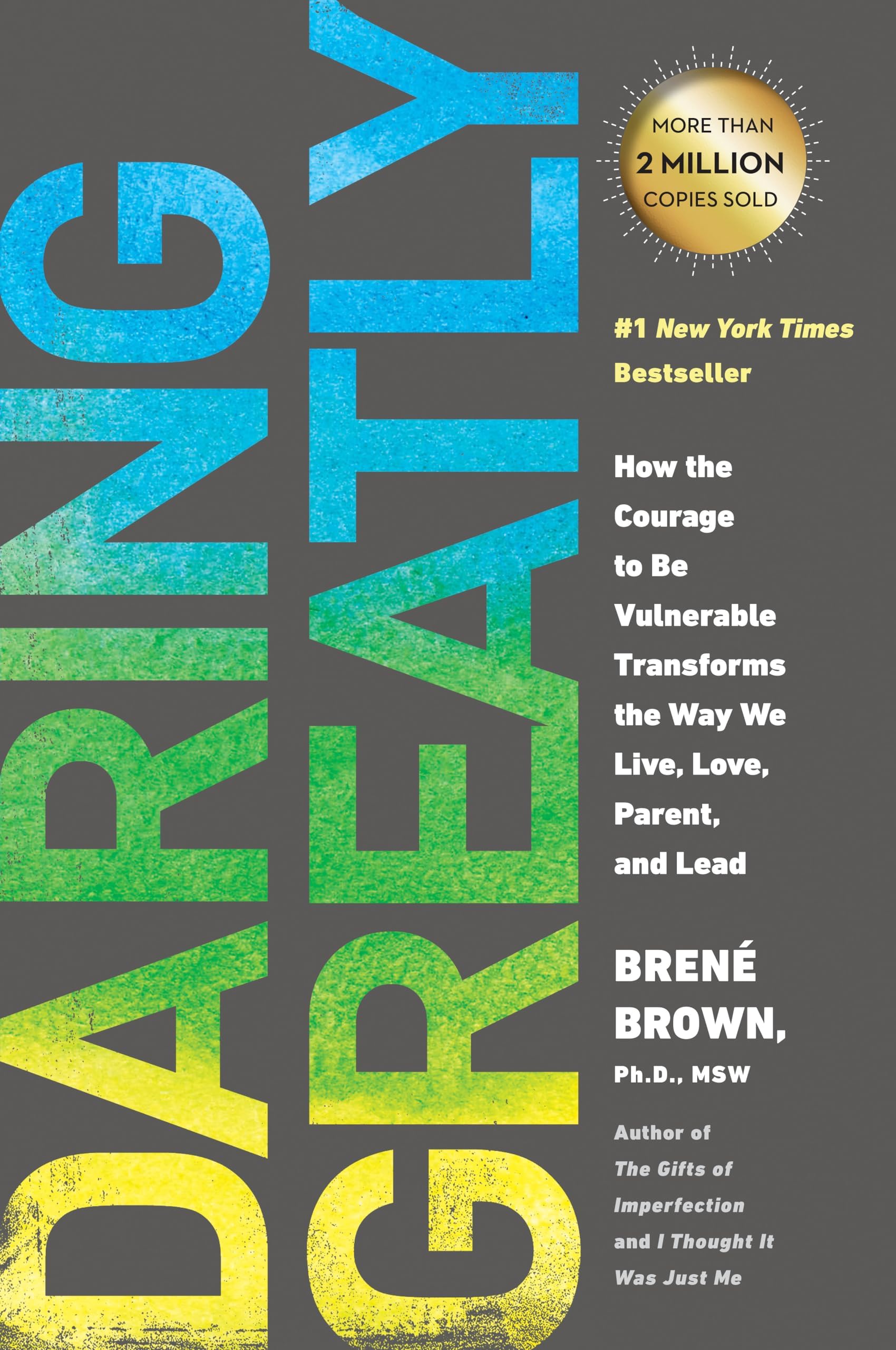
Daring Greatly: How the Courage to Be Vulnerable Transforms the Way We Live, Love, Parent, and Lead
Product ID: 298025114
⭐4.6/5 from 30,186 reviews
📚95 Popular Psychology Rank
🔥Top 300 in Business & Self-Help
Desertcart purchases this item on your behalf and handles shipping, customs, and support to Greece.
🔥 Dare to be vulnerable, lead with courage, and live boldly!
Daring Greatly by Brené Brown is a bestselling, award-winning book that redefines vulnerability as a powerful tool for personal and professional transformation. With a 4.6-star rating from over 30,000 readers, it ranks prominently in psychology, self-help, and business categories, offering actionable insights to cultivate courage, connection, and wholehearted living.


| Best Sellers Rank | 327,199 in Books ( See Top 100 in Books ) 95 in Popular Psychology 242 in Practical & Motivational Self Help 292 in Business, Finance & Law |
| Customer Reviews | 4.6 out of 5 stars 30,186 Reviews |
D**T
Must read. What an amazing book.
Must read. What an amazing book.
A**R
Good read, important knowledge, read it please
Well worth the read, brain food and insight.
N**S
Buckle up...there’s a lot to learn
Brought this as a cd for in the car....it’s very intense from start to finish,there’s a lot to take in and think about ( I may have been better with the book) I liked the cd for convenience ,I had to listen to each disc a couple of times for it to sink in.All in all good, informative...a lot to learn,so not always easy.
J**S
Daring Greatly, in intercultural perspective
This review of Brown's book takes a perspective of Christian Mission to the majority World, especially Africa. The author of this review has spent nearly 30 years, while serving in Africa, encouraging other missionaries to be vulnerable. Hence his fascination with Brown’s observations on vulnerability. In summary, Brown tells us that many problems in family, school, and organization are caused through inadequate recognition of the power of shame. Rigid machine-likeness that characterises today’s modern results-oriented society, stultifies innovation, relationship, joy, and creativity, and results in disengagement. Manoeuvring through shame, by enacting appropriate levels of vulnerability, in necessary combination with profound spirituality, results in healthy overcoming of shame, which brings about wholeheartedness. In parts of the majority world, especially Africa, taboos supporting traditional customs backed by the power of ancestors, are driven by the power of shame. (Brown makes no reference to majority world contexts. As mentioned above, this review endeavours to translate her book into some majority world contexts.) Vulnerability, which is “uncertainty, risk, and emotional exposure” is also “the core of all emotions and feelings” and “creativity, Innovation, and learning”, Brown tells us (p33, p187). Her analysis adds, to me, clarification to an already clear need for vulnerability in intercultural relationship. Intercultural missionaries often struggle to win the trust of people they are reaching. Vulnerability, says Brown, is a prerequisite for winning trust (p47). I agree. That is a profound, and very challenging, observation. Brown tells us that vulnerability is a prerequisite for love and for belonging. Those who fear vulnerability, she emphasizes, become cruel, cynical, and critical. The functioning of effective feedback loops requires vulnerability. Brown’s observations ring true. The giving and receiving of feedback can bring extreme relational volatility. While feedback-loops are essential for organisational success, what to one person may be positive feedback, may not be so received by another! Only vulnerability can guarantee feedback effectiveness. Brown is a shame researcher. Her studies of shame took her to analysis of vulnerability. Someone is shamed when their identity is linked to their failings. Missionaries who fear vulnerability fear an appearance of failure in the eyes of their supporters. They fear being enveloped by the very poverty that they supposedly come to resolve. These fears undermine vulnerability. A solution, Brown tells us, is self-compassion. This leads to wholehearted living, which is dependent on having a healthy spirituality, Brown (who is a Christian) tells us. Vulnerability, and the resultant trust by nationals, love, and belonging, can be achieved if missionaries separate their failings from their identity. Then they can be forgiven. ‘Guilt’ is ‘I have failed’. Unlike shame, guilt can be forgiven. The much more destructive shame is ‘I am a failure’, causing someone to give up and disengage (p66). Missionaries who intend to minister over a long term need to learn that God can forgive their failings – they may be guilty of some things, but they need not be ashamed. Brown talks of a gap needing to be filled. The gap is between what we say, and what we do. The gap can be overcome through honesty, which can only arise from a readiness to be vulnerable. Dis-honesty, in this sense, results in withdrawal, through disengagement. Many of Brown’s examples draw on the US educational sector. Teachers shamed when students’ results are too low, disengage from profound upbuilding-relationships with students, in favour of simply passing on information needed in examinations. So also, missionaries being set on achieving the kinds of results recognised by Westerners, especially by donors, pre-empts vulnerable engagement with majority world cultures, that could in the long run be the most innovative and profoundly transformative. Vulnerability, which includes refusal to be victim to shaming mechanisms (considered by Brown to be Gremlins; which should remind us of evil spirits), could transform mission approaches. Such a link, between Brown's writing and potential missionary fruitfulness, should not surprise us: Brown works with profoundly Christian paradigms in all but name, implicitly positioning us in a position where we should become vulnerable to God himself.
J**N
What a transformational book this is. I recommend it to every human being on the planet!
Daring Greatly is a work of genius; a labour of love of the Author, Brenee Brown, who, through searching on her own personal journey, realised that what was happening at home was all connected to the work she was doing as a paid researcher. From that moment on she made the connection between shame, vulnerability, courage and gratitude to be the keys to transformation in the lives we live. What is so compelling about this book is that with every page, I observed the mind challenge every thing that Brown wrote about the human condition and its denial of shame: "no, I am not that person... I am NOT that person. I have no thing to be ashamed about!" But then Brown cites examples from case studies, and twenty years of facts collated from her research, in order to support the contentions that come through her in this book. At this point, the mind has nowhere to go. The mind submits to the fact that this book is not, as so many are in the Self-Development field, an opinion of its author, based on his/her own life experiences, but that this book is based upon hard data, real life human experiences shared over thousands of hours of testimony of personal interviews between the author and volunteers across every socio-economic sector of the United States; of data gathering and processing of questionnaires, to finally be able to write this account of what was found. Thank you, Brenee Brown, for having dedicated - and most probably, sacrificed - so much of yourself, in bringing these profound insights of human behaviour to the conscious awareness of human kind through this book. I know that it has profoundly shifted the perspective of how I see myself, and what is important to me, and most of all, given me the courage to own with conviction, free of the shame, the purpose of what I am here to bring to humanity right now. With eternal love and gratitude, Sister.
A**C
Must read, eye opening with real valuable lessons.
Recommend for everyone who wants to live wholeheartedly. It’s been inspiring to learn, what I feel I should have always know and see how one could live a better live. And to do is to put yourself in some discomfort.. comfort doesn’t allow you to grow..
R**E
Life changing
Like other readers I strongly suggest you view her TED talks - but this book is an amplification and detailed explanation of the talk - it really enhances what she's saying. First, for those unfamiliar with Brene's work, she is a 'proper' academic, researcher, but working in the less common academic field of studying vulnerablilty and shame. Now before you decide this book isn't for you - just think about some of these things she's discovered. As we get older, wiser and more bruised by life's events - a lot of us try to shut down our feelings of vulnerability so we don't get hurt any more. We also try to comply to society's stereotypes of our gender (these are completely different for men and women - as a woman I thought the social prssure to be thin, pretty and have a perfect home was bad - just read her research on men's straitjacket). The problem is with this, is that we numb all our feelings. So if you don't feel bad, you don't feel good either. She identifies that so many of us believe we can avoid unhappiness by forboding - who hasn't had a moment of 'everything is going well - disaster must be about to strike', rather than accepting that if bad things happen, the missing out on enjoying the preceeding good years won't help? I'm explaining this badly - she does it really well, with honesty, vulnerability and humour. I urge you to try this book - I don't think you will regret it. It will change your perspective on life, your approach to parenting and contributes to a more joyful, less scared and angry middle-years period.
S**U
I really wanted to like this book
I really wanted to like this book. I watched Brene's famous TED talks. I think her ideas are brilliant and important, and I wanted to know more. But I found this book to be badly structured and not particularly well written. There are many repetitions, and same points being reiterated over and over again. There is a much greater emphasis on explaining why this problem is so bad, than on suggesting solutions and ways forward. Brene is a very effective and polished speaker - she obviously had some training on how to do that well. I wish she had bothered to do the same with her writing - or perhaps that that her editors were more ruthless. I love her ideas but am disappointed with the way this book delivers them.
C**A
Great book for introverts
What more can I say than thank you for reminding me who I am and how I should be. You always hear corny tags like love your imperfections but it dies make sense- be genuine above all else and embrace your vulnerabilities and life will never turn against you. I loved the book, perfect seaside read :)
H**R
Some people flip houses. This book will flip your life.
Last week I was sitting outside a coffee shop reading a book on my kindle when a youngish guy walked by carrying a coffee and a computer, looking for a place to sit. Since all of the tables were occupied and he was looking a bit displaced, I offered him a seat at my table. Relieved, he sat down and expressed his gratitude. I promptly went back to my reading but I could feel his eyes boring into me as I anticipated the dreaded question. "What are you reading?" he finally blurted. Now I know this is neither a profound nor earth-shattering inquiry but there were two problems at hand here. One, I'm terrible at summarizing books. Just awful. (Which you're about to discover.) There's just something about the vast amount of information that I'm pressured to wrap into one or two sentences that completely overwhelms and paralyzes me. And two, I was reading a book about shame and vulnerability. Which ironically, I was ashamed to admit for fear of being vulnerable. Clearly, I had just started reading the book. Part of me was tempted to lie to youngish guy by replying, "oh, it's just some silly novel." But then it occurred to me how shameful it would be to lie about reading a book about shame and vulnerability instead of just being vulnerable. Besides, as I'm sure it's obvious--I could use the practice. "I'm reading Daring Greatly by Brené Brown. It's about shame and vulnerability and how shame can truly only dissipate by allowing yourself to be vulnerable", I quickly blurted. Allowing myself to be vulnerable led Patrick and I into a conversation for the next hour. Patrick, if you're reading this, c'était une joie pour vous rencontrer. (If this is wrong I blame Google translate.) This moment of unabashed vulnerability with Patrick was the beginning of a major shift in my life. And I have Daring Greatly to thank for that.* I've always been one to be honest and open but Brene Brown's writing in Daring Greatly takes openness to another level. She reinforces what I've known all along but been afraid of admitting--that vulnerability leads to happiness. Or as Brown calls it, "wholeheartedness". And I, and maybe you too, could damn well use some wholeheartedness in my life. We're living in a culture of `never enough'. I'm certainly feeling it. Are you? I never work hard enough, I don't help others enough, I'm not successful enough, I don't eat healthy enough... and on and on. These thoughts of `never enough' turn into feelings of shame and fear. How do we combat shame and fear? By being vulnerable and expressing gratitude, according to Brené Brown. And now, according to me. Following Brene's advice and expertise garnered through her research and life stories, truly does work. It was the reading of Daring Greatly that prompted me to finally divulge my long kept secret of my history with an eating disorder; which wound up being my highest trafficked blog post of all time. As Brown explains, we're drawn to other's vulnerability but repelled by our own. Are you living with shame? Do you always feel an underlying itch of `never enough'? Do you find yourself disconnecting from people you love? If any of these questions ring true then I hope you'll read this book for yourself. Even if they don't ring true, read this book. It truly is a game changer. Buy It Right. This. Minute. Sit your butt down for an hour, and start reading. I promise you won't want to stop. I promise.Then come back to me and practice your newfound vulnerability. I'll appreciate and love every drop of the real you. And eventually, you will too. That's the truth. [...] *If you'll note the vulnerability here in that I'm attempting to review a book, despite my fear of reviewing books.
A**Y
Good reading
Enjoyed reading
E**G
A gem for all self-growth people
Another gem.
N**I
Amazing book. A must must must read.
I'm so glad I Received the book in good condition which actually was a concern for me. DARING GREATLY by @brenebrown As mentioned on the book cover " DARING GREATLY How the Courage to be Vulnerable Transforms the Way We Live, Love, Parent and Lead. The word Vulnerable increased my curiosity to read this book. Being someone who has been criticized for being vulnerable and sensitive since forever thought of reading this book to just feel understood by someone atleast. But this book is a treasure of knowledge and helps you understand much more than I thought. The author has put 12 years of research in this book. No amount of words can express how good this book is and surely a must read for each and everyone hence I would rather best let you all know the content of the book. What it means to dare greatly? Chapter 1- Scarcity : Looking inside our culture of "Never Enough" Chapter 2 - Debunking the Vulnerability myths Chapter 3 - Understanding and combating Shame ( personally found this so helpful ) Chapter 4 - The Vulnerability Armory Chapter 5 - Mind the Gap : Cultivating Change and Closing the Disengagement Divide Chapter 6 - Disruptive Engagement : Daring to Rehumanize Education and Work Chapter 7 - Wholehearted Parenting : Daring to be the Adults We Want Our Children to Be ( this is a must chapter for most of the parents/would be parents it can change the entire way of parenting and built such amazing relation between the parents and the child ) I would just keep ranting that this book is a must read for each and everyone of all age grp and from all walks of life. Whatever role you play ( I'm sure you're playing multiple roles all the time) be it student, parent, professional (could be any), boss, leader you name it, this book will really help you do better and even personally it will help you understand some of your traits come from where (childhood or adolescence) and how to process them and do better for yourself.
Trustpilot
5 days ago
1 month ago