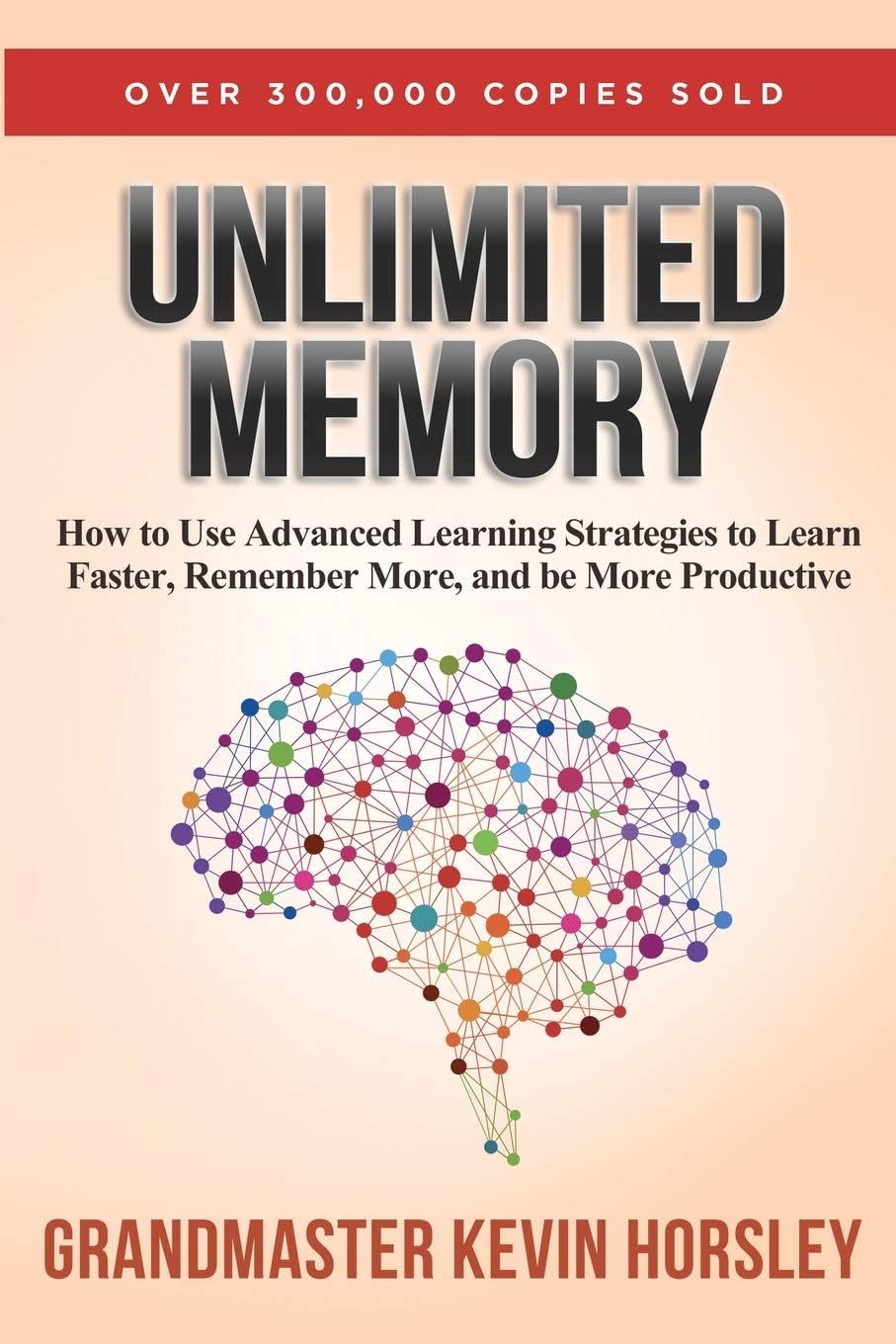
Unlimited Memory: How to Use Advanced Learning Strategies to Learn Faster, Remember More and be More Productive
Product ID: 27009939
Desertcart purchases this item on your behalf and handles shipping, customs, and support to Greece.
Kevin Horsley Broke a World Memory Record in 2013... And You're About to Learn How to Use His Memory Strategies to Learn Faster, Be More Productive and Achieve More Success With over 300,000 copies sold, Unlimited Memory is a Wall Street Journal Best Seller and has been the #1 memory book on desertcart for more than two years. It has been translated into more than a dozen languages including French, Chinese, Russian, Korean, Ukrainian, and Lithuanian. Most people never tap into 10% of their potential for memory. In this book, you will learn: How the World's Top Memory Experts Concentrate and Remember Any Information at Will, and How You Can Too Do you ever feel like you're too busy, too stressed or just too distracted to concentrate and get work done? In Unlimited Memory , you'll learn how the world's best memory masters get themselves to concentrate at will, anytime they want. When you can easily focus and concentrate on the task at hand, and store and recall useful information, you can easily double your productivity and eliminate wasted time, stress and mistakes at work. In this book, you'll find all the tools, strategies and techniques you need to improve your memory. Here’s just a taste of the memory methods in this book: The 3 bad habits that keep you from easily remembering important information How a simple pattern of thinking can stop you from imprinting and remembering key facts, figures and ideas, and how to break this old pattern so you’ll never again be known as someone with a “bad memory” How to master your attention so you can focus and concentrate longer, even during challenging or stressful situations How to use your car to remember anything you want (like long lists or information you need to remember for your studies or personal life) without writing anything down Simple methods that allow you to nail down tough information or complex concepts quickly and easily How to combine your long-term memory (things you already know and will never forget) and short-term memory (information you want to remember right now) to create instant recall for tests, presentations and important projects The simple, invisible mental technique for remembering names without social awkwardness or anxiety How using your imagination to bring boring information to life can help you dramatically improve your attention span and recall An incredible strategy for remembering numbers (the same system Kevin used to remember Pi to 10,000 digits and beat the world memory record by 14 minutes) How to use a mental map to lock in and connect hundreds or even thousands of ideas in your long-term memory (this method will allow you to become a leading expert in your field faster than you ever dreamed possible) If you're ready to harness the incredible power of your mind to remember more in less time, this book is for you. Scroll up and click "Buy Now" to get Unlimited Memory. Review: It's like a chance to be a super hero - "Unlimited Memory" by Kevin Horsley is an extraordinary book that offers a comprehensive exploration of memory techniques. Having read multiple books on this subject, I can confidently say that this is the most extensive, easily comprehensible, and effective resource I have come across. From cover to cover, I was captivated by the wealth of knowledge presented in this book. I found myself highlighting numerous sections and frequently revisiting them for reinforcement. The author's ability to convey complex concepts in a straightforward manner is commendable, making the learning process enjoyable and highly effective. It is astonishing to discover that the memory-enhancing techniques discussed in the book have not been widely implemented in modern-day early childhood education. The results obtained by applying these methods, both for myself and many others, are remarkable. While it does require some time to internalize and integrate these techniques into one's thinking and memory processes, this is to be expected when undergoing a complete transformation. After approximately six months of consistent practice, I have successfully incorporated the Car, Body, Peg, and Journey methods into my daily routine. Although the book introduces a few more techniques, these are the ones I consistently employ. As I progressed through the book, I found it increasingly perplexing that such a powerful and easily applicable system had not yet become mainstream. However, I cannot stress enough the incredible impact it has had on my life. Implementing these techniques truly feels like unlocking a superpower. One key aspect that has significantly aided my progress is the emphasis on regular review. As the book explains, even when memories have been linked to long-term memory, revisiting and reliving those memories is crucial for accurate recall. In conclusion, "Unlimited Memory" by Kevin Horsley is a game-changer for anyone seeking to tap into their memory potential. With its comprehensive approach, user-friendly style, and transformative techniques, this book stands as an invaluable resource. I highly recommend it to anyone looking to enhance their memory capacity and enjoy the benefits of improved recall. Prepare to unlock your memory prowess and embark on a journey of limitless possibilities! Review: Believe the hype on this one. - When I first saw this book, I was very skeptical. There is a very bold insinuation made in the title. But because it was on sale on Kindle for $1.49 the day I bought it, I decided it was worth the purchase. A few days later, after finishing the book, I am ready to call this one of the best and certainly most useful non-fiction books I have ever read, and I am a very avid reader. If you allow this book to change the way you learn, then this book is easily worth 20x the cover price for the keys and tools Horsley provides you with because you'll finally be able to overcome that old adage that claims that we only use about 10% of our brains. Like most of us, I've always just accepted the limitations that seem inherent with owning a brain, and I've become satisfied that I'll never be able to use more than "10%" as if it is not even realistic to tap into significantly more than that. However, this book invites you to throw away those limitations and strive for more. And Horsley's methods are not difficult to put into practice. They only require commitment, practice, and review. He compares it to taking your mind to the gym for a regular workout. Some of the strategies that he teaches near the beginning of the book may sound familiar to you, but read on. All the way through to the end. Have fun with the book. Practice what he is teaching you at each and every step along the way. You'll find some of the methods more useful to you than others, but you will find all of them legitimately helpful. Use any information that you want to learn as your training material, and you will see for yourself that these methods work. I'm not even going to give you any examples in this review because you really need to experience it for yourself. I will say this... usually, after I read a book, I never read it again. Not so with this one. This book is worth my reading every week because I want to practice, learn, and remember all of these methods. Horsley says, "Your mind is the only computer in the world with this characteristic: the more you put into it, the more it holds." His methods illustrate this truth very clearly. I only wish I could have discovered this book when I was in high school or college. The great thing about learning though is that you always have opportunities to learn more, and all of us could use these methods to be more successful in any area of our lives, personal or professional. This book is going to open up an unlimited world to you, if you are willing to make some changes in the way you think.
| Best Sellers Rank | #47,002 in Books ( See Top 100 in Books ) #11 in Study Skills (Books) #19 in Memory Improvement Self-Help #884 in Success Self-Help |
| Customer Reviews | 4.5 out of 5 stars 12,673 Reviews |
C**C
It's like a chance to be a super hero
"Unlimited Memory" by Kevin Horsley is an extraordinary book that offers a comprehensive exploration of memory techniques. Having read multiple books on this subject, I can confidently say that this is the most extensive, easily comprehensible, and effective resource I have come across. From cover to cover, I was captivated by the wealth of knowledge presented in this book. I found myself highlighting numerous sections and frequently revisiting them for reinforcement. The author's ability to convey complex concepts in a straightforward manner is commendable, making the learning process enjoyable and highly effective. It is astonishing to discover that the memory-enhancing techniques discussed in the book have not been widely implemented in modern-day early childhood education. The results obtained by applying these methods, both for myself and many others, are remarkable. While it does require some time to internalize and integrate these techniques into one's thinking and memory processes, this is to be expected when undergoing a complete transformation. After approximately six months of consistent practice, I have successfully incorporated the Car, Body, Peg, and Journey methods into my daily routine. Although the book introduces a few more techniques, these are the ones I consistently employ. As I progressed through the book, I found it increasingly perplexing that such a powerful and easily applicable system had not yet become mainstream. However, I cannot stress enough the incredible impact it has had on my life. Implementing these techniques truly feels like unlocking a superpower. One key aspect that has significantly aided my progress is the emphasis on regular review. As the book explains, even when memories have been linked to long-term memory, revisiting and reliving those memories is crucial for accurate recall. In conclusion, "Unlimited Memory" by Kevin Horsley is a game-changer for anyone seeking to tap into their memory potential. With its comprehensive approach, user-friendly style, and transformative techniques, this book stands as an invaluable resource. I highly recommend it to anyone looking to enhance their memory capacity and enjoy the benefits of improved recall. Prepare to unlock your memory prowess and embark on a journey of limitless possibilities!
W**S
Believe the hype on this one.
When I first saw this book, I was very skeptical. There is a very bold insinuation made in the title. But because it was on sale on Kindle for $1.49 the day I bought it, I decided it was worth the purchase. A few days later, after finishing the book, I am ready to call this one of the best and certainly most useful non-fiction books I have ever read, and I am a very avid reader. If you allow this book to change the way you learn, then this book is easily worth 20x the cover price for the keys and tools Horsley provides you with because you'll finally be able to overcome that old adage that claims that we only use about 10% of our brains. Like most of us, I've always just accepted the limitations that seem inherent with owning a brain, and I've become satisfied that I'll never be able to use more than "10%" as if it is not even realistic to tap into significantly more than that. However, this book invites you to throw away those limitations and strive for more. And Horsley's methods are not difficult to put into practice. They only require commitment, practice, and review. He compares it to taking your mind to the gym for a regular workout. Some of the strategies that he teaches near the beginning of the book may sound familiar to you, but read on. All the way through to the end. Have fun with the book. Practice what he is teaching you at each and every step along the way. You'll find some of the methods more useful to you than others, but you will find all of them legitimately helpful. Use any information that you want to learn as your training material, and you will see for yourself that these methods work. I'm not even going to give you any examples in this review because you really need to experience it for yourself. I will say this... usually, after I read a book, I never read it again. Not so with this one. This book is worth my reading every week because I want to practice, learn, and remember all of these methods. Horsley says, "Your mind is the only computer in the world with this characteristic: the more you put into it, the more it holds." His methods illustrate this truth very clearly. I only wish I could have discovered this book when I was in high school or college. The great thing about learning though is that you always have opportunities to learn more, and all of us could use these methods to be more successful in any area of our lives, personal or professional. This book is going to open up an unlimited world to you, if you are willing to make some changes in the way you think.
A**T
Far better than anticipated: actually helpful
The book being bold, and written for a popular audience, I did not expect much. But some reviews gave me cause enough to buy it. I can confirm, this is a book worth reading. It is practical, instructive, and not a bunch of "feel good" self-help nonsense. Part 1: Concentration Concentration is important. You must intentionally maintain interest. You also must be sure to not prevent yourself from achievement by disbelieving its possibility. This is about the most "self-help" it gets, which is pretty much telling you to believe reality, not assumptions. And thinking you can't memorize things is an assumption, not a reality. I'll offer my own proof: you remember the plots to your favorite TV shows and movies excellently. Part 2: Create and Connect (AKA: methods) This part goes through a series of methods. - Creativity: memorization requires creativity. Hyperbole and exaggeration are good. Weird is good. - Car Method: This starts some similar methods. You already have certain things in long-term memory, so pairing short-term memory with long-term makes them medium-term (which can later become long-term). The car method uses your car (and its various pieces) as storage containers for individual items to remember. - Body Method: same thing. But body parts instead of areas in your car. - Pegging: finding a way to pair with numbers for sequential / indexed information. He advises rhyming with the number to get a concept that is then creatively paired with memory items. - Journey: same as car / body, but bigger. - Linking: making connections between items makes memory stronger. Doing it in reverse also makes it stronger still. - Names: a couple of practical methods for remembering names. - Numbers: there's a system that pairs consonant sounds with digits 0-9. This lets you make numbers into words. - Art: Why picture only in your mind, when you can draw to strengthen the memory more? - Applications: he gives several helpful ones. Including memorizing a deck of cards. Part 3: Continuing This part highlights the habits needed to strengthen and improve (as well as retain) memorized information. Most helpful bit: the delayed review schedule. Review after learning at 10 minutes, 1 hour, 1 day, 3 days, 7 days, 14, 21, 28, 2 months, 3 months. Review forwards AND in reverse. This turns medium-term into long-term. Once you get to the 3-months interval, you can keep it forever. For storage methods: use unique ones for info you want to keep forever, but you can reuse storage compartments after 72-hours of using them for info. Overall: like I said, much more practical and actually helpful than I was expecting. It's light on "exercises" that you can repeatedly do, and very light on how to practically improve concentration. But each chapter gives info to learn, in order to actually practice and develop that method. Highly recommended.
N**Y
Unleash Your Potential with "Unlimited Memory"
Unlimited Memory: How to Use Advanced Learning Strategies to Learn Faster" by Kevin Horsley is a transformative book that has fundamentally changed the way I approach learning, memorization, and cognitive improvement. It's not just a book; it's a treasure trove of invaluable techniques and insights that can empower anyone to unlock their mind's full potential. The book goes beyond memory techniques and delves into effective learning strategies. It teaches you how to study efficiently, optimize your focus, and retain information for the long term. These strategies are not only useful for students but also for professionals looking to stay competitive in their fields. The book is grounded in scientific research, which adds credibility to the techniques presented. Horsley explains the science behind memory and learning, making it clear why these methods work. This scientific foundation reassured me that the strategies were not just gimmicks but backed by evidence. Since reading this book and implementing its techniques, I've noticed a significant improvement in my memory, productivity, and confidence in my ability to learn and retain information. It's a game-changer for anyone who is committed to personal growth and self-improvement. "Unlimited Memory" by Kevin Horsley is a must-read for anyone looking to enhance their memory, accelerate their learning, and unleash their cognitive potential. It's a comprehensive guide that empowers you with actionable strategies to optimize your mind. This book deserves a solid 5-star rating for its effectiveness, practicality, and life-changing impact. Don't miss out on the opportunity to unlock your unlimited memory!
P**E
Loved this book!
Enjoyable and easy to understand! Truly an fun and interesting experience!
E**N
Not New or Original, Still Good
I’ve read a lot of memory books, old ones, new ones, by famous authors and experts like Harry Lorayne, Dominic O’Brien, William Walker Atkinson, Josh Foer, and many by not so famous ones, and now this one. This book didn’t strike me as anything original or special, which is surprising given the overwhelming positive reviews. It does nothing more than take traditional memory techniques and more or less rehash them here. The presentation of the material isn’t even unique. It resembles most other books, using similar arguments, descriptions, and even cliché quotes like “if you keep doing what you’ve always done, you are going to get what you have always gotten.” The book that kept coming to mind as I was reading this is John Parker’s Memory: Simple, Easy, and Fun Ways to Improve Memory as some of the resemblances were quite uncanny. Both books’ introduction talk about the importance of memory and what it would be like to not have memory. Parker follows his introduction with what he refers to as “factors” that improve memory like beliefs, concentration, developing interest, letting go of stress & worry. Interestingly, Kevin follows the introduction with those same things. The words are different, but the content and message are essentially the same. The two also use cute little quotes at the beginning of each chapter and they both put a lot of emphasis on visualization and imagination. Prior to Parker, I never really came across memory books talking about beliefs or once that put them so at the center of the memory improvement process. Also not many discussed mind maps in their books either. Sure mind maps have been taught for decades, but in “mind map” or “study skills” books, not so much in memory improvement books. It’s these elements that aren’t the focal point of many memory books, but were in Parker’s and now in Kevin’s, why I draw such a parallel. The biggest similarity I saw to Parker’s work is in the chapter on remembering names. They both start by telling you to pay attention. They use the anecdote about how you never hear people say ‘I know the face, but I can’t remember the name.” They follow with instructions to create an image of the name; Parker uses the example of Teddy Bear & Garfield the Cat to remember Edgar while Ken uses horse & Bruce Lee to remember his last name Horsley. They suggest connecting the name to someone you already know with Parker’s example using Edgar to Edgar Allen Poe and Kevin using George to George Clooney. The list of recommendations continue with study features of the face, use the name in the conversation, talk about the name, and if these commonalities wasn’t enough, like Parker, Kevin suggests imagining the person whose name you want to remember giving you $1,000,000 next week…not tomorrow or next month, but next week. These are some of the similarities my mind kept associating as I was reading. No doubt there are differences between the two books, but the similarities are rather interesting. At the end of the day, this is not a bad book, which is why I still gave it three stars. If you’ve never read a memory book, you may find it helpful. But if you have, like I said it’s nothing new, original, or special. It simply regurgitates what the likes of Harry, Dominic, and Parker have already done. Yes Kevin is a memory champion, but so are many others.
A**R
Excellent starting point for any life improvements
This book is an easy read and quite enjoyable. Horsley breaks down the myths of memory that demotivate too many people from bringing out their potential. He gets straight to the point on the methods yet knows when to slow down the pace and take things step by step and guess what? It works. Horsley is right: to really learn something is to remember it; the better we can store and recall information, the more powerful and fluid learners we become. And we all know that the ability to learn only empowers us with more knowledge and opportunities. Thus, a stronger memory muscle is the best starting point for any life improvement. What I really enjoyed the most, though, is that Horsley also - like a true master and teacher - is very clear on the reality of this training: you must be willing to practice, let your imagination run wild, be cuckoo with your images, and be dedicated. Life changes don’t just HAPPEN…they are forged. And this book is (surprisingly, I’ll admit, but delightfully surprising) a solid tool in doing just that. But to balance the cold cut of reality the book is also filled with many motivational quotes, facts, and powerful knowledge from other great books such as The 7 Habits of Highly Effective People by Steven Covey (a book I highly recommend as well). It works AND it’s also quite fun. Doing the examples given I often found myself laughing at my own results. Holy crap, I’d think, this may actually be possible to master. I’m already planning my training and practice and I can’t wait to see what improvements I can make!
Q**Y
A Quick and Interesting Read; Inspiring.
It was a great introduction to memory-training. I can say that I most likely will not partake in such a regiment, but if I had such a stronger inclination, to begin with, this book would have been a perfect factor in doing so. I was pleased with the emphasis on creativity. My only issue is that since this book was made to be convincing of its message, it should have left the reader off on a more prepared note to arrange a form of incorporating the ideas. I can recall "15 minutes a day" being down as a notion of doing so. That, I considered, needed elaboration; maybe 50% of the book should have encompassed it. All-in-all, this was an interesting read, and maybe I'll read it once more when my high-school releases me for the winter holidays. Who knows, maybe I don't need to remember things from its rudimentary conception. I hope to bring information to life! -Quinn, Age 16; Texas, USA (P.S.: I do try to use the peg-systems and mnemonic systems to remember license plates (after reading your book), but always end up forgetting (quite due to the lack of associative-instinct between letters and numbers and the time wasted thinking about it) and relying upon the visual image of the car. Remembering the image is unreliable, and becomes more subjected to imaginary contrivance, and, as a result, the loss of vital information within a short time span. I will bump this review up to a 5 star when I accomplish it, for I believe that was the altruistic idea of you writing this book. Any tips you can give me to hasten this process would be appreciated greatly!)
K**R
Wish I met and red this book 20yrs ago!
This book really changed my way of inputting new information. So grateful for the opportunity to have met this amazing book !!
R**S
A remarkable set of tools and strategies to improve your memory!
This is a gem. That should do it as long as a quick description of this masterpiece is concerned. But let me elaborate some more and show you how useful and practical this big little book is. First, Kevin Horsley destroys some erroneous common sense beliefs about memory, mental capacities and the sort, in Part 1: Concentrate. He illustrates the wrongness of those beliefs by telling us a little about his own story, which is really inspiring (it reminded me Joshua Foer's, author of "Moonwalking With Einstein"). He impales multitasking, one of 21st century greatest myths. The necessity to "be present" is very highlighted as well - just as it should! Last, but by no means least, he presents the PIC principle, a tool both of motivation and engagement (something that can only be helpful in information retrieval / learning processes): P -> Purpose, I -> Interest, C-> Curiosity; if you can fire up these guys, oh boy... ain't no stopping between you and effective learning; because: "Have a clear purpose because clarity dissolves resistance. [...] Your level of interest sets the direction of your attention and, therefore, your level of focus. [...] Get curious about your mind and how it works. Tony Robbins says, 'If you want to cure boredom, be curious. If you’re curious, nothing is a chore; it’s automatic – you want to study. Cultivate curiosity, and life becomes an unending study of joy.'"By changing how we see these beliefs, the first foundation layer of unlimited memory is laid. Next we learn the backgrounds, the very underpinnings of memorization techniques in Part 2: Create and connect. I quote the first two sentences of paragraph 2 from chapter 5: "Memory is a creative process and not a photographic process. Many people who are thought to have a photographic memory are just using all the methods that you will learn in this book on some or other level". And you have no idea how truer words were never spoken: the SEE principle exposes the heart of all the techniques later discussed in part 3, so really take your time to know it with your very soul! I quote: "S - Senses: [...]When you utilize your senses you experience more of life and you remember more.[...]If you train your senses you will be using more of your brain, and if you learn to engage as many of your senses as you can then you will automatically improve your memory.[...] E - Exaggeration: what is easier to remember: a strawberry that is normal size or one the size of a house? Make your images larger or smaller than life.[...]There is no scientific evidence to prove that learning should be serious. E - Energize: [...]Would you rather watch a movie of your holiday or a slide show? What creates more feeling in your imagination: a horse standing still or a horse that is running and moving?" And no, my friend, he doesn't stop there: the damn good examples of a decent writer are just next: "You can turn all complex information into something meaningful and memorable by turning it into images. In the beginning it will take a bit of effort on your part. You will have to invest your attention at first and then it will become a habit. [...] First, we will use Spanish words: Tiger is Tigre, it sounds like tea grey. Imagine a tiger drinking his tea that has turned grey. [...] Some Italian words: Chicken is Polo. You can imagine playing polo with a chicken instead of a ball. [...] Some Japanese words: Chest is Mune (Mooneh). Imagine money growing out of your chest. [...]" The final paragraph of chapter 5 starts with the following words of advice: "The greatest secret of a powerful memory is to bring information to life with your endless imagination. Take responsibility for your memory. You can only learn to control your memory when you become the source of your imagination." From chapters 6 to 14, comprising the (big) rest of part 2, we learn marvelous applications of the aforementioned principles in practical schemes and strategies to remember information. This is so beautiful that it should fairly be considered pretty much lit-porn if exposed here, so I'll give you just one example from chapter 6: "See your car in your mind and imagine you squeeze a big apple into the front grid of your car. Take a carrot and stab it into the bonnet. On the windscreen see grainy bread, and think to yourself, “The grainy bread is going to damage my windscreen wipers.” Get inside your car and squash dried fruit on the dash board, really see it go into your speedometer. On the driver’s seat imagine you are sitting on blue berries and strawberries – really feel it. Throw eggs at the person sitting in the passenger seat next to you, they now have egg on their face. Imagine you are pouring thousands of nuts and seeds onto your back seat. Go outside your car and imagine a massive orange on your roof. You open the boot and it is full of fish – really smell the fish. In the exhaust pipe there is broccoli and Brussels sprouts growing out of the exhaust, and finally the tires of your car are made out of sweet potatoes. Sweet!" I really doubt you'll forget this. Here, we see one of the foundations of perfect memory, as Kevin emphasizes: "LTM + STM = MTM", that is, medium term memory is a combination of long term memory and short term memory. You link stuff that you already know very well to new ones, so that this goes to Medium Term Memory. Through the book, the Loci Method (or, as you probably know, the Memory Palace method), the Pegging method and other classics are teached and used, so that you can remember everything, from a market list to bit by bit information - whole texts, the digits of pi and so on... Part 3: Continuous Use Well, little must be said about this here: to live is to remember. The last chapters and forewords are pretty special and even more meaningful after you've gone through the rest of the book, so take your time and enjoy.
T**O
Un livre utile, agréable à lire et intéressant
Le livre contient 16 chapitres divisés en 3 parties. La première partie décrit quelles sont les attitudes qui limitent notre mémorisation et apporte des solutions. La seconde partie est une liste des méthodes qui marchent et sont utilisées par les champions en mémorisation, ainsi que des instructions sur la façon dont on peut concrètement les utiliser dans la vie de tous les jours. La troisième partie explique comment peut-on faire en sorte que l'utilisation des méthodes deviennent une habitude dans notre vie. Ce livre est donc très bien organisé, ce qui facilite sa compréhension et sa mémorisation. Il n'y a pas de longueurs, chaque mot a son importance. Pas besoin pour moi d'acheter un autre livre sur le même sujet après avoir acheté celui là. Je recommande vivement ce livre.
J**Y
Good
Good
L**O
Molto utile e interessante - Really useful
Ottimo libro, ben spiegato e con esempi chiari e precisi. Lo consiglio a chi, come me, cerca una maniera più interessante di studiare per gli esami universitari e fare in modo che le ore passate sopra i libri non vadano sprecate dopo poco tempo perché non si sono immagazzinate bene le informazioni. Molte le tecniche spiegate, tali da coprire tutti gli aspetti per cui si vuole utilizzare la memoria (numeri, nomi, frasi intere...); manca solo la spiegazione di una tecnica per le formule matematiche, ma per queste ci vuole un libro a sé.
Trustpilot
2 weeks ago
2 months ago