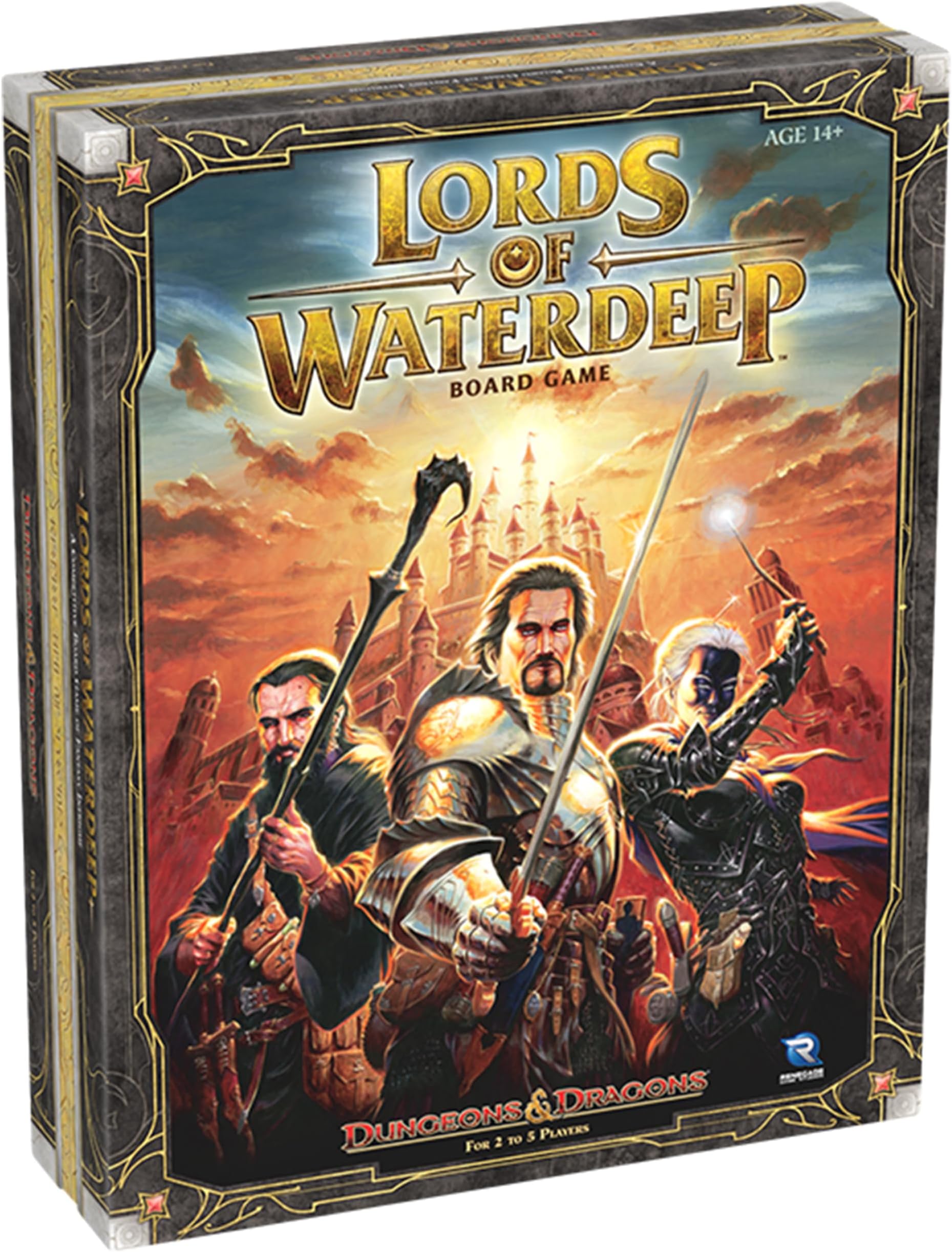
Dungeons & Dragons Lords of Waterdeep
Product ID: 261660
⏳60-min strategic gameplay
🎲2-5 players competitive action
🏙️Expansive city-building & control
Desertcart purchases this item on your behalf and handles shipping, customs, and support to Greece.
🏰 Rule Waterdeep, Outsmart Rivals, Win Glory!
Dungeons & Dragons Lords of Waterdeep is a 60-minute Euro-style strategy board game for 2-5 players where you become a secret lord vying for control of Waterdeep. Recruit adventurers, complete quests, build new city locations, and use intrigue cards to manipulate opponents in a richly thematic D&D setting. With elegant worker placement mechanics and immersive storytelling, it offers fast, competitive gameplay that keeps everyone engaged until the final reveal.


| Additional Features | Board Game |
| Age Range Description | Ages 12+ |
| Asin | 0786959916 |
| Best Sellers Rank | #44,446 in Toys & Games (See Top 100 in Toys & Games) #959 in Board Games (Toys & Games) |
| Brand Name | Dungeons & Dragons |
| Color | Multi-colored |
| Cpsia Cautionary Statement | Choking Hazard - Small Parts, No Warning Applicable |
| Customer Package Type | Standard Packaging |
| Customer Reviews | 4.8 4.8 out of 5 stars (3,390) 4.8 out of 5 stars |
| Edition | Standard Edition |
| Estimated Playing Time | 60 minutes |
| Game Mechanics | area control |
| Genre | Strategy |
| Global Trade Identification Number | 00069140899417, 00653569692584, 00810011729216, 09780786959914 |
| Included Components | Game |
| Item Dimensions | 12 x 7 x 15 inches |
| Item Dimensions L X W | 14"L x 11"W |
| Item Highlight | Award-winning 60-120 min strategy game for 2-5 players. Recruit adventurers and complete quests in the D&D universe. |
| Item Part Number | WTC388510000 |
| Item Type Name | Board Game |
| Item Weight | 501 g |
| Language | English |
| Manufacturer | Wizards of the Coast |
| Manufacturer Part Number | 388510000 |
| Manufacturer Recommended Age | 12 - 15 years |
| Manufacturer Warranty Description | No Warranty |
| Material Type | Wood |
| Minimum Age Recomendation | 144 |
| Model Number | 5513165 |
| Number Of Items | 1 |
| Number Of Packs | 1 |
| Number Of Players | 5 |
| Operation Mode | manual |
| Set Name | Lords of Waterdeep |
| Size | std |
| Sub Brand | Dungeons & Dragons |
| Subject Character | FantasyMilitary |
| Supported Battery Types | No battery needs |
| Theme | Fantasy |
| Unit Count | 1 Count |
| Upc | 069140899417 653569692584 |
User
Great board game for all audiences
Lords of Waterdeep is based in the Dungeons and Dragons world. More specifically, in the Forgotten Realms campaign setting. Unlike the other board games that have been released by Wizards of the Coast over the past few years that are also set in the D&D world (eg, Wrath of Ashardalon and Conquest of Norrath), this game is pure euro. For all intents and purposes, it is a worker-placement game with a pick-up and deliver mechanic (no, really, it's funner than that might sound!).The idea behind the game is the following: Each player takes on the role of a lord of Waterdeep - one of several actors who essentially controls the politics and economy of the City of Splendor (as Waterdeep is known). To increase their influence, they hire adventurers to complete quests on their behalf. For example, you might hire a few rogues to infiltrate one of the many guilds composing Waterdeep's market economy. The more quests you complete, the better you do in the game - the player who completes the most (and most valuable) quests, wins.Game playThe game play blends the theme with the mechanics almost seamlessly. The game plays over eight rounds, and each round players take turns assigning their agents to different buildings. Each building procures the player something, but most commonly a collection of adventurers. Adventurers come in four flavors: clerics, rogues, fighters, and wizards (in other words, classic D&D archetypes). After assigning agents to a building and collecting its benefits, a player can complete one quest per turn. To complete a quest, you must return a certain type and amount of adventurers to the general stock. In return, you earn victory points - and sometimes gold and more adventurers, or even advantages that last throughout the duration of the game.That's basically how the game plays. There area a few extra things, however, worth noting. First, the game begins with several basic buildings that allow players to procure all necessary resources: the four types of adventurers, quest cards, money, and intrigue cards (more on this in a second). But players who visit the Builders' Hall can also build a new building for that turn. This creates more spaces and resources for players to use and collect, and also provides a benefit for whoever built that building: whenever another player assigns an agent to that building, the owner receives a reward, as well.Intrigue cards allow players to mess with each other more directly than simply blocking one another when assigning agents to buildings. Sometimes they allow you to steal adventurers from other players, while other times you can force them to complete a quest before moving on to their own, more lucrative quest cards. Perhaps most importantly, when you play a quest card, you do so by assigning an agent to Waterdeep Harbor. At the end of each round, everyone who assigned an agent here, that is, played an intrigue card, gets at least one more turn to assign agents to buildings. This mechanic forces players to be in each others' faces.Finally, at the start of the game, players receive a Lord of Waterdeep card that indicates their particular character. Each character is typically associated with a specific type (or types) of quest cards. For example, a lord may be associated with both Skullduggery and Piety (odd combination, but it happened to me with the character Nindil Jalbuck - an evil doppelganger of an otherwise honest and philanthropic halfling). For each quest of that type you complete, you earn bonus points at the end of the game.Why we love this gamea. Lords of Waterdeep is easy to learn and pick up, and it goes quite fast. Our games clocked in at around 45-60 minutes. My current gaming group starts around 2200 and we usually poop out sooner rather than later. This means games that are quick to pick up and play, but strategically fun, are a boon. What's more, with the Lord of Waterdeep cards, each player starts out with a clear goal that helps shape their strategy.b. I like the theme, a lot. I've never played D&D as an RPG, but I've enjoyed the literature and the D&D Adventure Games (we own both Wrath of Ashardalon and The Legend of Drizzt). This game evokes the D&D world in a very unique way. Although I wish the adventurers were something other than classic euro-cubes for thematic reasons (I insist that everyone call the cubes wizards, clerics, fighters, and rogues, and not purple, white, orange, and black cubes!), it still works: you get the idea that you are hiring people to go do stuff for you. Fun, dungeony, high fantasy stuff. I dig it. It just does not feel like a cube-pusher to me. Along with the theme, there's actually quite a bit of flavor text (and incredible artwork) on the cards and in the rules book that make it even more fun (and yes, I read my flavor text, out loud, too, when completing a quest!).c. Although you keep track of victory points as you complete quests, you never quite know who wins until the end of the game, because it's only then that the Lord of Waterdeep cards are revealed. This means that the run-away front runner will not necessary win - and if they do, at least everyone else feels like they're still in the game and has a chance up until the bitter end!d. Finally, this is a good game for all numbers of players (2-5) for which we've played (2 and 4). Strategy changes slightly between player counts, but, in our experience, anyway, the core feel and tactics of the game remain constant between 2 and 4 players - a rather rare and well done feat, in my opinion.In short, Lords of Waterdeep is absolutely fun. I want to note, also, that within my gaming group, I am the only one with any D&D background or, shall we say, enduring and obsessive high fantasy/sci-fi interest. But that did not seem to matter: everyone loved the game and the theme, and this is one of the few games that got a call back from my gaming group.
User
A Great Worker Placement game
Check out full review at geeksplayinggames.comThe rule book (downloadable pdf) is 24 pages long, although only eight are about rules and explaining the parts of the game. There are 12 pages of appendices that give details about each building, the agents and each of the Lords and it wraps up with a glossary and the storage diagram. The back cover is a summary of the rules and a turn sequence reference.The game is played in eight rounds, the player with the most victory points at the end of the eight rounds is the winner. Each round consists of a number of turns equal to the number of agents a player has. Once all agents have been assigned the round ends. Each turn has two steps 1) Assign an Agent and 2) Complete a Quest. If you have agents left when your turn starts you must assign an agent, otherwise you are skipped and the next player who still has agents plays their turn. Completing quests is optional, if you have the resources to complete a quest you may, but you are not required to.The Quests are the main source for gaining victory points. Quests are completed by collecting gold and recruiting adventurers, which are represented by small colored blocks of wood. Clerics are white, fighters are orange, rogues are black and wizards are purple. Each quest is of a type that relates to which resource is primarily required to complete it. Piety quests will require more clerics than the Skullduggery quests which will require more rogues. Likewise warfare quests will see more fighters than the arcana quests that call on the magic of wizards. Commerce quests rely on gold and, generally, fewer adventurers. Each player gets a Lord card randomly, and that card will tell you which quests (in most cases) you need to complete to gain victory point bonuses.Gold and adventurers are gathered by sending out your agents who go throughout the city to one of nine buildings. Most buildings will provide your agent with your needed resource, which then gets placed in your Tavern, which is located on the player mat. There are four buildings which are not primarily about gathering resources. One of the buildings that you can assign your agents is Builder's Hall, where you are able to purchase new buildings that will add to the possible locations to gather future resources, in addition to giving the owner a special bonus for controlling the new building. Another unique building allows you to take the first player marker, and an intrigue card.Intrigue cards are the main way you are able to interact with the other players. They come in three fashions; Attack, which usually has a positive benefit for you while negatively effecting your opponent's, Utility, which always benefits you and may benefit an opponent or two, and Mandatory quests, which are quests you give to your opponents that they are required to complete before completing any other quest. Intrigue cards can only be played by assigning an agent to Waterdeep Harbor. The harbor has three numbered spaces for the agents to be assigned, you then play an intrigue card. The round continues as normal, however before the next round begins, each agent in the harbor gets reassigned to another building in order of the numbered spaces. The last, non-resource-giving building is the inn. Here you get one of the four face-up quests that are on the board, as well as gold, an intrigue card or you reset the quests and take one of the new ones.Finally, victory points are tracked along the edge of the board with a small round wooden disc that is the same color as your agents. If any player pases the 100 space there is a 100 victory point token you get to signify that you are rounding the track a second time.The game is fairly simple to learn. There are only two things you can do on each turn, so getting that down is relatively simple. The complicated part of the game comes in trying to outmaneuver your opponents. The quests you choose, the buildings you buy, the intrigue cards you play, will all impact the number of victory points you get. Figuring out what you should do on each turn is the hard part.The number of players determines the number of agents each player gets. Two players start with four agents, three with three, four and five start with two. In a two player game you have more to do each turn because you have more agents. Each player is also more likely to earn more victory points overall than in a game with fewer players. But this is a strategy game and the more players you have, the more you are going to have to plan.I really like this game. I downloaded the rules and as I read them I could totally see where they were going with the theme of the game and was very anxious to get and play it. I think the theme is what really makes the game. At its core, this is a resource gathering game, and if you approach it simply as such you will, I believe, really enjoy it. But if you limit yourself to viewing it as only a resource gathering game you are going to miss out on the richness of the well thought out theme. This is, after all, a D&D based game. Get into it, roleplay a little. Don't say "I need two orange ones" call them fighters. Read the flavor text on the quests, complete the quests with some flashy description of what your adventurers accomplished. Have some fun with it. Like I said, aside from the theme its a fun game, but the theme is what makes it a great game. Highly recommended, lots of fun, definitely worth getting.
User
AMAZING GAME-BUY NOW!!!!! <3
I LOVE THIS GAME!! If you are an avid games, buy this now! My husband and I play board games each night, and this is becoming our favorite quickly. My brother bought it a while back, and brought it on a trip where we all learned it together. We went about three days after my brother's departure before we had to buy it for ourselves.BACKGROUND:Our gaming history is extensive, but our favorites that are of similar caliber are: 7 wonders with expansions, rivals of catan, 7 wonders duel, and innovation.If you like all of those games I mentioned above, you need to buy this game. So, the story goes my husband and I bought Sid Meier's Civilization, which is quite a beast of a game. We promised we would not buy another game until we mastered Civ. However, life came about and we just didn't have the time to learn Civ. My brother taught us lords of Waterdeep, we fell in love, and we broke our promise to Civ.Lords of Waterdeep is easy to learn compared to Civ and other games with several components as long as you get over the fact it is based on a game, which is why everything has specific names. The terminology of the pieces isn't important unless you bought this board game because you love the original game. We just call the pieces by their color. We mostly play with two people, but we have played with up to four, and it is fun no matter the number of players! We love the game because it has several components and the strategy changes with each game.GAME COMPONENTS:There are lord cards, which allow you to get bonus points based on completing certain types of quests. There are quests, which come in four types. Each type has a certain cost theme. (more oranges for one type of quest, or more gold for other types of quests). There are plot quests, which give you a benefit throughout the remainder of the game.There are agents that you use to select the action you want to take for the game, and each player gets an additional agent about half way through the game to allow for an additional action. There are also buildings, which create a new action space, and offers certain benefits to its owner. (kind of like monopoly where if another player lands on your property, you get a benefit).Strategies can range from building a lot of buildings, completing several small quests, completing a few big quests, going for only bonus point quests, and somewhere in between.TIME/LENGTH OF PLAY:We are planning on getting the expansion soon, but the game still isn't boring for us. We have played it almost every night for about a month. Usually we play best out of three. With two players and a full understanding of the rules, the game takes 30 min-1 hr. We like this because there is a set number of rounds (7), so we know the game won't take more than an hour. It is similar to 7 wonders, in that there is a limited amount of choices, which makes the playing time pretty consistent However, if we take our sweet time choosing something, the game will take longer (just as in 7 wonders). Our other go-to-game is Innovation, which can take anywhere from 30 min to 3 hours, so if we need to end a game at a reasonable hour, Lords is a much better choice.The longest part of the game is putting it away. There are several components and each piece fits perfectly into the box with no room to spare. So, all the pieces have to be arranged in a specific way. There are instructions on how to organize the game within the box in the instruction booklet.OVERALL:Buy this game! It is fun for hours and for multiple people or just two players!
User
Not DEEP... But FUN
I'm a big fan of games with good theme, so I was a reluctant to pick this game up after reading other reviews that were saying the theme was just added on to the mechanics. But... I'm fan of worker placement games... and I'm a D&D player from way back. So, I pulled the trigger...so to speak.I'm glad I did. This game is fun, has good design elements, and great production value.Production:The box and insert for this game are just awesome. I have lots of games where the insert seems to be an after thought (I'm looking at you FFG). The box is unique but functional and the insert is one of the best I've seen. The insert holds all the bits and makes them easy to get to and easy to store and even has beveled sections that allow you to easily remove the components. The manual also has a section dedicated to showing you how to store the pieces. One of the best box designs ever.Game Play:There is plenty of player interaction unlike many Euro type games. Simply put, you are placing workers to collect resources that you turn in for points. However, you can see what every other player is attempting to collect and you have the option to delay and interfere with them if you want. Every turn has plenty of options and I didn't really get the feeling, like I do with a lot of Euros, that the game was playing me. The game is simple to teach and moves along pretty quickly.Theme:The theme is just a layer on top of the mechanics, but I did enjoy it. The resource collection aspect of the game manifests as "quests" that you complete/turn in. The resources are your typical D&D types: Clerics, Rogues, Wizards, and Fighters. As I was playing I found myself looking more at the items I needed to collect and not the quest itself. The game takes place in the very popular Forgotten Realms city of Waterdeep. I've read a number of the books and have enjoyed roleplaying in this campaign setting so I think that helped fill in some of the gaps that a tightly integrated theme normally fills.Final Thoughts:This game will have a permanent place on my shelf. It's easy to teach and play.... and I immediately wanted to play again after my first game. We are four months into 2012 and I think this is one of the best games of the year.
User
Old D&D Fan, love this game
I love this game.LoW is a euro or german style board game. If "board game" makes you think Monopoly, Life, Candyland, Chess--you're on the wrong page. Those games are terribly designed. That's why the only time you'll play a Milton-Bradley style game is when you're entertaining (with some condescension) your own little kids. These game are designed terribly and are often terrible for kids. They are unbalanced, who goes first gives you a benefit over everyone, they are survival based (you bankrupt your eight-year-old in monopoly and they get to sit and watch the rest of you play without them--did you realize you were teaching your child how bad they should feel being such a loser?), the game has no ways to cooperate or really go against a specific player (in monopoly you meta-game to not sell to a player--which is because the game has no way to do anything). Eurogames solve these and other problems with tradition American market games. Around 2000 new designs came out that revolutionized game design and hundreds of great games have been released amongst thousands of new ones. This is one.The theme will be appreciated by any D&D fan, more so if you ever played or read about the factions within Waterdeep. You have a secret Lord identity with a secret goal type amongst the Quests. Cubes represent Clerics, Fighters, Rogues and Wizards. You collect adventures in specific quantities to complete quests, earning victory points. The quests are on different types: Piety, Warfare, Skullduggery, Arcana and Commerce. They correspond to the four adventurer types with gold(money) being the last. This is the resource they emphasize or always need. When the quests match your secret goal types, you'll get additional points at the end of the game. These bonus points earned in the background are not known to other players and they can result in the last place player zooming to the top at the end. So there are different strategies that you can use and they are all valid in different situations. Some quests have "plot lines", these are simply constant bonuses that stay in effect for the rest of the game. They can be very powerful. The hardest part of the game is remembering that your action or another's action has triggered one of your plot lines. We forget all the time. The physical game needed some kind of reminder on the main board to help this. This is not a problem with the ios game version.I do think some of the quest types are more desirable than others. Arcana quests give you the ability to use a position already filled(very powerful), and more access to Intrigue cards. Warfare gives you an extra agent for the rest of the game, it is costly but if gotten early well worth it. I believe it is commerce that earns you money when you buy buildings, which acts as a great discount. Off the top of my head I can't recall a Piety or Skullduggery quest power that is uniformly desirable. Arcana quests can have greater competition since they are desirable by players who DON'T have that as their Lord's secret quest type. I feel that may put a Lord that needs Arcana quests at a disadvantage due to the extra competition. I also don't think there are as many buildings producing gold as any other resource type. So If two players need commerce quests... money is going to be scarce on the board.The game plays 2 to 5 players. There is one great expansion box that allows for a sixth player. The primary mechanism is a "worker placement". You have several agents that you place at different spots (named from Waterdeep adventures). Each one gets you something. You compete with players for these limited positions each round. There are eight rounds per game. The latter half of the game increases your agent by one and there are additional ways to get an extra agent for a single round or for the remainder of the game. You can buy a building which expands the number of agent positions on the board, decreasing competition for positions. However visiting another player's building benefits them as well as you.Okay, I hate Intrigue cards at times. Intrigue cards gain you bonuses or are played against other players. Some cards benefit you and another player of your choice. Intrigue cards add the "take that" mechanism to the game, where you can hurt another player. It works pretty well, although I'm never a big fan of a lot of take-that in a game. It can foster a fair amount of frustration or feeling ganged up on (hello Munchkin!) There are some pretty broken combinations that I don't like being on the other side of. Arcana has quests that give you powers to draw or play additional intrigue cards when you play an intrigue card. So one Intrigue card played can turn into a stream of 2,3,4,5,6,7,8,9 or more cards drawn and played in a row using just one agent. It usually stops because the player just feels bad. But I've seen a single player go through most of the intrigue cards in the game by themselves. Each player may regularly only draw 4-8 during the whole game normally. This is the one thing I really dislike in the base game--and very specifically due to that broken power combo. If you know it exists, players have to make sure both of those looping abilities don't fall into one player's hands.The online version is also very good when played on a good sized iPad. It solves the plot line problem. I see a lot of complaints about the newest version, but I think it is quite Excellent. Lords of Waterdeep is a big gameboard and you have a lot of cards to look at. I think ity does a good job of making all the different information accessible.
User
Excellent Board Game
I've heard great things about this board game from other people who have played it, and so I decided to pick it up for myself as a birthday present (using a gift card that was actually a gift, so technically it was a birthday gift from a friend!).I played a 3-player game, which worked out nicely. The game has 8 total turns with each player getting a number of distinct actions within each turn, which are tracked through "agent" tokens. If you are playing a 2-player match, each player would start with 4 agent actions per turn, and if you have the maximum recommended 5 players, there would only be 2 agent actions per turn. The 3-player version, players start with 3 agent actions. Once the fifth turn is reached, all players are given an additional agent, making the later turns a little more important than earlier turns. This is a nice way of having games with more players be a little less burdensome than it would be otherwise. There are also two additional "agents" (with associated extra actions for the player that controls them) which can become available during later rounds.The basic concept of the game is that each of the players represents the "sponsor" for adventurers (wizards, thieves, fighters, clerics) in a D&D world. Scoring consists of "victory points", which may be earned in various ways, but are mostly earned by having sponsored adventurers complete "quests". To complete a quest, each quest will have a specific number of each type of adventurer that need to be recruited, and perhaps gold to be supplied. Once completed, quest rewards (adventurers, gold, and/or victory points) will be earned. Players recruit the adventurers or earn the gold by having their agents visit various buildings within the city. There are also "intrigue" cards which can be played against other players to interfere with their progress in getting quests completed.There are no dice rolled in this game, so it really is a "resource" game with shuffled cards providing the randomness to make the game different with each play. Even though this is set in the Dungeons and Dragons universe, and having some experience with D&D makes it easier to grasp some of the concepts, past experience playing D&D is certainly not a requirement for enjoying this board game. For me, given that I don't have as much free time as I used to when I was younger, it is nice to not have to take hours "prepping characters" before jumping into a fun game set in the D&D universe.This game could certainly take a long period of time if everyone plays slowly and deliberately, but fast paced game play is very much a possibility, potentially allowing for multiple play-throughs on game night. The rules seem simple enough that one play through will be more than enough for people to understand almost all of the nuances to the game without too much trouble. So, while new players might be at a disadvantage in not knowing exactly what to do in the first turn or two, after a while keeping up with experienced players shouldn't be too much of a problem.Overall, this is a very well balanced board game, with plenty of player interaction, and only a marginal level of "cut throat" actions harming other players. While there is some potential for a player in the lead running away with the game, but due to some interesting design elements (hidden "victory points" that are counted at the end of the game; "manditory quests" that can be forced on other players, the ability to see what resources other players need to gain victory points) that is less of a problem than I have seen in other board games.I would rate this as a "moderately serious" board game with a high degree of re-playability. I don't think I would enjoy a 2-player session quite as much as a 3, 4 or 5-player session.
User
Good mix of complex and simple
Lords of Waterdeep (LoW) has a good mix of the intricacies of eurogames like Agricola, while developing more options and variation and a simplified scoring system more similar to games like Ticket to Ride. LoW is limited to 8 turns, unlike the drawn out Agricola, and also unlike Agricola, there is no rush to gather more people to accomplish your goals - your Agents are determined at the start of each game by the number of players. A variation on Agricola's theme of placing a set number of placards in random order, is the option for a variety of buildings cards, the entire stack of which is not possible to all be built in a single game so you never know which opportunities you might have to develop in that regard (also similar to 7 Wonders age 3 Guilds and Cities expansion Spies cards).Another game-to-game variation is the Lords cards, of which each player is dealt one randomly at the start of the game. These cards determine the type of Quests for which you gain extra Victory Points when scoring is accomplished at the end of the game. In this way, scoring is similar to Ticket to Ride in tallying up the Quest bonuses, similar to the Destination cards in that game. While Agricola uses a scoring method more similar to 7 Wonders, with all tallying of points done at the end of the game and no one ever really being sure how they fare against their opponents during the game itself, Lords of Waterdeep grants victory points during the game, again similar to Ticket to Ride, and then again at the end based on your Lord, as previously noted. The basic 'win' concept is to gain VP's by using adventurers (and gold), who are gained by placing Agents on buildings to acquire them, to complete Quests. You gain extra VP's based on the type of Quests you've completed from your Lord at the end of the game, but since your Lord is secret from your opponents, the type of Quests that you get bonuses from is also kept secret.While Agricola faces challenges of balancing long-term game strategy over short-term gains, LoW allows for a better mix because of these variations on the theme. Fewer turns, more visible scoring, and less difficulty determining how to proceed - short term vs. long term, because there really isn't enough time to separate the two and everyone has the same number of chances to gain benefits each turn, unlike Agricola's 'family' building element.Lastly, I can really appreciate the plastic case in the box for which there's even a diagram of how to place the various pieces and cards. I had a bunch of plastic baggies all ready to go, and I saw that diagram, I know it sounds funny, but I got really excited that Wizards of the Coast thought ahead enough for this type of game to grant the owner the option to have a safe, effective, neat, organized way to store it. The box itself is also very sturdy and quite artistic construction.
User
Just buy it
We're fans of the European style board games and the theme actually caused me pause but the reviews made it clear it was NOT a lame attempt to use the D&D/Forgotten Realms brand to eke a few more bucks out of D&D fans. I guess it's an exceptional attempt. Heh. This is my new favorite.As is often the case with European style games, there's lots of chits and bits and pages of instructions, but the game mechanics are fundamentally pretty simple: It's a resource gathering game and you can use the resources to buy buildings or complete quests. Between those primary goals and some assorted plays during the game, you'll accrue victory points and s/he with the most at the end of 8 rounds wins. Resources are gold and 'adventurers' in the flavors of white, purple, black or orange (cleric, wizard, rogue, fighter, respectively). The 'Lord of Waterdeep' that you represent influences your victory strategy a little bit, but mostly just in terms of which quests you favor, not in style of play. Intrigue cards, quest benefits and different benefits of the respective buildings alter your strategy a little during game play. For example, if you complete a quest that gives you a few victory points every time you construct a building, then you'll probably make that a slightly higher priority. Every turn is interesting because you have that decision to make between which resources, building or quest to grab before an opponent does.One thing that sold me (based on reviews) is that you can make a mistake and still win the game. It's not like if you didn't know some bit of rules or strategy that you ruin your chance to win on the first turn. You can play the game and enjoy it even if it seems you're losing because there's always hope until the last turn. Another thing I liked is the game doesn't require you to be cut-throat to win. I suppose you could make a point of ensuring your fellow player(s) can't get the resources they need to complete a quest, but there really are a lot of options available to them so it's not like you could shut them out entirely and you'd be hurting your own chances if you tried.The bottom line is this game is my new favorite. I still like 7 Wonders for fast, fun play, but if i have a bit more time, I'm going to want to play this over Settlers of Catan or Ticket to Ride or others. If I had one critique, I'm a little let down with the Lords. There are 11 of them and with one exception, they all give 4 victory points for every (this) or (that) quest completed, say Skullduggery or Piety. The exception is the Lord that gives you victory points for owning buildings. That might be a bit of a handicap because there are only 8 'natural' opportunites to build a building. Your opponents could beat you to the punch. There are a couple of quests and I think at least one Intrigue card that give you an opportunity to build a building, but you could easly see those slip through your grasp, too. I just think they should have done something so it felt like the different Lords had different goals and I have several ideas how it could have been done. I'm a little surprised they made the Lords so 'cookie cutter.'
User
I love this game!
The delivery was super quick and all the pieces completed
User
Great game
Great game.However, insert does not support sleeved cards and the material for the box could be a little thicker
User
Tolles Einstiegs-Spiel in das Worker-Placement-Genre
Als langjähriger und leidenschaftlicher Fan sowohl von Brettspielen als auch des D&D Universums und damit Kenner der Stadt Waterdeep (oder zu deutsch Tiefwasser) fiel die Wahl des Kaufs dieses Brettspieles nicht allzu schwer, gibt es doch bereits zahlreiche, zumeist positive Kritiken zu dem Spiel. Ich sollte den Kauf nicht bereuen.Das Spiel ist meines Erachtens nach ein sehr gutes Ableger, um sowohl Neulinge in das Genre der "Worker-Placement"-Spiele einzuführen, als auch für Fans des D&D-Universums und Brettspielveteranen bei der Stange zu halten. Denn die Aktionen bzw. der Spielablauf sind innerhalb weniger Minuten erklärt, das Spiel lässt aber dennoch genug Freiräume und spielt sich jedesmal leicht anders (durch die unterschiedliche Ziehung von Gebäuden, den Lord-Karten, etc.), ermutigt dazu, sich eigene Strategien auszudenken und diese meist auch erfolgreich auszutesten. Die Konfrontation zwischen den Spielern findet wie in Worker Placement Spielen üblich eher am rande statt, es gibt einige "nimm das!"-Karten, aber niemals in einem Maße, in denen man das Spiel für einen anderen zunichte macht. Man muss dennoch genau aufpassen, was die anderen machen und seine eigenen Strategien eventuell entsprechend anpassen.Das Spiel ist leider momentan nur auf Englisch zu erhalten, dies macht aber so gut wie keinen Unterschied, da die meisten der Aktionen, die die Spieler im Verlauf des Spieles auswählen können durch einfach zu verstehende Symbole erklärt bekommen. Die Personen, die des Englischen mächtig sind und zudem noch Fans des Universums, freuen sich über Bekannte Namen und Ereignisse der Auftragskarten, die zudem durch ein tolles ArtWork glänzen. Zudem muss man den kompakten Spelablauf anmerken, selbst mit Neulingen dauert eine Runde zu 4 selten länger als 1 1/2 Stunden.Sowohl Freunde als auch Familie sind begeistert von diesem Kleinod, ich kann es nur empfehlen.
User
Ottimo in ogni suo aspetto!!
Dopo un mese dall'acquisto e con più di dieci partite all'attivo, posso senza dubbio affermare che questo gioco merita l acquisto a occhi chiusi.Si tratta di un gestione risorse in cui fino a 5 giocatori si contendono il dominio della città di waterdeep risolvendo quest, assoldando avventurieri (le risorse appunto) e usando carte intrigo, il tutto per accumulare punti vittoria necessari per prevalere sugli altri.Ad inizio partita ogni giocatore sceglie segretamente un Lord, che alla fine degli 8 round di cui é composta la partita darà punti vittoria extra in base ai tipi di avventure completate (ad esempio, ci sono lord che premiano per aver completato avventure Arcana e Commerce, altri premiano per le avventure piety e warfare, e cosi via).Fatto ciò, si passa alla fase centrale del gioco: piazzare agenti, accumulare risorse, risolvere avventure, giocare carte ecc ecc.La forza di questo gioco sta nei materiali ottimi, nel regolamento davvero semplice (é un gioco che possono giocare davvero tutti, anche i neofiti: credetemi, dopo un giro di tavolo, anche chi non è avvezzo ai boardgame non avrà più necessità di consultare il regolamento o di chiedere spiegazioni), scalabilità ottima (durata e intensità della partita restano uguali a prescindere dal numero di giocatori).Per quelli che si pongono il problema dell'inglese: é più che elementare, davvero, oltre al fatto che le carte sono anche illustrate...credetemi, la localizzazione in italiano é davvero inutile.Per cui se siete alla ricerca di un gioco dal regolamento semplice, dalle meccaniche intuitive, dai bei materiali e dalla durata non eccessiva, non pensateci 2 volte e acquistate LoW !
User
Juegazo
Juegazo, una pena que sea muy difícil de encontrar ya
Trustpilot
3 weeks ago
2 days ago