
DOWNLOAD THE APP


Customer Services
Copyright © 2025 Desertcart Holdings Limited
DOWNLOAD THE APP
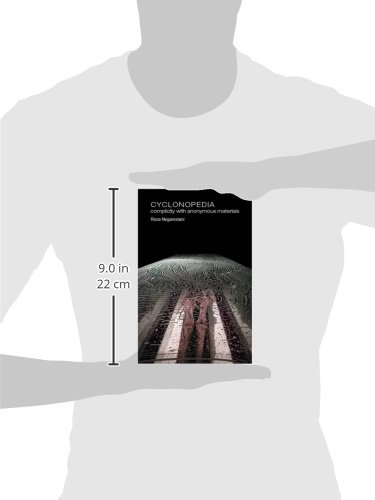

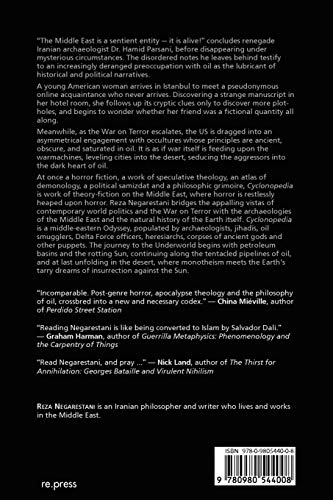

Cyclonopedia: Complicity with Anonymous Materials (Anomaly) [Negarestani, Reza] on desertcart.com. *FREE* shipping on qualifying offers. Cyclonopedia: Complicity with Anonymous Materials (Anomaly) Review: Super fun - Its a decent read. Very.....unique. Review: Important Literature! - A necronomicon for the Bush administration and a guidebook for the dissolution of the western narrative. Read today!
| Best Sellers Rank | #104,235 in Books ( See Top 100 in Books ) #4,224 in Horror Literature & Fiction #8,883 in Science Fiction (Books) |
| Customer Reviews | 4.4 4.4 out of 5 stars (150) |
| Dimensions | 6 x 0.56 x 9 inches |
| Edition | First Edition |
| ISBN-10 | 0980544009 |
| ISBN-13 | 978-0980544008 |
| Item Weight | 13.6 ounces |
| Language | English |
| Print length | 268 pages |
| Publication date | August 30, 2008 |
| Publisher | Re.Press |
C**H
Super fun
Its a decent read. Very.....unique.
F**N
Important Literature!
A necronomicon for the Bush administration and a guidebook for the dissolution of the western narrative. Read today!
T**N
Oil is the unsign of the Outside
Reading this book feels like playing an awesome pen-and-paper game from the 80s. It's not for everyone but if you're reading these words you've already heard Its call.
G**T
Unusual , disorientating, as much a grimoire as it is a socio-historical treatise.
I originally purchased this out of academic curiosity while studying sociology after a peer recommended it to me. The book offers a provocative challenge: it refuses to separate material reality from mythology, geopolitics from occultism, or human actors from inhuman forces. Instead, it treats the Middle East and its oil reserves as active, quasi-agential participants in global social processes. While many sociological texts emphasize human systems, structures, and power relations, Cyclonopedia destabilizes those assumptions and asks the reader to consider the nonhuman world as an actor entwined in social life. The book also offers a critical, if unconventional, lens on Western narratives of the Middle East. Rather than reproducing Orientalist stereotypes, Negarestani subverts them by turning Western geopolitical anxieties into a kind of philosophical horror. The region becomes unreadable and unstable, not because it is “irrational,” but because global political actors refuse to see the full assemblage of forces at play. The book is best approached not as a conventional sociological analysis but as a speculative experiment that disrupts how we think about agency, conflict, and global systems. For students willing to engage with its nonlinear style, Cyclonopedia offers a unique opportunity to explore the intersections between materiality, mythology, and geopolitics in ways that enrich sociological imagination.
A**R
Five Stars
Great.
F**R
Five Stars
EEEEE!!!
G**A
Complicity with Anonymous Philosophers
Readers who are looking for new thoughts and concepts will find some unprecedented ideas in Cyclonopedia. For example, in one place Negarestani challenges Deleuze and Guattari's concept of war machines in relation to war. In another place he builds a different philosophy of becoming. He analyzes the politics of the Middle East through the eyes of a mad archeologist who has discovered connections between monotheism, petroleum and geology. These are just a few things that stand out for me after my first read through. I plan to go back chapter by chapter for a slower read to take in the many more themes he has presented. I think there are a couple reasons why this book might be difficult for some readers though- 1. For readers who are expecting a novel, Cyclonopedia works like a theory book and for those who anticipate a philosophy book, it may read like a novel. My thought is that it would be best to read it as a philosophy or theory book which uses different or alternative ways for thinking. Negarestani doesn't strictly abide by philosophy or politics in order to discuss politics and philosophize about the world, but instead opts to also use a wide variety of speculative tools to make points (i.e. occult, archeology, Islamic theology and even current culture such as video game and literary studies). 2. At first, readers might feel alienated from Cyclonopedia. One of the reasons for this estrangement may be due to a lack of a parallel works to compare it with. Cyclonopedia like every other book has references and influences, but it is hard to give a coherent list of similar books. The closest and most helpful example which comes to mind is A Thousand Plateaus by Deleuze and Guattari. The influence of Deleuze is obvious throughout the book and the narrative resembles the chapter 'The Geology of Morals'. Deleuze and Guattari have incorporated experimental writing into a work of philosophy (for example, every chapter a is 'plateau' covering every topic imaginable) in much the same way Negarestani uses experimental narration and 'plotholes' throughout the book to create a work of experimental writing opposed to an academic philosophical work. While this sounds like a Deleuzian book it should be noted that Negarestani's ideas are independent of Deleuze and sometimes transcend them. Another reason for Cyclonopedia's eccentricity is that it is inherently Middle Eastern, it uses alternative resources and concepts related to different forms of thought, politics, cultures and people. In my opinion, it is what makes Negarestani's work so compelling.
I**L
The only other comparison I can give is House of Leaves. That book is superbly constructed, thing to live with. But... About a third of the way through I could feel the focus shift. It felt a very talented artist had composed this genre work and the made the mistake of asking his hip NY crowd to check it out and they 'it brilliant... But why is it a genre piece? You're so much better. This could be ART!' And he re-directed it. Spoiler: Danielewski's book ends up being about a failed marriage. On the other hand, this book doesn't blink. It keeps going. Lovecrafts meets Adam Curtis. It follows you around...
B**A
I like this book, and I hope to find more like it.
F**F
More cover than deep.
R**I
Incredible book!
P**I
An interesting book, well written, interesting cover. Would read again.
Trustpilot
1 month ago
2 weeks ago