
DOWNLOAD THE APP


Customer Services
Copyright © 2025 Desertcart Holdings Limited
DOWNLOAD THE APP
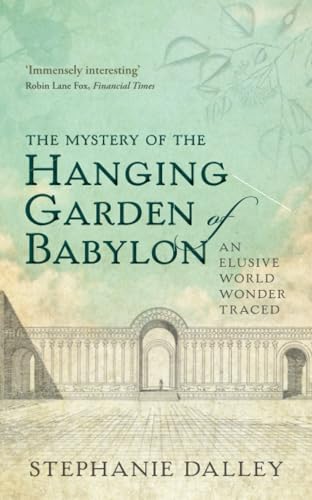
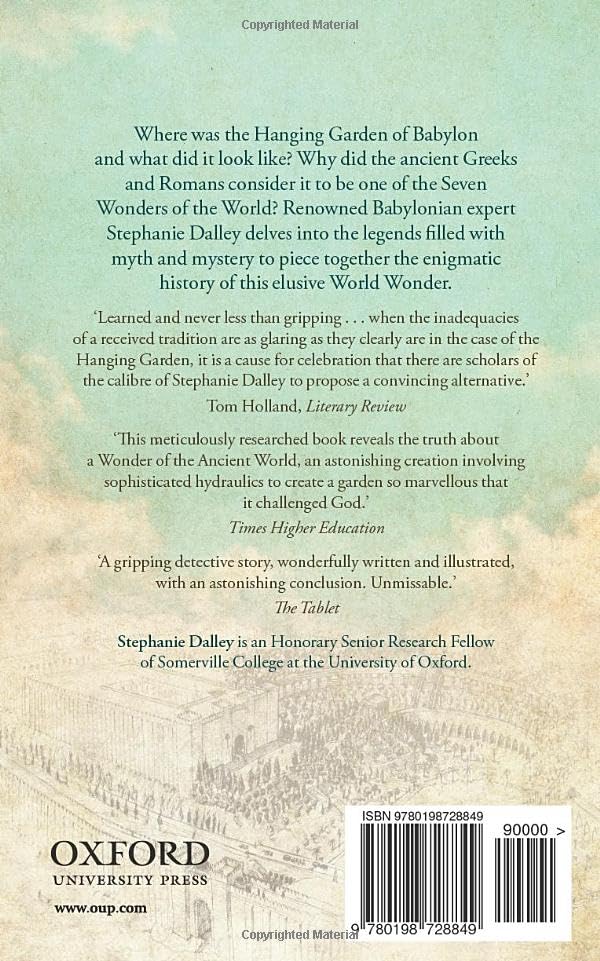
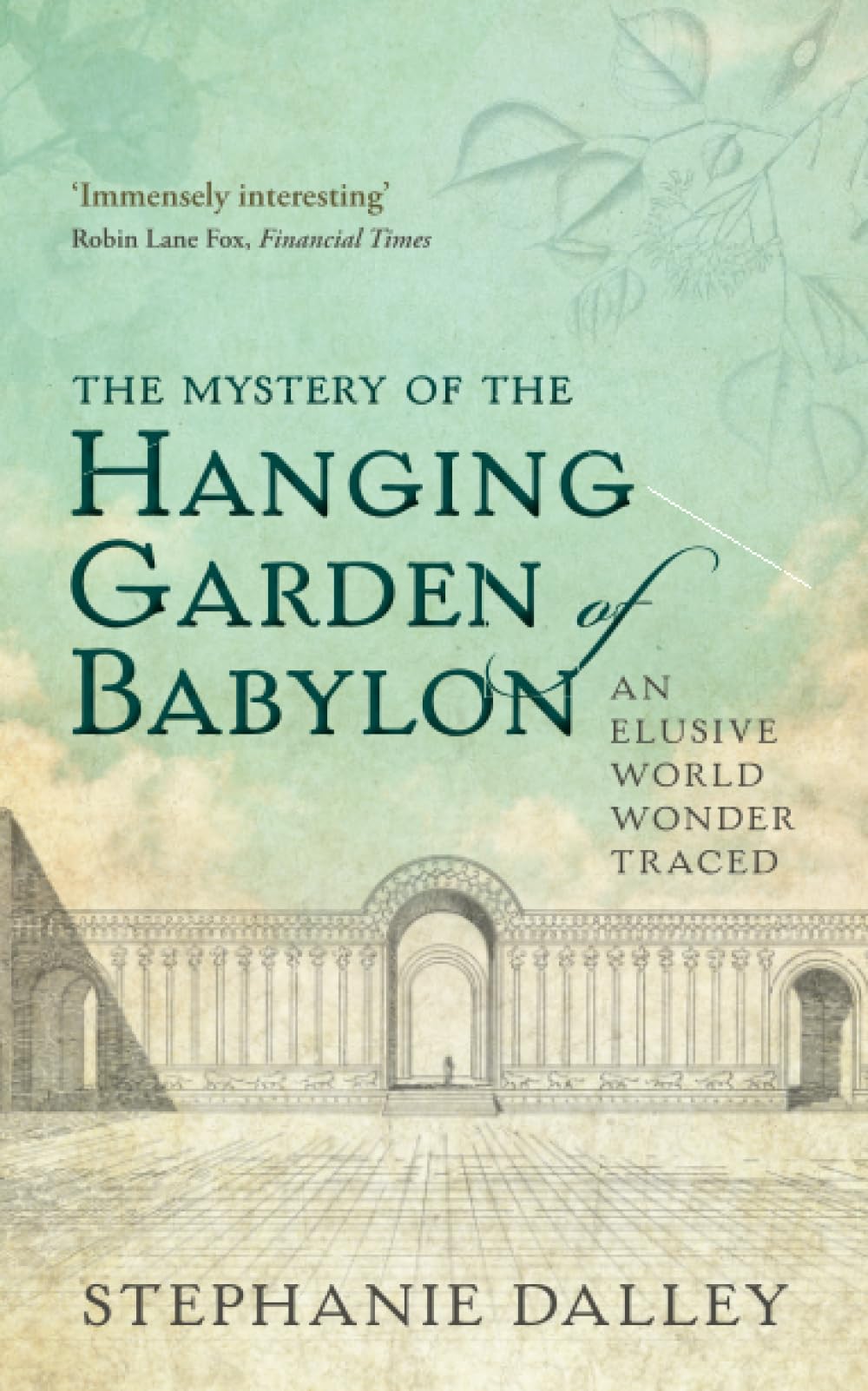
Buy The Mystery of the Hanging Garden of Babylon: An Elusive World Wonder Traced Illustrated by Dalley (ISBN: 9780198728849) from desertcart's Book Store. Everyday low prices and free delivery on eligible orders. Review: The Controversey of the Hanging Gardens of Babylon - Very interesting piece of ancient Mesapotamian history which we often forget in favour of history of the Nile civilization much of which followed a melenia after Mesapotamia. Dr.Dalley writes a very interesting book which has been followed by a program on television. She is obviously a very well informed Assyriologist and obviously loves that part of what is today the North of Iraq. However her conclusion that the Gardens were in Nineva and not Babylon is based on her conclusion that there is no evidence of the Hanging Gardens being in Babylon. The German Archiologist Robert Koldeway, in 1899 dug the various sites at Babylon for nearly fourteen years and unerthed many of its features including those reported by Diodorus. Among these was what appeared to him to be the cellar of the gardens including a room with three large holes in the floor. From which Koldeway concluded that this had been the location of the chain pumps that raised the water to the top of the gardens from where irrigation water would flow by gravity. The source of water would have been either a small farm channel from the Euphrates which flowed through Babylon or alternatively, if the three shafts were deep enough , from seepage from the river. The flow required to irrigate an area of 1.5 ha, which is the area given by Dr. Dalley for the Nineva gardens would require no more than a continious flow of three liters a second to deliver a water daily requirement of about 90 cubic meters in the summer months in the central climatic zone of Iraq, where Babylon is located. I found Dr. Dalley's information about the very advanced state of water management established by the assyrian king Senacharib very interesting, where she demonstrates that the inclined water lifting devices using helical shaftes (similar to present day archemedian screw pumps) was actually used by the Mesapotamians at least four centuries before the birth of the Greek Archamides. The fact that Alexanders legions would have camped by the Jerwan aquaduct (which used arched supports the like of which the greek homland would not have seen for several centuries to come) prior to the very decisive battle of Gogomela (where Darius iii, of persia was defeated and Alexanders armies progressed to the Nile, Babylon, Persia and the Indus) on the plains of Arbil is a very interesting point which further shows the historical importance of Mesapotamia, However I see no reason why there could not have been two such gardens (about 150 years apart), one in Nineva, built by Senecharib, and the second in Babylon, built by the Neo Babylonian Nebukadnezzar. As for there not being any evidence of the Gardens being in Babylon, there is apparently a report that they were destroyed by an earthquake in the second century BCE. Be it as it may, I am sure the controversey raised by this book may continue for a long time to come. Nejdet Al-Salihi (a Mesapotamian and an irrigation engineer). Review: Hanging Gardens History- The Mystery of the HANGING GARDENS OF BABYLON by Stephanie Dalley - Wonderful book by a lady Stephanie Dalley who can actually read the cuneiform script and loves her subject. She actually goes out to visit Nineveh taking her life into her hands with the help of guides, she has seen the huge aqueduct, which crossed another river and took water to the REAL HANGING GARDENS, (which the Babylonians copied down river)carried out around 705-703 BC; and used the type of palm trees which had a natural screw design, that enabled the people to draw water up to the gardens, in Archimedes style. Stephanie also reads Sennacherib's name in Cuneiform on the Aqueduct which he built, taking the waters from miles away in the ice melting mountains. What a feat! She courageously looks upon the devastation which after Isis had visited had been defaced further, and makes no comment in front of her guides and protectors, but her heart must be breaking. So much ancient art and architecture and information ruined further from Iconoclasts, and ancient history form which we could find out more is gone. Dalley states something that reveals what confuses Babylon Gardens with Nineveh's Hanging gardens. Babylon and Nineveh was known to the Greeks and Romans and much history written by them on the Euphrates and Tigris adds to our knowledge and understanding. The enthusiasm for engineering and controlling the waters was shared by Sennacherib and later kings such as Ashurbanipal, whose sculptured panels are preserved in the British Museum, as well as huge and beautiful sculptures of fish skin clad Wise men and Bull men;- the latter seen in Nineveh and destroyed by Iconoclasts.
| Best Sellers Rank | 143,052 in Books ( See Top 100 in Books ) 268 in History of Civilisation & Culture 14,178 in Reference (Books) 20,104 in Social Sciences (Books) |
| Customer reviews | 4.5 4.5 out of 5 stars (139) |
| Dimensions | 2.03 x 13.46 x 21.34 cm |
| Edition | Illustrated |
| ISBN-10 | 0198728840 |
| ISBN-13 | 978-0198728849 |
| Item weight | 1.05 kg |
| Language | English |
| Print length | 312 pages |
| Publication date | 5 Feb. 2015 |
| Publisher | Oxford University Press |
N**I
The Controversey of the Hanging Gardens of Babylon
Very interesting piece of ancient Mesapotamian history which we often forget in favour of history of the Nile civilization much of which followed a melenia after Mesapotamia. Dr.Dalley writes a very interesting book which has been followed by a program on television. She is obviously a very well informed Assyriologist and obviously loves that part of what is today the North of Iraq. However her conclusion that the Gardens were in Nineva and not Babylon is based on her conclusion that there is no evidence of the Hanging Gardens being in Babylon. The German Archiologist Robert Koldeway, in 1899 dug the various sites at Babylon for nearly fourteen years and unerthed many of its features including those reported by Diodorus. Among these was what appeared to him to be the cellar of the gardens including a room with three large holes in the floor. From which Koldeway concluded that this had been the location of the chain pumps that raised the water to the top of the gardens from where irrigation water would flow by gravity. The source of water would have been either a small farm channel from the Euphrates which flowed through Babylon or alternatively, if the three shafts were deep enough , from seepage from the river. The flow required to irrigate an area of 1.5 ha, which is the area given by Dr. Dalley for the Nineva gardens would require no more than a continious flow of three liters a second to deliver a water daily requirement of about 90 cubic meters in the summer months in the central climatic zone of Iraq, where Babylon is located. I found Dr. Dalley's information about the very advanced state of water management established by the assyrian king Senacharib very interesting, where she demonstrates that the inclined water lifting devices using helical shaftes (similar to present day archemedian screw pumps) was actually used by the Mesapotamians at least four centuries before the birth of the Greek Archamides. The fact that Alexanders legions would have camped by the Jerwan aquaduct (which used arched supports the like of which the greek homland would not have seen for several centuries to come) prior to the very decisive battle of Gogomela (where Darius iii, of persia was defeated and Alexanders armies progressed to the Nile, Babylon, Persia and the Indus) on the plains of Arbil is a very interesting point which further shows the historical importance of Mesapotamia, However I see no reason why there could not have been two such gardens (about 150 years apart), one in Nineva, built by Senecharib, and the second in Babylon, built by the Neo Babylonian Nebukadnezzar. As for there not being any evidence of the Gardens being in Babylon, there is apparently a report that they were destroyed by an earthquake in the second century BCE. Be it as it may, I am sure the controversey raised by this book may continue for a long time to come. Nejdet Al-Salihi (a Mesapotamian and an irrigation engineer).
C**N
Hanging Gardens History- The Mystery of the HANGING GARDENS OF BABYLON by Stephanie Dalley
Wonderful book by a lady Stephanie Dalley who can actually read the cuneiform script and loves her subject. She actually goes out to visit Nineveh taking her life into her hands with the help of guides, she has seen the huge aqueduct, which crossed another river and took water to the REAL HANGING GARDENS, (which the Babylonians copied down river)carried out around 705-703 BC; and used the type of palm trees which had a natural screw design, that enabled the people to draw water up to the gardens, in Archimedes style. Stephanie also reads Sennacherib's name in Cuneiform on the Aqueduct which he built, taking the waters from miles away in the ice melting mountains. What a feat! She courageously looks upon the devastation which after Isis had visited had been defaced further, and makes no comment in front of her guides and protectors, but her heart must be breaking. So much ancient art and architecture and information ruined further from Iconoclasts, and ancient history form which we could find out more is gone. Dalley states something that reveals what confuses Babylon Gardens with Nineveh's Hanging gardens. Babylon and Nineveh was known to the Greeks and Romans and much history written by them on the Euphrates and Tigris adds to our knowledge and understanding. The enthusiasm for engineering and controlling the waters was shared by Sennacherib and later kings such as Ashurbanipal, whose sculptured panels are preserved in the British Museum, as well as huge and beautiful sculptures of fish skin clad Wise men and Bull men;- the latter seen in Nineveh and destroyed by Iconoclasts.
M**K
Improve your historical knowledge
Learn more than you thought possible about the Hanging Gardens! However, I was not totally convinced that the real location was an historical error but it is a fascinating journey. Well worth a read.
A**N
Not to be missed!
This is a book reporting meticulous research into every aspect of a complicated and abstruse topic relating to our distant past. It is the culmination of many years of scholarly work. it is also written with an exemplary clarity of style making it accessible to the general reader. All readers will find the mists of time dissolving as they read this book, which establishes that the world wonder, the Hanging Gardens of Babylon were built not at Babylon by Nebuchadnezzar, but at Nineveh by Sennacherib. How such an apparent contradiction could come about is revealed step by step, and in following the arguments, we are offered an insight into the ways and patterns of thought of successive ancient civilisations. By the end of the book the displacement no longer seems at all improbable, and, on the way to the irresistible conclusions, the reader has been treated to a unique and most enriching journey.
E**S
well researched book
Having recently returned from a ten day visit in Kurdistan (Iraq) with an excellent guide who was enthusiastic about the history of this region I bought this book on her recommendation. Having visited the source of the water that by a system of canals fed the hanging garden and the ruined aquaduct that brought that water across difficult terrain I was excited to read that the garden itself could not have been in been in Babylon but was as this book convincingly shows was in Assyria, the empire in the north of Iraq in Nineveh. She has shown after two decades of careful research that the hanging garden of Babylon should now be renamed as the hanging garden of Nineveh.
D**S
Excellent book
This is an excellent book by a great scholar and writer. This should appeal to anyone interested in the history of Babylon and Ninevah. Dalley puts a convincing argument forward for establishing where the Hanging Gardens were, and how they were watered. I couldn't put it down; thoroughly interesting.
H**T
Livraison rapide dans un emballage parfait. Ouvrage très intéressant et bien écrit (rare dans le genre) qui bouscule bien des idées reçues depuis des millénaires; malgré l'absence de quelques photos couleur et malgré l' agrandissement insuffisant des gravures de bas reliefs, qui soumet le lecteur à la rude épreuve de la détection de détails, richement décrits par l'archéologue.
V**S
Though I lack the academic credentials to dispute any part of the author's solution to "The Mystery of the Hanging Gardens of Babylon", I enjoyed every step of her convincing investigation, and would be interested to read any serious objections. The footnotes and bibliography support the most thorough research into every aspect of the written and archaelogical evidence. There are many figures, and some color photos, including stills from her BBC documentary of 1999, which is now available on line. Since this is a mystery apparently solved, I shall not disclose any spoilers. However, here are a couple of things not generally known outside academic circles: An analysis of samples, taken in 1935, confirmed that concrete was used by the civilization that created the Garden. Even recent books continue to state that the Romans invented concrete, when in fact they perfected the mix by adding volcanic ash, etc, and were also masters of its use underwater. The use of bronze-cast screws, explained here, and recreated in the documentary, suggests that this civilization had mastered this device hundreds of years before Archimedes, who is usually given credit. And hydraulic engineering in general was of course an essential component. This book is not "fantastic archaeology", a speculative fantasy resting on nothing. It is a work of serious scholarship, well written for a wide audience. It belongs in every collection on archaeology and the ancient near east,and I have no reservations about placing it on my shelf with established studies in those fields.
V**N
Deciphering the cuneiform tablets already in museum collections has allowed this woman to prove that Ninevah WAS the site of the HAnging Gardens. Genius!!
G**C
The hanging gardens have been a mystery for many decades. It seems that this book reveals the truth. Besides solving the puzzle the book is excellent reading for everybody interested in archaeology of Mesopotamia. And it is a delight just to read it! gerhard chroust
L**E
I am a very keen gardener and like to read books about garden history. This is a scholary work and still very easy to read. I have a US stamp showing Mickey Mouse and Goofy with gardening gear with the Hanging Gardens in the background, so obviously there are others who agree with Ms Dalley that Nebuchanezzar was not the builder of these Gardens! Seriously however I agree with her theory. It is meticulously analysed and well argued. I would recommend this book to garden history lovers and those who like a good real historical mystery.
Trustpilot
4 days ago
3 days ago