
DOWNLOAD THE APP


Customer Services
Copyright © 2025 Desertcart Holdings Limited
DOWNLOAD THE APP
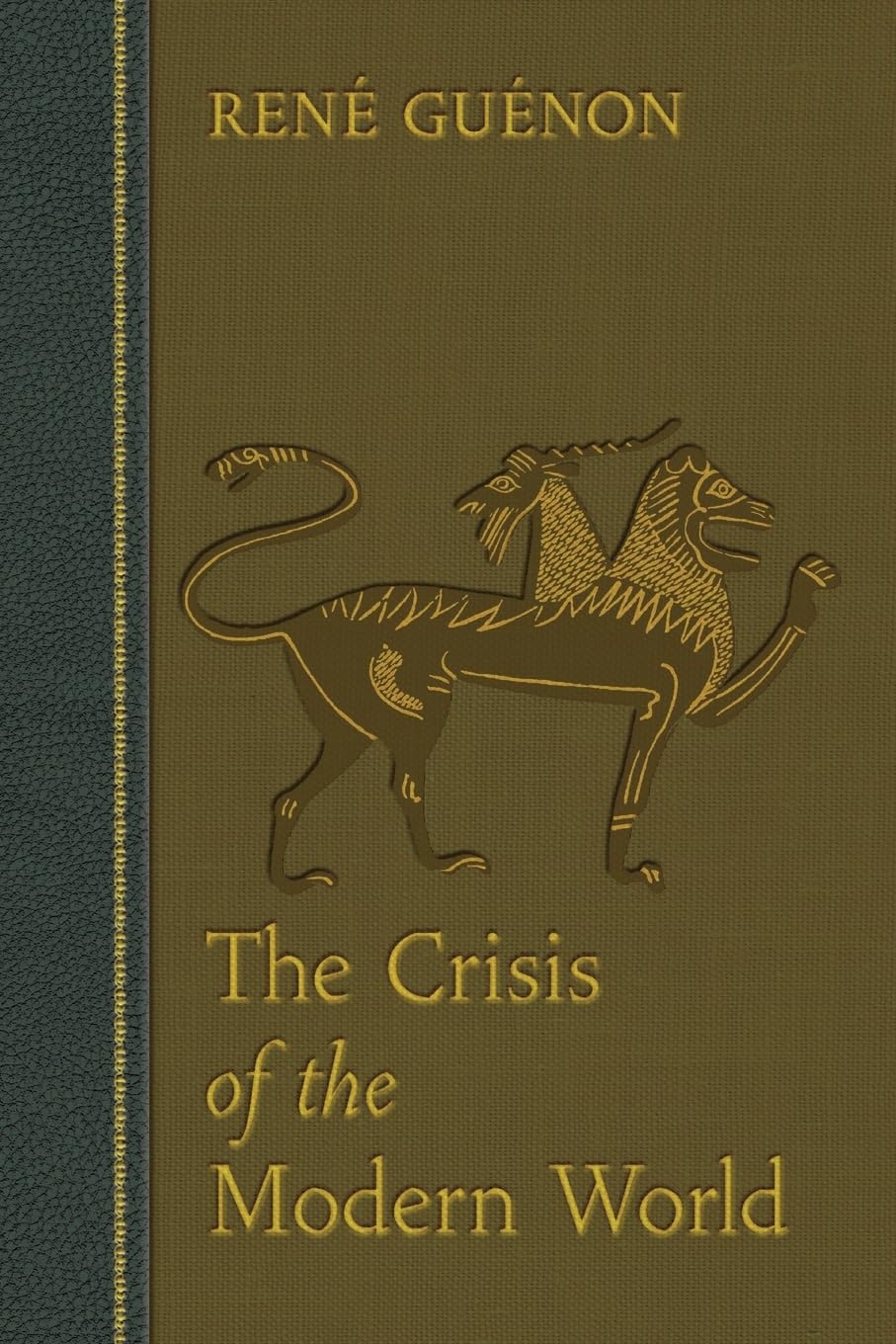
📖 Unlock the ancient wisdom behind modern chaos — don’t get left behind!
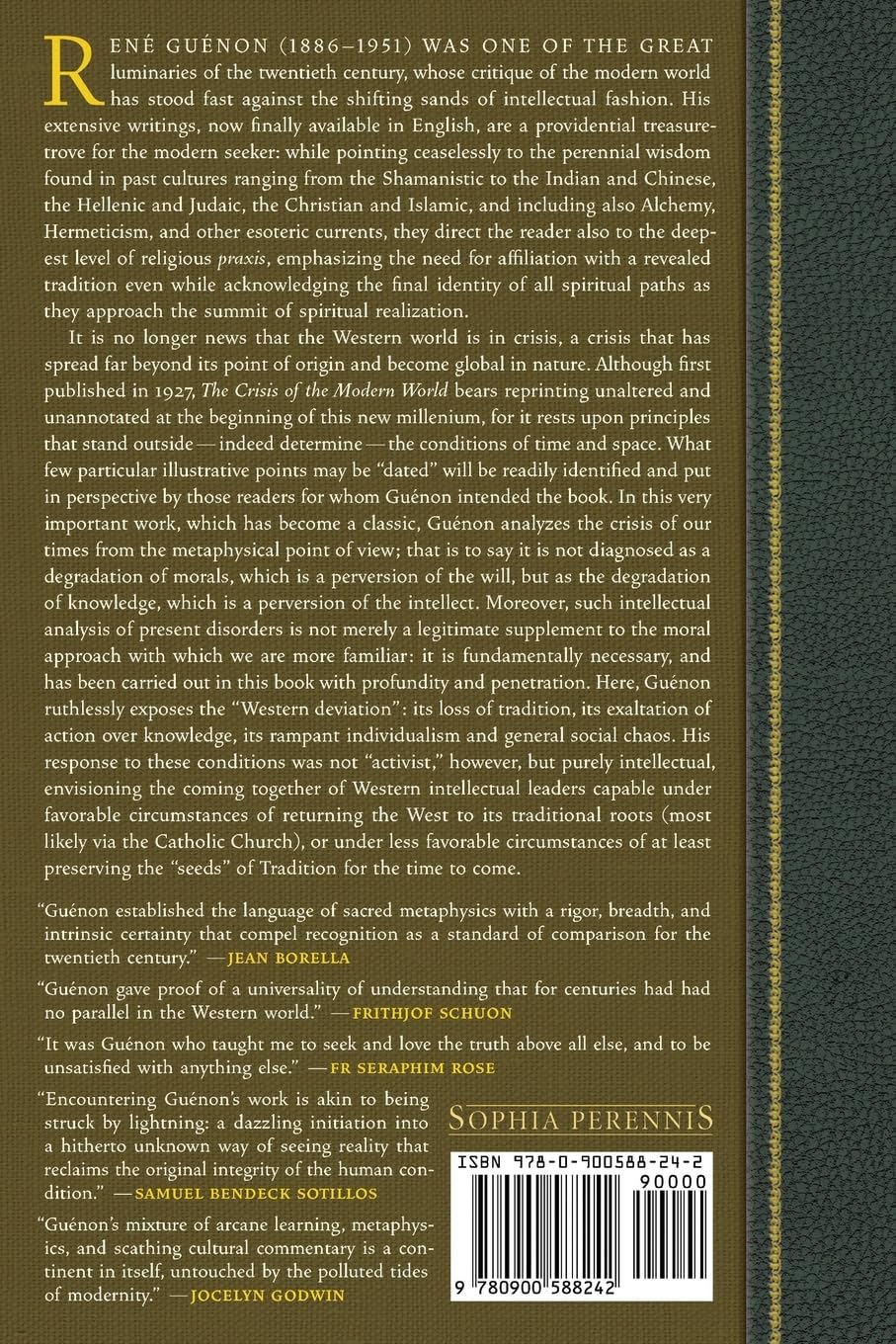
The Crisis of the Modern World by Rene Guénon is a seminal work in traditionalist philosophy, diagnosing the spiritual decline of modernity through the lens of primordial wisdom and metaphysics. Ranked highly in Comparative Religion and Cultural Anthropology, this used book in good condition offers a profound critique of materialism and relativism, making it essential reading for those seeking to understand the cultural and intellectual crises of our time.
| ASIN | 0900588241 |
| Best Sellers Rank | #52,104 in Books ( See Top 100 in Books ) #39 in Comparative Religion (Books) #86 in Cultural Anthropology (Books) #112 in Religious Philosophy (Books) |
| Customer Reviews | 4.5 4.5 out of 5 stars (300) |
| Dimensions | 6 x 0.31 x 9 inches |
| Edition | 4th Revised ed. |
| ISBN-10 | 9780900588242 |
| ISBN-13 | 978-0900588242 |
| Item Weight | 2.31 pounds |
| Language | English |
| Print length | 136 pages |
| Publication date | June 24, 2004 |
| Publisher | Sophia Perennis |
T**I
A Spiritual Conscience for Modern Madness
The scholarly world is never too short of what is in vogue as `critiques of modernity' that another addition to this stock would have been redundant. Guénon's The Crisis of the Modern World however, is not simply `another' of this but is distinguished by its profound wisdom, transcending conventional approaches that either diagnosed the symptoms and not the real disease or carried from an exclusively `philosophical' viewpoint, oblivious to the fact that `philosophy' itself is among modernity's offspring. Guénon's theme is sophia perennis, or primordial Wisdom, which seeks to resurrect the sacred metaphysics that lies at the root of the world's major religions. Guénon begins with the premise that the modern world as we know it corresponds exactly to the period of Kali Yuga (or Dark Age) in Hindu cosmology, similar to the Iron Age in Western traditional doctrine, a time when the forces of matter reign supreme and spirituality has been thoroughly eclipsed. In fact, history itself is a gradual process of declining spirituality and "progressive materialization", so that at the last phase of the human cycle (or the darkest of the Dark Age), mankind shall witness the abundance of material prosperity as has never been witnessed before, while simultaneously impoverished spiritually and utterly divorced from true intellectuality and hence truth itself. Intellectually, this decline is especially evident in science and philosophy. Philosophy - `love' of wisdom - became wisdom unto itself; `physics' - the science of `nature' in its totality - became a science that deals with only a portion of nature; astrology degraded into astronomy; alchemy degenerated into chemistry; and all that was once meaningful and bound to truth transcending the domain of matter and the world of sensible experience is reduced to bare facts bereft of truth, meaning and purpose. It is no wonder that the modern man today feels alienated from the world, from each other and from himself. The ancient sciences were invariably bound to metaphysical principles found in the world's great religions, made possible by the eminently religious and theocentric character of the earlier people. Truth for them is one, just as God is One. The different orders and aspects of Reality are but reflections of this same, single and universal truth. Whichever angle the truth is approached, contradictions only appear at the surface so that `specialization' would eventually lead to the convergence of the various disciplines, which explains why the ancients were so adept at mastering several different branches of knowledge at the same time, insofar as mastery of certain basic laws underlying all of reality permits their application to many different domains. Modernity by contrast, is built upon the spirit of opposition to religion (think of the Renaissance, Reformation and the Enlightenment) and therefore hostility to metaphysics and truth. Once the ultimate Truth is denied, the ground is cleared for the manufacture of many different "truths", tending naturally towards relativism and nihilism that are so prevalent in today's world. Indeed, relativism is the logical outcome of rationalism, this in turn being the result of humanism and individualism, which of course, is the "determining cause of the present decline of the West." Descartes' rationalism, instead of raising man to transcend himself towards truth, seeks to drag truth down to the "purely relative and human faculty" of rational thought. The mental outlook that made this possible is materialism, "a conception according to which nothing else exists but matter and its derivatives." Now this is significant even symbolically, for matter is essentially multiplicity and division, hence the source of strife and conflict. This decadence even manifests itself in the social order - from the separation of religion from the state, the triumph of mediocrity over the wise (democracy), the spread of `mass education' (which compromises the uniqueness of each individual) to the rise of the cult of `originality' in the intellectual domain, for whom it is better to create a new error than repeat an old truth. All this are but manifestations of the same catastrophe - neglect of spirituality, hence the loss of unity. Materialism is also tied to Western domination. The East has been traditionally religious, but in the face of (material) challenge and encroachment by the modern West, is now compelled to adopt the materialistic worldview to compete in this profane realm and in this regard, its religious past is certainly no guide. Where else would they seek guidance and `light', if not from the very civilization in which materialism organically springed forth? This is in fact how the present age fits neatly into that last phase of Kali Yuga as Guénon understands it, namely that the darkness of materialism will ultimately bring the whole world into its dominion (long before `globalization' and `end of history' became common lingo), marking finally the end of an era, i.e. the end of a human cycle, or Manvantara, where `the wheel stops turning.' This is when chaos, conflict and strife will erupt as never before, a time known in Christianity as the reign of the Antichrist and in Islam as the era of Dajjal. There is a way out - for the establishment of a spiritual elite to lead the masses out of this darkness. This elite necessarily has to operate covertly, like a secret puppeteer when others could not see the strings, for the masses have become deeply entrenched in their materialism, which continuously creates in them more artificial needs for materiality than it can satisfy. In the West, the only institution capable of bringing about this change is the Catholic Church, which alone is in possession of the sacred traditional doctrine of Christianity. Yet even then, Guenon remains skeptical and calls for the Western world to summon aid from what modicum of true spirituality is left in the East, unadulterated by the `modernized' outlook that is fast making headways throughout the Orient.
M**N
Solid Introduction to the Traditionalist School
Although I'd more so recommend Frithjof Schuon as a starting point, you can't really go wrong reading this book either, which is not a substitute for other more metaphysical works but which well circumscribes the essential contrast between the traditional and modern world. Experienced traditionalists will find little here that hasn't already been stated ad nauseam. Blah blah doctrine of the four ages, blah blah Kali Yuga, blah blah hierarchy, and so on. If you already know a lot about the traditionalist school you might as well just skip this and go on to other books. Although, Guenon's attack on conformist spirituality here is pretty apropos, an idea that other traditionalists have briefly touched on as well. Guenon's pointed language is, at least, amusing enough to justify a look. One blemish (maybe a couple) stand out in this work. First of all, in this work Guenon had an overly optimistic view of the Catholic Church as a potential point of restoration. His views, and the Traditionalist school of thought more broadly, is officially rejected and refuses to admit any such thing as a transcendent unity of religion as well as esoteric spirituality. Fellow Traditionalist Julius Evola remarked on this in his autobiography, stating that Guenon simply included this positive evaluation as a matter of technicality but knew it would most likely be an exercise in futility. In view of the rapidly liberalizing Church of today, we can safely say that this idea is thoroughly unsound. Second, Guenon frequently speaks throughout his books of a more or less intact traditional spirituality in the east. Like his statement about the Church, this one has also aged poorly. China, home to the esoteric tradition of Taoism, has since been through a communist revolution under Mao and is now a materialistic technocracy of a kind. Japan's imperial government exists without any serious power and its people are being swept away by work culture just like us in the west. Suffice to say that the state of the east is no longer less advanced in terms of spiritual decay than the west, and that Guenon's assessment here was meant for another era. All-in-all, this book is a staple title in the Traditionalist lineup. If you're new to these ideas, you can't go wrong by giving this a read. It will put you in the right mindset, serving as a great point of departure for other ideas. If you're not new, maybe you might still something out of certain critiques found within.
A**O
Good book poor binding
There were about twenty pages loose.
S**A
Estou relendo a tradução em inglês. A tradução em português me foi emprestada. Toda a obra de René Guenon merece ser relida com calma. E é o que estou fazendo! Ele tornou-se ainda em vida um Mestre do Sufismo. Previu com décadas de antecedência as mudanças que hoje estamos vendo. Estou lendo com muito vagar pois ainda tenho outros livros para ler.
K**I
第一次世界大戦の終了直後、「世界の終わり」を感じさせざるをない時代状況の中上梓された本書は、「個人主義」「進歩主義」「物質主義」など、様々な意匠で現れている近代=西洋文明思想を、この世界を超えた原理の否定として性格づけ、多角的な批判的検討を行っている。 近代に対するに「伝統精神」の復興を唱えるところは、いわゆる保守主義と軌を一にするが、世界の伝統宗教に共通に含まれる純粋形而上学の観点からそれを行っているところが、ルネ・ゲノン、またゲノンにはじまるペレニアリスト・スクールの特徴と言えよう。そこから、近代主義の変種としての「擬似伝統」「擬似宗教」の危険性の告発も行い得ているのだ。 今日の世界にもそのまま当てはまりそうな分析診断の数々は、過度の単純化を差し引いても傾聴に値する。幸い邦訳(『世界の終末――現代世界の危機』(平河出版社))もあり、この20世紀の預言書を、ぜひとも多くの人に読んでもらいたい。
G**L
Absolutely brilliant. Needs to read again and again. The material west is in a severe crisis and it is the traditional East which it needs to look at to escape. The West only knows domination either by war or economics. Such an attitude does not hold a good promise for the future of the world.
G**N
Written in 1946 and everything said applies today
M**N
René Guénon dissects the Western World and Modernism, as a dead end: literally. In a comprehensive and unsentimental way he demonstrates how the materialistic culture of the West has lost all touch with the supra-tradition that has direct links to Real Knowledge, that remains a living factor in the East. He predicts the West will (and must) fall, the darkest representation of the deepest murk of the Kali Yuga. He saw very little hope of redemption. Reading this, at the time of viruses and lockdowns, surrounded by pernicious and devious propaganda with no spiritual awareness in it at all, it is hard to disagree with Guénon. We may only hope the current flirtation with authoritarian madness is the gateway from one world to the next (a birth of an Age based on the power of Intellectual Intuition). Martin Lings, whom I met, lived with Guénon in Egypt in the war years. He later wrote a powerful book on the End Times. Guénon is not a catastrophist. He knew the Universal Tradition always has an ‘ark’ as he calls it. But, for him, the West has little left to offer humanity as a whole. Looking around at our masked and thoughtless society, led by the senile, the technocratic and buffoons, we believe his prophecy is even more certain now.
Trustpilot
1 month ago
2 months ago