
DOWNLOAD THE APP


Customer Services
Copyright © 2025 Desertcart Holdings Limited
DOWNLOAD THE APP

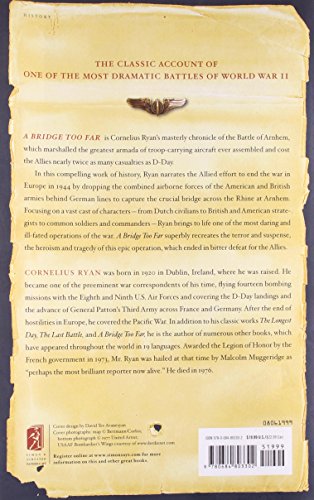
Full description not available
M**M
Ryan is a Terrific Author!
This book is one of my favorite WWII books - a great read!
D**N
Tremendous information on the impact of the military operation.
True account of the famous operation designed to end WWII by Dec of 1944.
F**K
A Top WWII Read on Arnhem - a Battle so Notable but so often Forgotten
One of the best WWII books that I have read in quite some time. First of all, Ryan writes in a very artful fashion - easy to read but with very rich detail and narrative with a lot of well-crafted research every step of the war. In addition to readability that is very difficult to match (to me, even superior to Ambrose), the author lays out the invasion from conception to its rather challenging conclusion. He details every aspect of Market Garden from the role of the top brass to the bravery of the Red Devils, the Polish Airborne, The U.S. Airborne (82nd and 101st) under Maxwell and Gavin, and Horrock's XXX Corp which get bogged down early in the fight. I really appreciated the individual detail to the soldiers on the ground and the anecdotes provided both at the beginning and the end (as well as what happened to them after the war if they survived). Also, there was very good detail regarding the German forces, the Dutch underground and the Dutch citizenry who were extremely helpful to the wounded of all combatants. The author does a good job in detailing the discussions about the attack between Eisenhower and Montgomery - I was surprised that Ike went along with the plan, especially as the intelligence came through detailing German SS Panzer Divisions in the proximity. The plan really did appear fanciful from the beginning but it appears that the Allies were chomping at the bit to utilize their airborne forces and drive a wedge into the Ruhr/Rhine at this critical juncture. Ryan detailed well the critical mishaps that occurred from the communications snafus to the bad weather and the inability of the various ground forces to properly coordinate. But they really did come close to achieving their objectives all things considered. However, the opportune arrival of Von Zangens troops in addition to the Hohenstauffen and Frundsberg Divisions weighed heavily on the attempt to merge "Market" with the "Garden". The combat endurance and resilience of the various airborne units was very impressive - I had previously read about the 101st in Bastogne but had less info on the 82nd and very little on the British and Polish commands. Maybe if Patton was leading the tank charge up, the outcome might have been different. Either way, actually reaching the bridges in time and before they could be demolished was risky business and the high roads did not help in regard to painting the advancing armor as super-targets. Many interesting twists and turns involved in this often under-appreciated battle. This was a very enjoyable book and I would heartily recommend to anyone.
D**L
Military History at its Best
After devouring Ryan's The Longest Day (about D-Day in Europe), I thought reading military history couldn't get any better. But A Bridge to Far is a triumph of accuracy, neutrality and readibility that few militarian historians ever accomplish.The book should not be chosen as an introduction to World War II. Much knowledge on the part of the reader is assumed, from the causes of the war to the prosecution of the war through the Normandy invasion in June of 1944. The book can be read by the World War II neophyte, but much of the depth will be lost. For those who have a working understanding of the war, the book is a delight. Integrating the machinations of SHAEF with the simple needs of the lowly private, Ryan describes the absolute tragic failure of the Allies to surround the German forces remaining around Antwerp, Montgomery's brilliant if somewhat naive idea for ending the war quickly, the inevitable problems arising with a plan that calls for the retention of a single, long south-to-north corridor for reinforcement and supply, the valor of both the Allied and German soldiers, and the anti-climatic end of the battle for the Arnhem bridge. (The Arnhem bridge was destroyed by allied bombing shortly after the battle. A second battle of Arnhem took place in April 1945 when the city was liberated by I Canadian Corps of the First Canadian Army. The bridge was rebuilt after the war and named The John Frost Bridge after the valiant commander of the British paratroopers.)Reading the book--as with any good history--prompts additional inquiry. Good information on the battle can be found on the web at places like [...].I highly recommend this book for all who are interested in World War II, military planning, field execution of complicated plans, individual valor and the fog of war.
R**G
Enjoyed this book.
I read The last battle by Mr. Ryan and I really enjoyed it . This was a good read very insightful because Mr Ryan interviewed many of the soldiers that were still living at the time of writing. I would recommend this book.
D**S
Couldn't put this book down
This was an amazing read, from beginning to end. There are of course a lot of names to try and keep track of, but Ryan does an excellent job peppering personal stories, remembrances and details among the more tactical and historical notes taken from war diaries and interviews with allied and German forces that fill the nearly 600 pages of this book. Accounts of personal bravery, sacrifice, professionalism, humanity and honor -- bring the characters (Allies and the Germans, along with Dutch resistance & civilians alike) to life and it's hard to imagine an operation (let alone a war) like this ever happening again. The end result is a book that I didn't want to put down. Ryan has masterfully spun this narrative in such a manner that instills glimmer of hope and optimism (no matter how faint) -- of course we know that the Allies will lose this battle, but even while reading it you get the feeling that maybe they can scratch out a victory, and it's only in the last chapter or two when even the reader has to finally admit that it's over.
R**)
Military History at its best
Without a doubt, my favourite history book of the WW2 era.Weaving a masterful tale of civilian struggle, epic battles, and fateful military decisions at high command, Ryan (who wrote most of this book on his deathbed) presents the definitive story of the doomed allied attempt to end the Second World War in a bold stroke with the launch of Operation Market Garden. Plagued by bad luck, fateful indecision, and stubborn German resistance, the descriptions of war have lost none of their potency as we chart the British, American, and Polish struggle to win a campaign that was supposed to last no more than two days (it went on for ten)Although lacking up to date modern material, and recently discovered material from Dutch and German archives (it was written in the 1970s) A bridge too far retains all of its vibrant relevancy.Military history books can often suffer from tedious descriptions of military organisation or fall into the trap that war isn't really that bad. This book is neither, plotting a line between both extremes.Although a keen military historian, there was never a sense that a layman reading about Market Garden for the first time, would find much to trouble them, detail wise. As mentioned, it's the perfect blend of narrative and human drama.
J**F
The classic account of Arnhem
Whatever books you read on this still-controversial battle, Cornelius Ryan's magisterial account must be one of them. It has the advantage of having been written when many of the key players were still around to share their personal accounts. Beyond this, the author has the gift of being able to put the reader in the middle of action (or at least, as close as most people will wish to get). That makes the book very readable, even though it's not a short account. The often larger than life characters are depicted memorably. As for blame for what went wrong, this is dealt with in a detached and even-handed way that takes no sides. One of the essential WWII books.
M**R
A well written, balanced history - and a thunderingly good read
This book is fairly ancient now, and its subject is fading into the mists of time too, but it is a vital element of the library of any Second World War buff. It is a story which can be read and appreciated in isolation, relating to a single, short, and ultimately unsuccessful campaign, but I think it is best read after a thorough review of D-Day (another book by Cornelius Ryan may help here, among many others)and the subsequent liberation of France and Belgium. This context is important, as an understanding of the rivalry, between Montgomery and the American forces, a rivalry which seemed to border on jealousy on Montgomery's part, is vital, if one is to have an idea of why Market Garden took place. The normally cautious Montgomery, usually a thorough, meticulous and assiduous planner, grabbed hold of the idea for Market Garden and launched it after hurried planning and an unfortunately inadequate appreciation of intelligence reports, despite the best efforts of the intelligence community. The result was, as the title proclaims, a bridge too far. Armchair strategists will analyse this till the cows come home, but for me the flaw was having Urquhurt's men land seven miles from their target - the bridge at Arnhem. The British Paras were a match for anybody, but their progress to the bridge was slow, after all, the Germans were fighting too. In the end, Frost's battalion put up an epic resistance which was admired and respected by the very men who were trying to annihilate them. To no avail. American general Jim Gavin in his memoirs relates the bitter taste of knowing that he could not help his brothers in arms in Arnhem. My father talked about Arnhem quite a lot. He hadn't been there, having enlisted in the Royal Navy before conscription swept him into the army. He lost a good many of his friends at Arnhem, and always thought that "there but for the grace go I". Always an iconoclast, he held Montgomery in low esteem for having ignored the reports coming from the Arnhem area before the battle, that there were two SS divisions refitting in the immediate vicinity of where Urquhurt's men were due to arrive. "Brave men's lives wasted" was my father's comment. Well, he had personal reasons to doubt the value or the sense of Market Garden, but for me, it is hard not to draw the conclusion that the operation was a reflection of Montgomery's growing concern that the Americans were going to beat him to Berlin first. He convinced Eisenhower that this would shorten the war if it succeeded, and the decision to proceed was taken. Had the timeframe allowed a little (a lot?) more planning, then changes would surely have been implemented to the plan which would probably guaranteed its success. Was it worth the risk? Yes, probably. Maybe even definitely, given that they missed by only seven miles. But it remained a Bridge too Far. The dashing and charismatic General Brian Horrocks said "This is a story you will tell your grandchildren... and mightily bored they will be!" Here, at least, Horrocks was wrong: it is a tremendous story of superhuman courage, and it is splendidly told. Highly recommended.
A**R
Montgomery , A. Selfish Army Commander
Supposedly good at fixed set battles but even at El Alemain he had to take more than two changes of plan to achieve his objective. This book shows just how badly things can go wrong with decisions being made that del upon others to put things right then for the decision makers to claim the glory of the end result.
S**R
What a book!
I recently purchased It Never Snows in September by Robert Kershaw based on a recommendation in Al Murrays excellent Watching War Films With My Dad; the book presents the German view of Operation Market Garden, the disasterous allied attempt to shorten world war II by seizing a series of bridges over rivers and canals in Holland culminating with the Rhine crossing at Arnhem. Unfortunately, around about a third of the way through I was thoroughly bogged down without a clue who was who, where they were and what they were doing there. This is no fault of Mr Kershaw but rather my lack of knowledge about the battle. Back onto Amazon to purchase "the" book on the subject, Cornelius Ryan's A Bridge Too Far, and what a book it is!I read military histories the way some people read the sports pages but I usually have to have Google Earth open to track the action and a notepad and pencil to track the individual players but even then find myself backtracking to remind myself who commanded "2nd platoon, B company, 9th battalion, The Royal Loamshire Regiment" and by the time I've found that I've forgotten whether they are attacking or defending Hill 252, or is it Hill 525?. This book, on the other hand, is really well written and tells the story in such a lucid manner that you find yourself, like a good thriller, wanting to read just another page before you put it down then find you've completed another chapter and it's only two hours before you should be getting up for work.The story itself is absolutely heartbreaking with it's incompetence, arrogance and the squandering of mens lives long after the point of the operation was passed; the Polish drop, days after it should have taken place, is particulary heart rending, arguably they could have saved a lot of time, effort and precious aircraft simply by murdering the paratroopers in England rather than letting the Germans do it in Holland.If, like me, you've only seen the film of the same name I recommend you read this book - you'll be amazed how much you didn't know
Trustpilot
3 weeks ago
2 weeks ago