Some deliveries may take a little longer than usual due to regional shipping conditions.

DOWNLOAD THE APP


Customer Services
Copyright © 2025 Desertcart Holdings Limited
DOWNLOAD THE APP

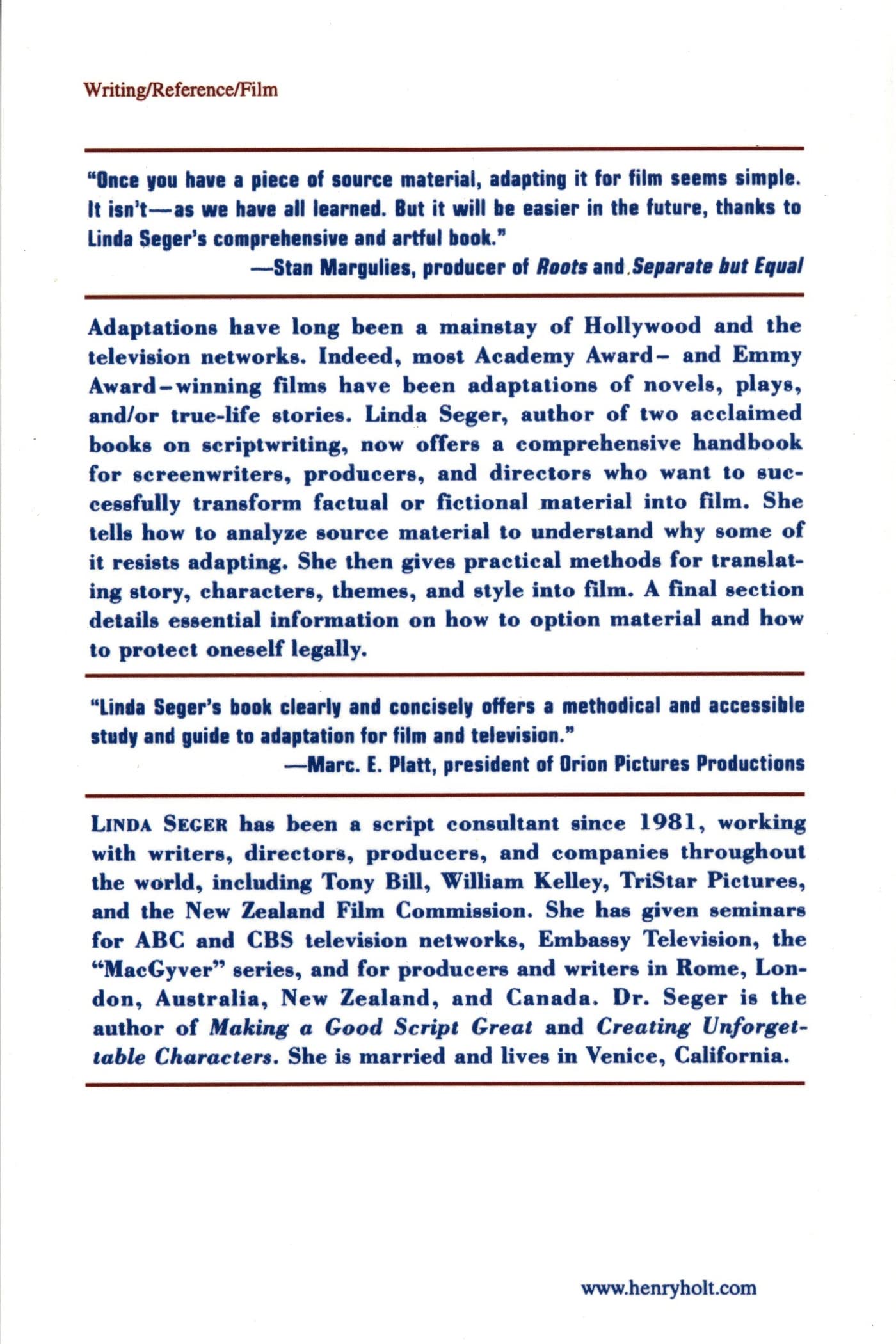
The Art of Adaptation (Owl Books)

G**N
Very Practical even though dated
Adapting a novel to a screenplay is like trying to get into a room by climbing through the keyhole in the door. The first problem is learning how to write a screenplay in the first place. This book doesn't really do that. The second problem, though, is much more difficult: how do you fit a 250 page novel into a 110 page screenplay? What is important and what is not? Which characters should you keep and which combine and which jettison? What subplots are essential and which are extraeous? What dialog should be kept and what translated into a visual instead of a verbal? This book answers all these questions and more. It is like an adapter's Bible. Cannot recommend it enough. And if you don't recognize the movies and novels she uses as examples, you shouldn't be adapting anything. So don't complain about how dated it is.
D**A
An Excellent Book on Adaptation
Historically, more than 75 percent Academy Award and Emmy Award-winning films have been adaptations of novels, short stories, plays, nonfiction books, and articles.Linda Seger sets the tone of THE ART OF ADAPTATION on the opening page: "In spite of what we may think, there is no such thing as an easy adaptation. We've probably all heard people say, `All you have to do is film the book,' Francis Ford Coppola tried that with the 1974 version of `The Great Gatsby,' and it failed. Others say, `This was immensely popular it's bound to be a blockbuster.' `Bonfire of the Vanities' was a best-seller, but the film was panned."With exceptional lucidity, the author explains the issues and solutions in adaptations from fact and fiction into film. The book includes two detailed examples of successful adaptations: E. M. Foster's novel "A Room with a View" and Andrew Lloyd Webber's play "The Phantom of the Opera." Other examples include "Gone With the Wind," "It's a Wonderful Life," "Deliverance," "Dances With Wolves," " Silence of the Lambs."This was the first Linda Seger screenwriting book I read. Impressed, I went on to study three more: "Creating Unforgettable Characters"; "Making a Good Script Great"; "Advanced Screenwriting." Each of them a five-star book.-- C J Singh
S**D
Good reference material
Not having read other books on adaptation, I have nothing to compare this one to but as a stand alone book, it offers a lot of good information on different types of materials to adapt and things to consider when looking for material to adapt.Seger's writing is easy to follow and I find myself referring back to sections I've highlighted so I guess that means I'm getting something out of it. She occasionally seems to spend too much time on analyzing some stories (I found the "Gone with the Wind" stuff to drag quite a bit) but overall you get a lot of insight into different parts of the adaptation game which makes this a good read for those considering or about to take on an adaptation.
B**N
New Thoughts within the Structure
I am the author of a novel (The Circumstantial Enemy) that I'd like to turn into a screenplay. I know nothing about writing scripts, so I'm reading how to do it. This is my seventh "how to" book on the art, and the only one so far that concentrates on this aspect. Linda does a wonderful job of keeping the reader's mind on structure and at the same time offering a guidelines on how to tear the novel apart and reconstruct it as a screenplay.
A**T
covers the basics well, but a bit dated
Seger does a good job of covering the basics of how to adapt a published work &/or a real-life story into a saleable screenplay. The final section of the book explains the legal aspects of optioning a script, and this is extremely helpful as well. On the down side, this book was published in 1992 and most of the examples Seger uses are from films that were released around that time. As someone who was born in the late 70s, I found myself skipping paragraph after paragraph about movies that I'd never seen, or that I hadn't seen in 10 years. The book is further dated when Seger gives mailing addresses and phone numbers of places to seek more information -- pretty much no one had a website in 1992. If you've recently watched Room With a View, Deliverance, Out of Africa, Reversal of Fortune, Driving Miss Daisy, and Field of Dreams, you'll probably connect with this book better than I did.
S**N
Review
This book was purchased for a screenwriting class. The instructor uses it as one of our textbooks. Our assignments were from that book and others. I would recommend it to writers because sometimes we can take other people stories and rewrite them in other forms with additional information.
G**R
Must read if you're adapting a novel
Complete instructions on what you need to do. It's not as easy as it seems. You already need to know how to write a screenplay, this only covers how to adapt.
A**E
The update of a former work it was especially valuable ...
The update of a former work it was especially valuable regarding writing a true life script. Just what I needed
Trustpilot
1 month ago
3 weeks ago