Some deliveries may take a little longer than usual due to regional shipping conditions.

DOWNLOAD THE APP


Customer Services
Copyright © 2025 Desertcart Holdings Limited
DOWNLOAD THE APP
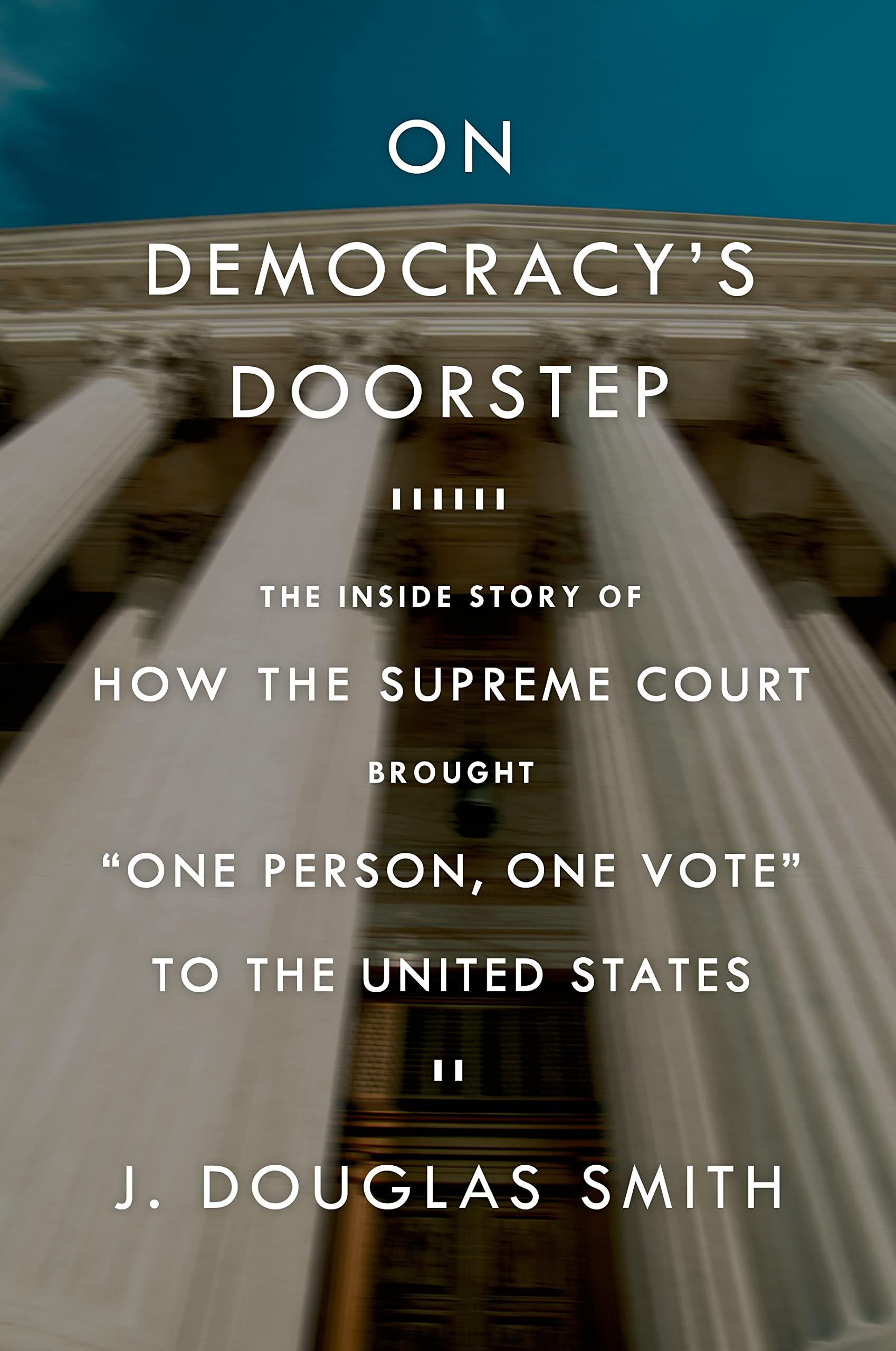
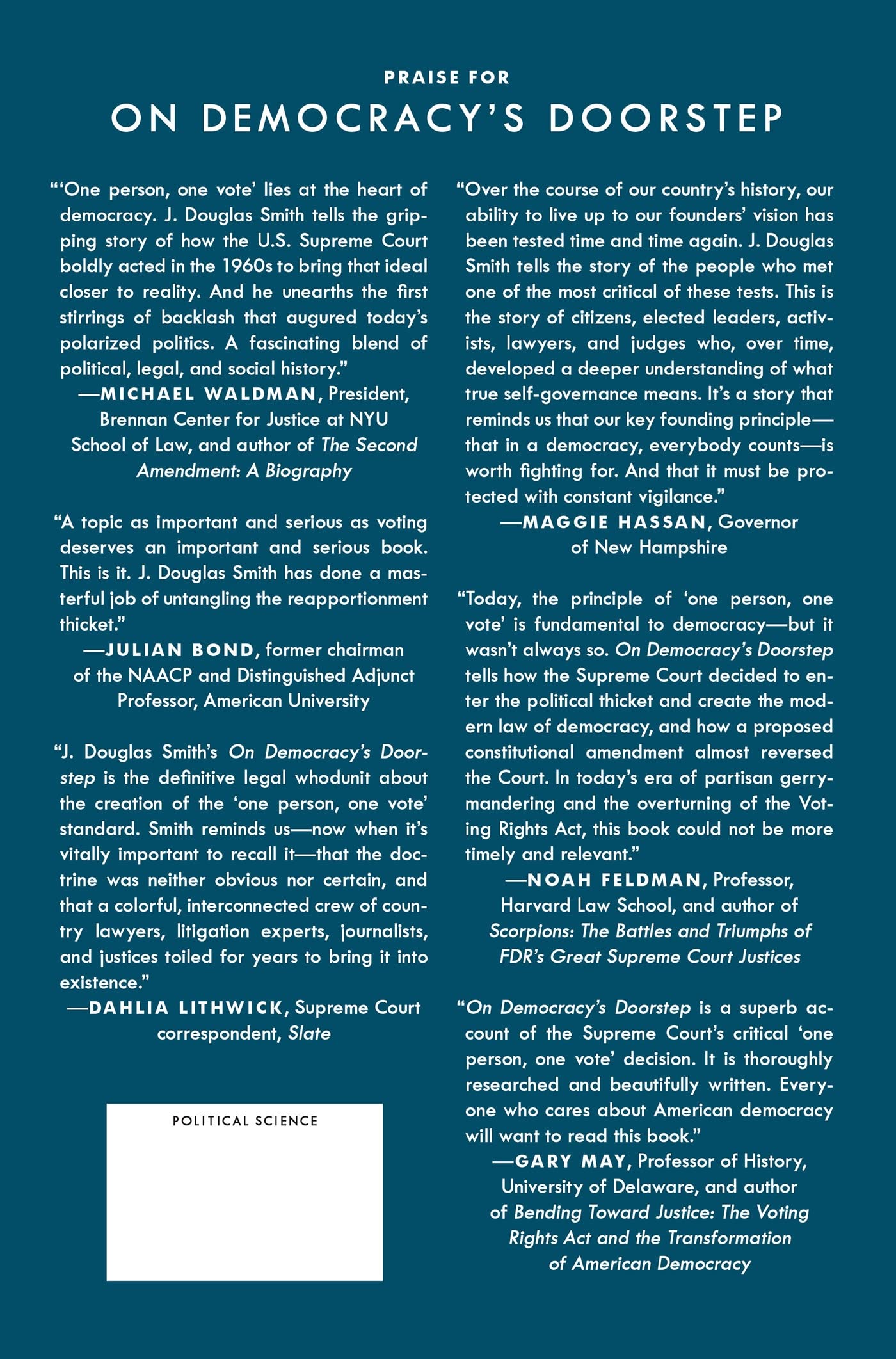
Full description not available
A**N
A Superb Account
This book provides an excellent account, amply corroborated by primary sources cited in the notes, of the long struggle for reapportionment of U.S. House of Representatives districts and state legislatures on the basis of "one person one vote." In a series of decisions from 1962 to 1965, the U.S. Supreme Court held that apportionment issues were not merely "political questions" beyond the reach of the federal courts, that state governments were required to devise electoral districts for the U.S. House of Representatives that were roughly equal in population, and that state legislative districts (including both houses of a bicameral legislature) had to be drawn so that each district comprised an approximately equal number of people as every other district. These decisions abolished the long-time practice of federal and state legislative districts in which people in urban or metropolitan areas were grossly underrepresented in the U.S. House of Representatives and in state legislatures.After these decisions were issued, the Senate Republican Minority Leader, Everett Dirkson of Illinois, led a years-long effort to obtain a constitutional amendment that would overrule some or all of their holdings. He worked on both of the alternative prongs of the amendment procedure in Article V of the U.S. Constitution: attempting to obtain adoption in the Congress (requiring a two-thirds majority of each house) of such a constitutional amendment to be submitted for ratification by three-fourths of the states, and, alternatively, to have the legislatures of two-thirds of the states request a federal constitutional convention in order to overrule the reapportionment decisions. Senator Dirkson was unsuccessful on both counts, though he almost succeeded in obtaining the approvals of two-thirds of the states for a new federal constitutional convention. The latter prospect horrified many people in both parties, because it was not clear whether a constitutional convention could be limited to one issue; liberal Democrats and some Republicans expressed concern that such a convention might repeal important provisions of the Bill of Rights, as least as those first ten amendments to the Constitution had been construed and applied by the contemporary Supreme Court led by Chief Justice Earl Warren.In the Epilogue of his book, the author discusses the results of these epic Supreme Court cases. The reapportionments did cause state legislatures to pay more attention to the needs of urban residents. However, even as the reapportionment battles were being waged, people were moving from urban to suburban communities that usually had little interest in the problems of the cities. These suburbs often voted Republican rather than Democrat, contrary to the expectations of many politicians and media commentators. One of the reasons for the failure of Senator Dirkson's proposed constitutional amendments is that members of his own party came to realize that they might find a strong political base in the growing suburban communities.Moreover, the legal success of reapportionment has resulted in political forces turning to different methods to ensure the political success of special interests. This book was first published in 2014. The author observes (page 283) that "after June 1964, both political parties, no longer able to gain an advantage simply by designing districts made up of wildly divergent numbers of people, came to rely on gerrymandering more than they had before. After the 1970 census and every ten years thereafter, legislators across the nation turned to gerrymandering with gusto. In October 2012, the Atlantic referred to gerrymandering as 'the dark art and modern science of making democracy a lot less democratic.'” I might add that the Supreme Court will soon be addressing the issue of partisan gerrymandering in a case it will decide in the term ending June 30, 2018: Gill v. Whitford, U.S. Supreme Court Docket No. 16-1161. It would not be surprising if the Supreme Court looked to the history of the reapportionment cases for guidance, especially on the issue of the applicability of the "political question" doctrine—the threshold justiciability question that has heretofore prevented the Court from becoming involved with partisan (as distinguished from racial) gerrymandering cases and that similarly delayed consideration by the Court of apportionment cases before its decision in Baker v. Carr, 369 U.S. 186 (1962).The author of this book also notes (page 284) that "the Court’s historic embrace of one person, one vote comports uneasily with fears that its more recent actions may have enabled 'one dollar, one vote' to become a more accurate description of American democracy. Today, corporate interests and anti-tax groups continue to push a probusiness, anti-labor agenda of low taxes, limited government spending, and minimal regulation. The Chamber of Commerce, once Dirksen’s primary ally, has led the way as business groups, freed from spending limits by the 2010 Supreme Court decision in Citizens United v. Federal Election Commission, now spend tens of millions of dollars per election cycle in an effort to influence public policy."The author concludes the book with the observation (page 290) that Chief Justice Warren "understood all too well that the journey remained unfinished—and that the struggle to affirm and reaffirm the rights of individuals to a truly equal voice in a representative system of government must go on."
A**Z
Fascinating subject
Perhaps others will find this story dry and uninteresting, but I found it fascinating. Growing up at that time, I had no idea of this important fight going on around me. And of course the JFK assassination obscured other things. This is an important issue, and I am so pleased to have learned all about it.
C**R
Five Stars
good
M**L
A step-by-step description of how the Supreme Court forced states to establish greater political equality among their citizens
This is a fine book that carefully traces the numerous cases making their way to the Supreme Court regarding the blatant malapportionment of state legislatures that had evolved in America by the early 1960s. In a sense the subtitle should be reversed to state that the book addresses "how the United States brought 'one person, one vote' to the Supreme Court," given how much time and research the author has devoted to the origins of the cases the Court considered. I grew up in St. Louis in the 1950s and was appalled to realize how malapportioned the Missouri legislature was. When I got the chance to study these cases in graduate school, I was delighted to see how decisively the Court had struck down this undemocratic practice. My only quibble is that the author delves into so many examples of malapportionment, giving due credit to so many attorneys who worked on these cases on a mostly pro bono basis, that it is sometimes difficult to keep them all straight.
R**N
A REAL EYE-OPENER TO THE POLITICS OF THE U.S.
I received a copy of this book through a giveaway on GoodReads and the following is my honest opinion.In high school history had always been my best subject with about a 93 average, from the 10th to the 12th grade. The depth and breadth of the information author, J. Douglas Smith, has covered in his book is extraordinary when compared to what I’d been taught.One would think given the democracy we reportedly live in; one person one, one vote has always been the way part of the democratic process. “On Democracy’s Doorstep” proves the contrary had actually existed prior to the Supreme Court decisions which corrected this situation.The politics used by both parties, the Democrats and the Republicans, to maintain the levels of apportionment they’ve enjoyed for decades; as well as the gerrymandering of districts even within the same party to keep a particular individual in office would be deemed by those unfamiliar to the “Game of Politics” to be unbelievable.To read about the details described by the author concerning the shenanigans pulled by both parties to keep their status quo is a real eye-opener to the uninitiated common citizen of the United States.I’m therefore giving Mr. Smith my thanks and 5 STARS for opening the door and removing the “veil of secrecy” to the issue of “one person, one vote” for all those who read his book.
C**S
An Undertold Story
I had barely heard about this court case. I certainly had never heard about all the history before and afterwards. This book does a wonderful job of explaining why this was such an important court case and what people did to try and stop this.
Trustpilot
5 days ago
3 weeks ago