Buy anything from 5,000+ international stores. One checkout price. No surprise fees. Join 2M+ shoppers on Desertcart.
Desertcart purchases this item on your behalf and handles shipping, customs, and support to Greece.
⚡ Detect with confidence, illuminate with ease — the pro’s choice for safe, smart testing.
The Martindale NC4 Dual Sensitivity Voltage Tester offers professional-grade non-contact AC voltage detection from 12V to 1000V with dual sensitivity modes. Featuring audible and visual alerts via a bright red LED tip and buzzer, an extended probe for hard-to-reach areas, and an integrated LED torch for low-light conditions, it’s designed for precision and convenience. Compact and lightweight with smart battery-saving auto power-off, the NC4 is a reliable essential for electricians and DIY pros alike.


| ASIN | B07TP5BLRW |
| Best Sellers Rank | 18,780 in DIY & Tools ( See Top 100 in DIY & Tools ) 19 in Voltage Testers |
| Brand | Martindale |
| Colour | Yellow |
| Country Of Origin | China |
| Customer Reviews | 4.4 4.4 out of 5 stars (656) |
| Global Trade Identification Number | 05036162188039 |
| Included Components | batteries |
| Item Dimensions | 15.5 x 2.5 x 2.5 centimetres |
| Manufacturer | Martindale Electric Co Ltd |
| Manufacturer Part Number | NC4 |
| Maximum Operating Voltage | 1000 Volts |
| Measurement Type | Voltmeter |
| Minimum Operating Voltage | 50 Volts (AC) |
| Model Number | NC4 |
| Power Source | Battery Powered |
| Product Warranty | 2 year manufacturer |
| Style Name | Single |
R**N
Does the job!
Works as it should!
F**N
NC4 not too sensitive, just about right.
I was looking at getting the Fluke 2AC/90-1000V but found that it does not have an audible alert and the LED isn't great in bright light. I looked at the 1AC-II which has an audible alert, however the UK version is only 200-1000V. Ignore UK suppliers advertising the 90-1000V, you'll receive the UK 200-1000V model. I wanted to have a non-contact tester that would indicate lower voltages such as 110V. Having recently bought the Martindale VT12 Voltage Tester and found it to be very good (see my review) I took a punt on the Martindale NC4 as a companion device. The NC4 has two sensitivity ranges 12-1000V AC (not DC) and 50-1000V AC with a nice audible alert and flashing red LED when it detects my 240V domestic supply (I don't have anything lower in AC to test). It also has a handy LED torch function. When you first switch on the NC4 the bright red LED flashes once a second to indicate that it is in the 50-1000V range. Briefly pressing the button again switches to the 12-1000V range and the red LED flashes twice in one second. Turn off the NC4 by pressing the green button for 2 seconds or it will eventfully auto-power off. I did a 240V test of how well it works where there are three wires in close proximity. I cut the end off a cable exposing the Live/Neutral/Earth to a length as you would when fitting a UK plug. I then plugged the other end into 240V so making one of the three exposed wires live with the other two dead cables close to the Live. In the 50-1000V range the NC4 probe had to be approximately within 3mm of Live for it to alert, it did not alert when placed near the other cables even though they are close to the Live. In tight spaces it is unlikely that you will get false positives from cables that are not live when they are close to a Live. That is an excellent result, I've read reviews where these devices are far too sensitive and pick up so-called "live" cables when in fact they are picking up the Live from one close-by. I much prefer to be almost touching the Live cable, the probe is long and suited for this very purpose. In the 12-1000V range you merely have to be within 50mm of the cable for it to detect Live, handy for checking thicker cables and wall/light sockets (it isn't sensitive enough to detect cables within walls). You'd also use this when waving it around to find a Live cable and then you'd switch to 50-1000V to focus in onto the individual Live cable. As with any device there is the odd gotcha with these things that can trip you up: When using a non-contact tester it is important to know that when testing cables you should move the probe all around the circumference and up and down the length of the cable as the Earth cable could be blocking the detection of the Live in a twisted core. You should of course test the device on a known Live before use (and after use if it didn't find anything as it could be faulty!). As with any device of this nature (like neon screwdrivers) you should NEVER use it to test for dead. These devices are not reliable enough to put your life at risk, in a tight space these devices can easily be fooled if the Earth wire is blocking the Live wire. Use with caution and know the limitations of your kit. If you must rely on a device for testing for dead then a Martindale VT12 is absolutely what you should be using. I can not stress the importance of using a VT12 to test for dead and not one of these non-contact devices, or you might be dead yourself!
L**6
A touch too sensitive
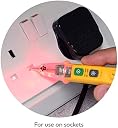
It's pretty good, and I like that it has a light and 2 sensitivity settings, but it's still too sensitive! If for example youre testing which brown is your feed at a switch this will just beeb away once youre near it, making it difficult to tell whats live and whats just a switch wire, making the 2 sensitivity settings kind of redundant! This does however make it more reliable than my old Fluke pen at testing whether a circuit is actually live or not so I would put more trust in this device than the fluke for that purpose although you should never assume a circuit is dead, but better for example at testing sockets at the face rather than having to open it up! Good, but i wish sensitivity was refined more, or better yet adjustable with variable resistors inside the casing!
S**E
A magic wand
I volunteer at a repair cafe and this little marvel as been a game changer for tracing electrical faults. It detects current flow and helps identify what components are working or not working without having to dismantle the whole thing.
8**D
Great safety aid
Everyone who gets involved with potentially live wiring should have one of these. Few tips on use: Prove before and after use (easy to see it is on - but still essential to prove it is functioning). With cable or flex it is possible for the earth conductor to shield the live conductor. You can demonstrate this by running the detector along a flex where inside the wires are twisted into a helix. The detection will go off and on. Easy to remove this risk by running the probe around the flex or cable and not just at one spot. In the video the three core white cable is "live" with 240V. The twisted individual cores are simulating why the signal drops out periodically due to shielding.
T**T
Great tester
Works very well for testing live electricity
J**D
Good purchase
Does the job it is made for.
V**H
Great gadget for anyone
This is a perfect gadget that every household should have. It alerts you to any live electrical items so you know it is safe to undertake DIY, change fuses, light bulbs etc. would thoroughly recommend. Price is great and so is the quality. Its small enough not to be in the way.
C**C
Très pratique pour les interventions urgentes lorsque il s'agit de vérifier la présence de courant sans utiliser un multimètre.
Trustpilot
2 weeks ago
4 days ago