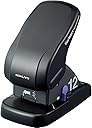


No needle stapler Kokuyo (desktop 12 sheets) SLN MS112D (japan import) Review: Excellent performance, really ingenious - Excellent performance, really ingenious, no doubt best for paper, which does not need to be stored for long periods ( albeit the sheets are hard to separate from each other, they can be ) BUT THE MANUAL WAS COMPLETELY IN JAPANESE! It has to be translated because there are tricks involved with this little machine too. You can figure them out experimentally, but a good manual would be a gift from Heaven. Review: Beware! Too Much Fun! - First, I acknowledge that, as other reviewers have stated, the instructions are only in Japanese. However, these instructions come with diagrams, which will be sufficient for most users. And, let's also consider whether-and-when a product created for a market in one country should be dinged for not providing instructions in the language of another. I am glad to be able to get this device, even though the Japanese did not create it with me in-mind. This staple-less stapler is essentially a descendent of the Bump staple-less stapler (invented by American George P[endleton] Bump, 14 May 1870 – 19 Feb 1947); it cuts tabs and slits into the papers, and then folds and feeds the tabs through the slits. Generally, this method creates a more reliable attachment than that of crimping papers together, as do some staple-less staplers for five sheets or fewer. Unlike the Bump device, this device creates tabs with flanged heads, making the attachment a bit more secure. The producer makes a number of staple-less staplers, some of which crimp and others of which use the Bump method. This particular model seems to be their high-end device, with a slightly higher capacity and conceived to make it easier to produce results of professional quality. If you can survive only able to attach ten-or-fewer sheets, and are unconcerned about precisely placing the attachment, then you can save some money by getting a different model; but both stationery geeks and supermodels will sneer at you.


| ASIN | B0074ZTPFA |
| Customer Reviews | 4.2 out of 5 stars 253 Reviews |
| Item Height | 15.5 Centimeters |
| Item Weight | 0.58 Kilograms |
| Manufacturer | Kokuyo |
| Number Of Fasteners | 12 |
| Number of Fasteners | 12 |
| Operation Mode | Manual |
O**.
Excellent performance, really ingenious
Excellent performance, really ingenious, no doubt best for paper, which does not need to be stored for long periods ( albeit the sheets are hard to separate from each other, they can be ) BUT THE MANUAL WAS COMPLETELY IN JAPANESE! It has to be translated because there are tricks involved with this little machine too. You can figure them out experimentally, but a good manual would be a gift from Heaven.
D**N
Beware! Too Much Fun!
First, I acknowledge that, as other reviewers have stated, the instructions are only in Japanese. However, these instructions come with diagrams, which will be sufficient for most users. And, let's also consider whether-and-when a product created for a market in one country should be dinged for not providing instructions in the language of another. I am glad to be able to get this device, even though the Japanese did not create it with me in-mind. This staple-less stapler is essentially a descendent of the Bump staple-less stapler (invented by American George P[endleton] Bump, 14 May 1870 – 19 Feb 1947); it cuts tabs and slits into the papers, and then folds and feeds the tabs through the slits. Generally, this method creates a more reliable attachment than that of crimping papers together, as do some staple-less staplers for five sheets or fewer. Unlike the Bump device, this device creates tabs with flanged heads, making the attachment a bit more secure. The producer makes a number of staple-less staplers, some of which crimp and others of which use the Bump method. This particular model seems to be their high-end device, with a slightly higher capacity and conceived to make it easier to produce results of professional quality. If you can survive only able to attach ten-or-fewer sheets, and are unconcerned about precisely placing the attachment, then you can save some money by getting a different model; but both stationery geeks and supermodels will sneer at you.
J**O
Sencillo de usar, resistente y buena calidad
Me gusto que sujeta varias hojas y que trae la opción de que la perforación sea en 2 posiciones. Se siente resistente y que va a durar mucho tiempo. Trae una guía en un lado, por si se quiere sujetar la hoja de ambos lados, volteando las hojas. todas las instrucciones vienen en japones, pero por las ilustraciones, se entiende. No he tratado de sujetar 12 hojas. Pero creo que no debe de tener problemas en hacerlo. Recomiendo esta engrapadora sin grapas. Otra cosa es que lo que sujetes con esta engrapadora, no tienes problemas para después de que ya no sean necesarias las hojas, las tritures en cualquier trituradora, ya que al no tener grapas no dañara la trituradora.
M**R
Kokyo
Dieses Teil ist einfach unglaublich. Stanzt eine Lasche aus dem Papier und fädelt sie wieder unter eine andere Stanzung, sodass die Papiere durch diese eingefädelte Stanzung gehalten werden. Ich hab einen Ordner mit Papieren, die alle geklammert waren, und der an der gekalmmerten Ecke fast voll, ansonsten aber nur eindrittel voll war, mit dem Kokyo geheftet und die Draht-Klammern rausgemacht - und in dem Ordner ist wieder jede Menge Platz. Ich versteh zwar nichts von dem, was in der Beienanleitung steht, ich kann keinerlei Japanisch, aber ich hab die anleitung noch nicht gebraucht. Möglicherweise steht da ja noch was drin, was man sonst noch alles mit dem Gerät anstellen kann. Ich werd also in absehbarer Zeit wohl mal versuchen, eine Übersetzerin kennenzulernen..... ;)
昭**ん
デザインや作りがいい
新聞なんかが、ズレるのが嫌でとめるために購入しました。他に12枚とめれるものが他社で安く出ていますが、これにして良かったです。デザインや耐久性はしっかりしていて、よいです。とめるのも、しっかりとまっていて、力もいりません。大きいという意見もありますが、こんなもんだと思います。
Trustpilot
3 days ago
3 weeks ago