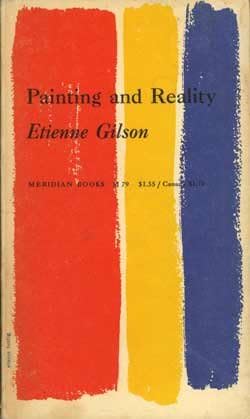
Painting and Reality (Meridian books)
Product ID: 156239820
Etienne Gilson was a French philosopher and historian of philosophy, especially medieval philosophy, The book is about the kind of reality proper to paintings and their relation to the natural order. He writes in the own problem exactly what has a philosopher to learn from painting? This book, therefore, is the work of a philosopher asking himself philosophical questions on what he happens to know about a certain art. Just as we can philosophize about science, about history, or about religion, so also we can philosophize about art. The first chapter of this book will make clear, I hope, the reason it has seemed advisable to confine this inquiry to what philosophy can learn only from the art of painting." Review: A philosopher's reflections on painting - This is a wonderful book for anyone interested in what makes a good painting. It is a very eloquent reflection by a philosopher, Gilson, as part of the Mellon Lectures in the Fine Arts. Gilson's ideas are considered a bit passé in the art world now, but they're still worth reading. He's largely arguing against the position that paintings are supposed to say something. For example, he argues that paintings are essentially non-representational. So he distinguished between paintings and pictures. Pictures are representative; the best picture is the one that looks the most like what it is supposed to represent. But this can't be what it means to be a painting if we think that things like Impressionist art are also good paintings. Otherwise we would have to say that the Impressionists did a bad job because all of their paintings look like sort of fuzzy versions of the original. Rather, Gilson says these kinds of paintings are typical of the move away from paintings as pictures to paintings as paintings. Paintings as paintings are, properly speaking, attempts to create purely aesthetic beauty-the beauty of lines, shapes, and colors. So, for example, in a Cezanne it is not the representation of apples and pears which is important, but only the beauty of the colors, shapes, and lines by which they are depicted. That's a very quick and dirty summary of Gilson's argument. If you're interested in painting or other fine arts and you're at least a bit philosophically inclined, I think you'll like this. It's not always particularly exciting, but it really does make a good, solid argument. Like, I said, if you agree with Gilson that beauty is what makes good art, then you won't be very popular in the art world these days. Review: WARNING: There are no pictures in the Kindle edition - wonderful book, needs pictures keyed


| Customer Reviews | 3.9 out of 5 stars 12 Reviews |
G**E
A philosopher's reflections on painting
This is a wonderful book for anyone interested in what makes a good painting. It is a very eloquent reflection by a philosopher, Gilson, as part of the Mellon Lectures in the Fine Arts. Gilson's ideas are considered a bit passé in the art world now, but they're still worth reading. He's largely arguing against the position that paintings are supposed to say something. For example, he argues that paintings are essentially non-representational. So he distinguished between paintings and pictures. Pictures are representative; the best picture is the one that looks the most like what it is supposed to represent. But this can't be what it means to be a painting if we think that things like Impressionist art are also good paintings. Otherwise we would have to say that the Impressionists did a bad job because all of their paintings look like sort of fuzzy versions of the original. Rather, Gilson says these kinds of paintings are typical of the move away from paintings as pictures to paintings as paintings. Paintings as paintings are, properly speaking, attempts to create purely aesthetic beauty-the beauty of lines, shapes, and colors. So, for example, in a Cezanne it is not the representation of apples and pears which is important, but only the beauty of the colors, shapes, and lines by which they are depicted. That's a very quick and dirty summary of Gilson's argument. If you're interested in painting or other fine arts and you're at least a bit philosophically inclined, I think you'll like this. It's not always particularly exciting, but it really does make a good, solid argument. Like, I said, if you agree with Gilson that beauty is what makes good art, then you won't be very popular in the art world these days.
T**O
WARNING: There are no pictures in the Kindle edition
wonderful book, needs pictures keyed
H**C
I believe it's quite Good.
Present to my cousin who studied art in Italy. I think he liked it.
W**R
MISSING THE PHOTOS OF THE PAINTINGS
This book discusses paintings. In the original book, a copy if each painting discussed is included in book. This reprint is MISSING THE PICTURES. The book is not really understandable if you cant see the images. The original book is FANTASTIC, really great commentary and color plates but it is out of print. I have seen another reprint that had black and white plates (not so bad) but this version has no plates at all, even though there is a list of plates at the beginning. Go figure.
J**M
Wonderful book.
Gifted author, incredibly well informed.
V**O
Libro interessante
Entrega rápida, en la tienda más cercana y no en casa a pesar de las señales de seguimiento :/ La calidad del libro es... bueno... demasiado plastificado para mi gusto... pero ok El libro no trata de pintura, trata de cómo la pintura puede ayudar a definir la filosofía monista del autor (o formalista como se dice en las plásticas). Llegué a este libro a través de citas de Walter Swennen,
Trustpilot
4 days ago
2 weeks ago