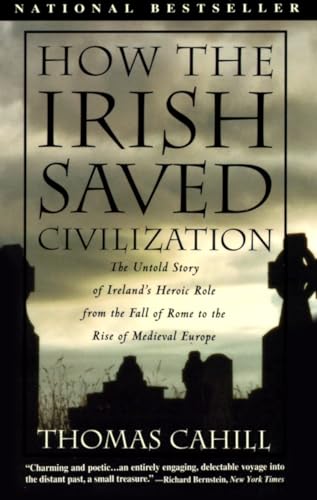
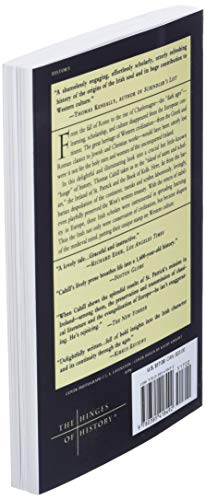
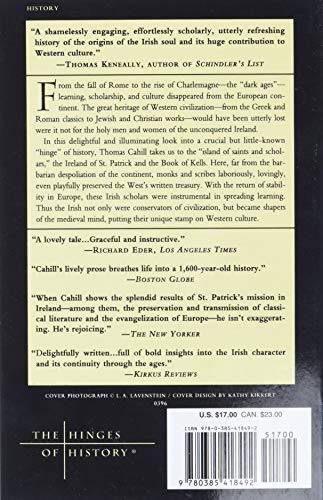

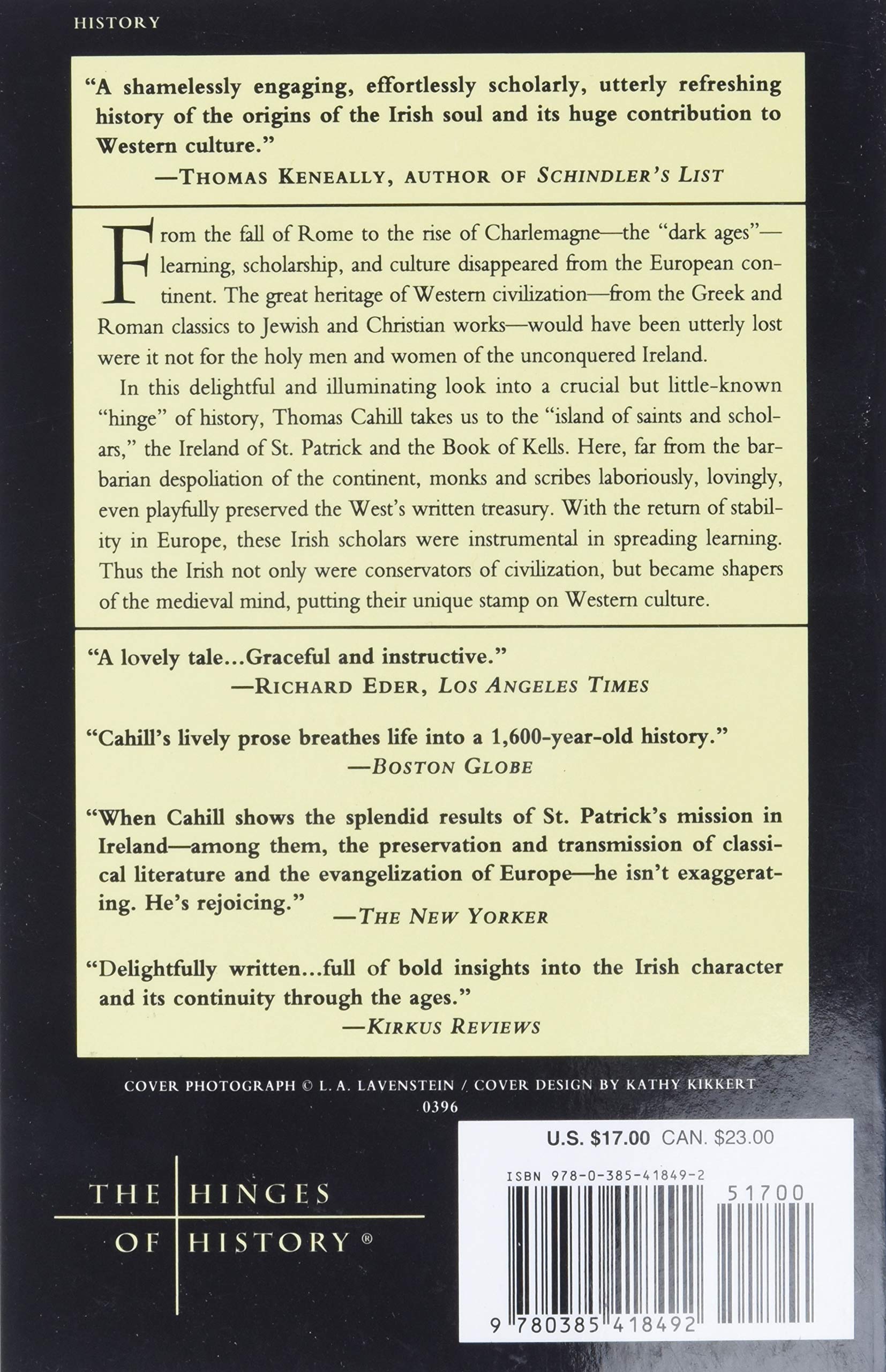
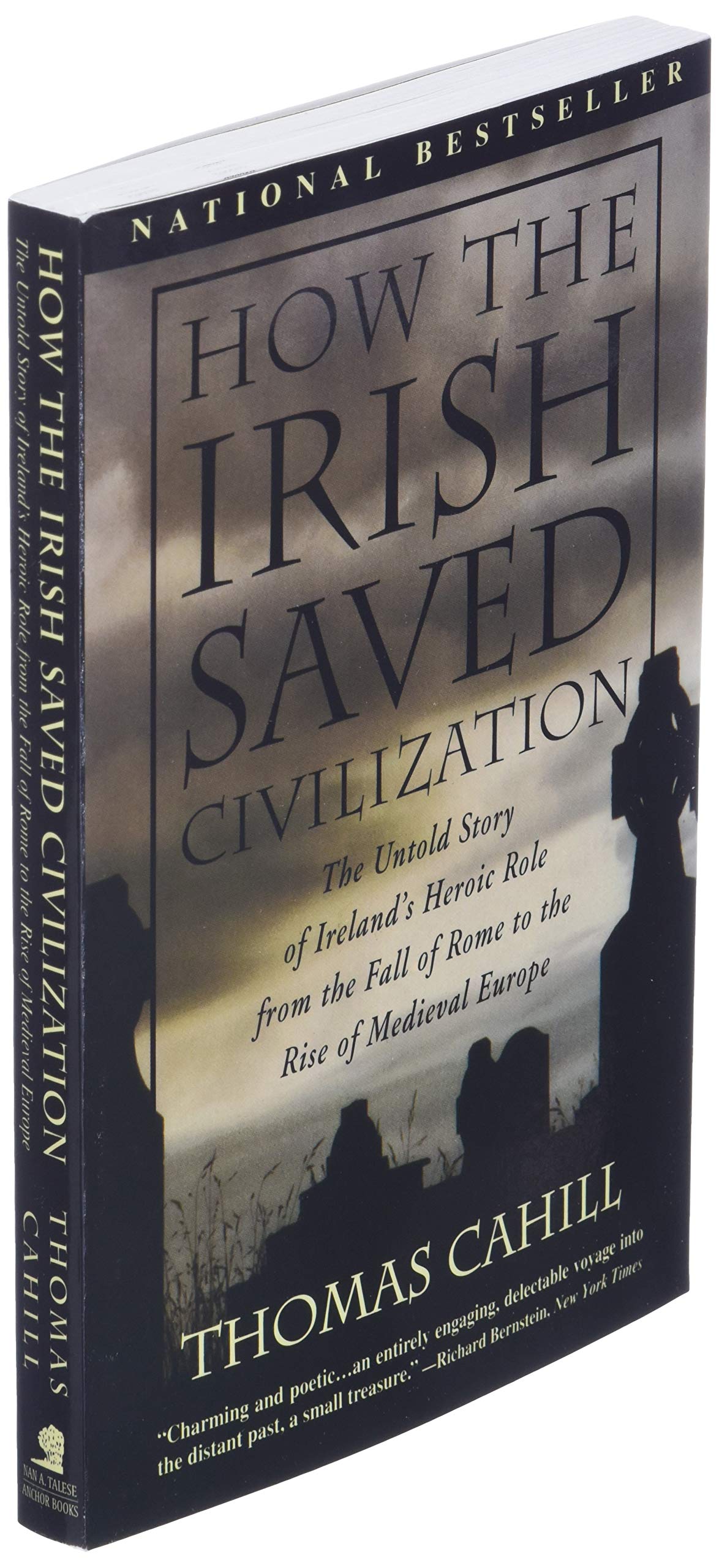
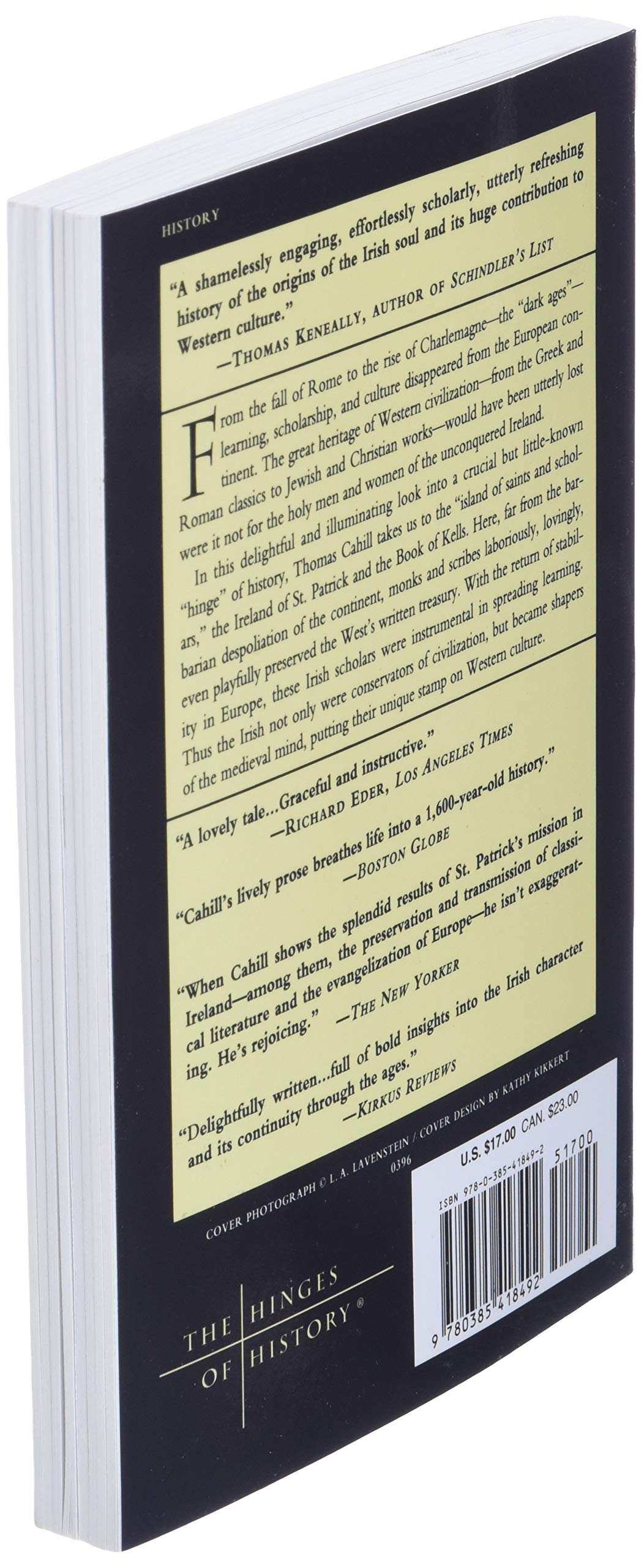
How the Irish Saved Civilization: The Untold Story of Ireland's Heroic Role From the Fall of Rome to the Rise of Medieval Europe (The Hinges of History) [Cahill, Thomas] on desertcart.com. *FREE* shipping on qualifying offers. How the Irish Saved Civilization: The Untold Story of Ireland's Heroic Role From the Fall of Rome to the Rise of Medieval Europe (The Hinges of History) Review: a bypassed gem - I've heard much about the book over the years. But it really isn't a period of history that i am particularily interested in, so i never followed up on the hearing about it to buy a copy. So it got into that list of book:"if you trip over a copy, pick it up and read it". It ought to have been in the "must read now" list. I'm sorry i postponed reading it and don't really understand why, i wonder how many other gems i know about but haven't looked at. sure wish "God doesn't deduct from man's allotted time, the time spent reading"...but i know better. IT was a joy to read, from clever word choices to hints of big ideas long suppressed or overlooked in the usual historical textbooks, a hint of esoteric knowledge hidden from mere mortals. The major themes are probably at least partial true, but after finishing the book, i'm not sure it matters, it is just an engrossing story told by a very competent and interesting storyteller. That is the great strength of the book, it is a tale well and interestingly told. There is one thing i'd like to specially follow up on in my reading. That is how the Irish "temper" modified the "Roman" and yielded a different kind of Christianity as the Irish monks carried their books back into Europe. This is the theme of Celtic Christianity that i see occasionally as i browse bookstores for the new and interesting. The problem, for me, is that it is a nearly cultic topic that consists of a lot of trash to be waded through to find the gems. So like the best of books, it engrosses and allows you to loose yourself in the reading and causes new ideas to bubble up and supply incentive to go to the library and get more. My highest recommendation which is "give to the wife and tell her to read it"..... one of the very best things about desertcart reviews are emails from people who read the review. i received an interesting note about this review and thought i'd include my response to it here, so i edited the review and added to it. this is not an historical epoch i am particularly well read in. which is why i didn't spend time talking about the historical facts but rather spoke about style and how i was effected by the book. to see if the book is historical fiction or good history writing is beyond both my abilities and my current interests. at this point, i'm content to classify it as a jolly good read and move on to the next book in my TBR pile. did the Irish save civilization? i don't know. does it matter? history interests me yet isn't always a definitive subject like physics. there is more than a little room for interpretation. what is best about the book is the style and engrossingly interesting reading. to understand the issues will require several more books that concentrate on the details of the issues and not, like this book, on convincing people of the big issue. thanks for reading the review. and please share anything about the book to [email protected] subject book reviews (to get past spam filters) especially about my research question above concerning celtic christianity and how it might differ from the more intellectual roman variation that won the day. Review: Fast, fascinating read that shines a light into an un-looked into corner of our history. - How the Irish Saved Civilization Thomas Cahill published this slender essay in 1995. It stayed on the New York Times best seller list for two years, which gives us a reason to read it. Other reasons abound. Cahill has an accomplished background in the ancient languages of Latin and Greek. He spent two years studying Hebrew and theology at the Jewish Theological Seminary of America. He also reads English, Italian and French, more modern languages. Cahill must be considered a complete and focused scholar. He has taught at several famous colleges and universities. His style is fluid and erudite without being pretentious and never becomes boring. This volume begins a so far six volume series he calls 'The hinges of History Series', all works on key elements of Western Civilization. In “How the Irish Saved Civilization” he outlines the Western World as it existed around the year 400, its political structure, its religious basis in its magnificent achievements literature and philosophy. Then he shows us how this world disappeared under the waves of the Barbarian invasions. Literacy declined, books vanished into the fires of illiterate warriors and cities empties. The Dark Ages overcame classical civilization. But in Ireland there was no fall. It had never been built up in the first place. The Irish squabbled happily among themselves, content with their bards and poets. Saint Patrick changed all that with his missionary conversion of the Irish. They took to Christianity at once, and once introduced to the idea, became not just literate but scholarly. Isolated monks gathered here and there to pray and study. And to copy. They had a fierce delight in the written word. Most importantly, they copied everything they could get their hands on from saintly lives to the works of Livy. A generation later, the monkish monasteries began to send out missionaries of their own. They colonized first Scotland then Northern England, planting monasteries in their mode, complete with scriptoriums. In another generation, Irish monks spread across Europe founding astonishing numbers of monasteries. Irish monk-scholars popped up everywhere, in France, in Germany, in the Alps and all the way to Italy. Some of the most famous and important monasteries in Europe were founded by Irish holy men. And in every one of these dozens, scores of holy retreats, young monks copied madly everything that they could get their hands on. Without the holy dedication and patience of these men much of the ancient lore of the classic age would be forever lost, as much was in spite of their efforts. This book, for all of its scholarly intent, is a fast read. And a fascinating one.


| Best Sellers Rank | #21,328 in Books ( See Top 100 in Books ) #34 in History of Civilization & Culture #36 in History of Christianity (Books) #45 in Christian Church History (Books) |
| Customer Reviews | 4.5 4.5 out of 5 stars (2,366) |
| Dimensions | 5.17 x 0.6 x 7.97 inches |
| Edition | First Edition |
| ISBN-10 | 0385418493 |
| ISBN-13 | 978-0385418492 |
| Item Weight | 7.2 ounces |
| Language | English |
| Part of series | The Hinges of History |
| Print length | 246 pages |
| Publication date | February 1, 1996 |
| Publisher | Vintage |
R**S
a bypassed gem
I've heard much about the book over the years. But it really isn't a period of history that i am particularily interested in, so i never followed up on the hearing about it to buy a copy. So it got into that list of book:"if you trip over a copy, pick it up and read it". It ought to have been in the "must read now" list. I'm sorry i postponed reading it and don't really understand why, i wonder how many other gems i know about but haven't looked at. sure wish "God doesn't deduct from man's allotted time, the time spent reading"...but i know better. IT was a joy to read, from clever word choices to hints of big ideas long suppressed or overlooked in the usual historical textbooks, a hint of esoteric knowledge hidden from mere mortals. The major themes are probably at least partial true, but after finishing the book, i'm not sure it matters, it is just an engrossing story told by a very competent and interesting storyteller. That is the great strength of the book, it is a tale well and interestingly told. There is one thing i'd like to specially follow up on in my reading. That is how the Irish "temper" modified the "Roman" and yielded a different kind of Christianity as the Irish monks carried their books back into Europe. This is the theme of Celtic Christianity that i see occasionally as i browse bookstores for the new and interesting. The problem, for me, is that it is a nearly cultic topic that consists of a lot of trash to be waded through to find the gems. So like the best of books, it engrosses and allows you to loose yourself in the reading and causes new ideas to bubble up and supply incentive to go to the library and get more. My highest recommendation which is "give to the wife and tell her to read it"..... one of the very best things about amazon reviews are emails from people who read the review. i received an interesting note about this review and thought i'd include my response to it here, so i edited the review and added to it. this is not an historical epoch i am particularly well read in. which is why i didn't spend time talking about the historical facts but rather spoke about style and how i was effected by the book. to see if the book is historical fiction or good history writing is beyond both my abilities and my current interests. at this point, i'm content to classify it as a jolly good read and move on to the next book in my TBR pile. did the Irish save civilization? i don't know. does it matter? history interests me yet isn't always a definitive subject like physics. there is more than a little room for interpretation. what is best about the book is the style and engrossingly interesting reading. to understand the issues will require several more books that concentrate on the details of the issues and not, like this book, on convincing people of the big issue. thanks for reading the review. and please share anything about the book to [email protected] subject book reviews (to get past spam filters) especially about my research question above concerning celtic christianity and how it might differ from the more intellectual roman variation that won the day.
A**Y
Fast, fascinating read that shines a light into an un-looked into corner of our history.
How the Irish Saved Civilization Thomas Cahill published this slender essay in 1995. It stayed on the New York Times best seller list for two years, which gives us a reason to read it. Other reasons abound. Cahill has an accomplished background in the ancient languages of Latin and Greek. He spent two years studying Hebrew and theology at the Jewish Theological Seminary of America. He also reads English, Italian and French, more modern languages. Cahill must be considered a complete and focused scholar. He has taught at several famous colleges and universities. His style is fluid and erudite without being pretentious and never becomes boring. This volume begins a so far six volume series he calls 'The hinges of History Series', all works on key elements of Western Civilization. In “How the Irish Saved Civilization” he outlines the Western World as it existed around the year 400, its political structure, its religious basis in its magnificent achievements literature and philosophy. Then he shows us how this world disappeared under the waves of the Barbarian invasions. Literacy declined, books vanished into the fires of illiterate warriors and cities empties. The Dark Ages overcame classical civilization. But in Ireland there was no fall. It had never been built up in the first place. The Irish squabbled happily among themselves, content with their bards and poets. Saint Patrick changed all that with his missionary conversion of the Irish. They took to Christianity at once, and once introduced to the idea, became not just literate but scholarly. Isolated monks gathered here and there to pray and study. And to copy. They had a fierce delight in the written word. Most importantly, they copied everything they could get their hands on from saintly lives to the works of Livy. A generation later, the monkish monasteries began to send out missionaries of their own. They colonized first Scotland then Northern England, planting monasteries in their mode, complete with scriptoriums. In another generation, Irish monks spread across Europe founding astonishing numbers of monasteries. Irish monk-scholars popped up everywhere, in France, in Germany, in the Alps and all the way to Italy. Some of the most famous and important monasteries in Europe were founded by Irish holy men. And in every one of these dozens, scores of holy retreats, young monks copied madly everything that they could get their hands on. Without the holy dedication and patience of these men much of the ancient lore of the classic age would be forever lost, as much was in spite of their efforts. This book, for all of its scholarly intent, is a fast read. And a fascinating one.
A**A
Physically talking, the book is worth buying, containing detailed maps, illustrations, and at the end, a Chronology and a Pronunciation Guide to Key Irish Words. When I embarked on this book, 'How the Irish Saved Civilization' by Thomas Cahill, I was skeptical about the bold claim encapsulated in its title. Was Cahill using hyperbole, or was there substance to the notion of the Irish playing a pivotal role in saving civilization? While the title might seem grandiose, the narrative unfolds into a fascinating exploration of a lesser-known part of history that, if true, carries profound implications. The book commences with an examination of the Fall of the Roman Empire, attributing its decline to reasons like indolence, decadence, and disease. Cahill contends that amid this collapse, the invaluable libraries of Ancient Rome and its wealth of learning faced imminent peril. The invading barbarian hordes, being pagan and illiterate, posed a significant threat to the preservation of knowledge. Enter the Irish, whose role in rescuing Western civilization forms the crux of Cahill's narrative. The author recounts a condensed version of St. Patrick's history and highlights how Irish abbots and monks ventured across the continent, reviving Christianity in places where it had waned or never taken root. They meticulously copied manuscripts, preserving classical texts through generations, often when they were lost elsewhere. Cahill emphasizes their use of the vernacular Irish language, even providing a Pronunciation Guide at the end of the book. The influence of Plato's philosophical texts is also explored. If Cahill's assertions are accurate, Irish monks played a pivotal role in saving civilization by safeguarding classical literature. As the Dark Age gave way to the Medieval Age, these Irish scholars disseminated the knowledge they had preserved throughout Europe. The very idea that such a significant historical event is not more widely known raises doubts. Shouldn't an event of such magnitude be a more prominent part of historical discourse? Compounding the uncertainty is the fact that Cahill himself is not a historian. While this isn't inherently problematic, as compelling histories and biographies can be written by journalists, the best ones typically include exhaustive notes and sources to substantiate their claims—something notably absent in this case. After completing the book, I find myself grappling with uncertainty. The overarching premise—that Irish monks saved civilization by preserving classical literature—feels dubious. However, the narrative is compelling, and certain aspects resonate with logic. Perhaps, amid the uncertainties, there are kernels of truth that merit further exploration.
D**S
Très bonne description des faits historiques
T**Z
Un arricchimento incredibile, witty e profondissimo - da leggere con attenzione!
洋**友
アイルラン人が文明を救った?!と意表を突くタイトルで、米国アマゾンブック・レヴュー数も500以上!かつ評価も高く!!という訳で読んでみたら、ローマ帝国崩壊から8世紀頃までのキリスト教会史でした。ただ、こまかい傍証を省いた司馬遼太郎風記述で読みやすい。初め、聖アウグスチヌスの話が長く、???だったが、これは前座で、真打はアイルランドの守護聖人、聖パトリックだ。彼が蛮族の海に飲み込まれるローマからアイルランドに渡り、その地にローマのキリスト教文明を伝え、栄えさせ、後継者たちが逆に輸出することになった。聖パトリックが創立した僧院では徹底的に写本に取り組んだために、本家のローマでは失われた貴重なギリシャ・ローマの文書が後世に伝えられることになった由、感謝せねばハイ。聖パトリックの布教に際し、殉教者がいなかったことは興味深い。土俗宗教と融合・すみ分けしたのだろう。その為、アイルランド教会独特の性格が形成されたのだろう。ハロウィーンのような。著者は勿論アイルランド人で、内容プラス民族愛に訴えての大ヒットか・・・
M**R
Many reviewers have detailed the content so I will not repeat this. But I want to point out one thing: the author has the ability to convey a large amount of historical information and understanding in a thrilling way while leaving a smile on your face asa you recall the charms of Ireland.
Trustpilot
3 days ago
1 month ago