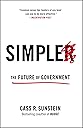
Simpler: The Future of Government
Product ID: 11611658
Desertcart purchases this item on your behalf and handles shipping, customs, and support to Greece.
Simpler: The Future of Government [Sunstein, Cass R.] on desertcart.com. *FREE* shipping on qualifying offers. Simpler: The Future of Government Review: An authentic review, not a libertarian bully pulpit statement. - The intent of this desertcart review is to describe one layman's apolitical opinion of a book, not to espouse extremist rhetoric. (Unfortunately I have to make this explicit to help those consumers on the fence about a purchase.) This book generally revolves around two topics: an explanation of one particular method for deriving and implementing public policy, and how Sunstein adopted this method in order to fulfill his purpose as a public servant. The former is complicated, and he is mostly successful at trying not to lose his readers. The latter is achieved by weaving personal narrative with examples while remaining candid. Perhaps to the surprise of some, he admits when neither government nor his method are perfect. Those of you who believe citations and evidence lend credence and credibility in an argument will be pleased. 1/3 of the book consists of the bibliography. His method is synonymous with choice architecture, libertarian paternalism, or "framing" a decision, but goes one step further by emphasizing the importance of cost-benefit analysis. Here Sunstein transcends politics by explaining how numbers can be used to drive policy. This should appeal to those of you who believe data, analysis, the scientific method, transparency and accountability all have a place in government. Sunstein's candor especially shines here by admitting caveats. For example, how do you quantify the value of a human life? What is the right amount of information we should be armed with in order to make a decision--there is such a thing as not knowing enough, but can we be bombarded with so much information that we couldn't or wouldn't be able to decide? These difficult questions do become addressed, but those seeking a Goldilocks prescription or magical algorithm to everything may be disappointed. A qualitative portrayal as head of OIRA for the Obama administration prevents Simpler from being just a dry series of studies. Examples are often both enlightening and amusing, with results and conclusions often countering intuition. In fact, Sunstein even takes proper time to explain how our intuition is subject to biases, adopting psychology and economics in simple words. Again, those with a penchant for science will be pleased. Ironically, the only thing the book lacks is a complete, data-laden comparison of the effectiveness of his work versus prior administrations. A few statistics are mentioned, but a table or chart integrated with the prose would help quell any skepticism. Whether this was an architectural decision or simply unfeasible within the scope of publishing remains. Perhaps academics and Sunstein's peers are best left to decide if his methods should truly pave the future of government. At least he has one reader convinced. Review: Good Read on ROI in Rulemaking - A coherent look at the role of government and effective regulation in a ROI driven world. Building on the authors earlier work, Nudge, the book takes you into the challenges and approaches used by the Obama Administration to evaluate rule making and regulatory decisions. It shows what is possible, and the pitfalls of policy. A good read.
| ASIN | 1476726604 |
| Best Sellers Rank | #1,887,992 in Books ( See Top 100 in Books ) #2,875 in Popular Social Psychology & Interactions #4,591 in U.S. Political Science #5,156 in Political Leader Biographies |
| Customer Reviews | 4.1 4.1 out of 5 stars (112) |
| Dimensions | 5.5 x 0.68 x 8.38 inches |
| Edition | Illustrated |
| ISBN-10 | 9781476726601 |
| ISBN-13 | 978-1476726601 |
| Item Weight | 8.6 ounces |
| Language | English |
| Print length | 272 pages |
| Publication date | December 2, 2014 |
| Publisher | Simon & Schuster |
M**Z
An authentic review, not a libertarian bully pulpit statement.
The intent of this Amazon review is to describe one layman's apolitical opinion of a book, not to espouse extremist rhetoric. (Unfortunately I have to make this explicit to help those consumers on the fence about a purchase.) This book generally revolves around two topics: an explanation of one particular method for deriving and implementing public policy, and how Sunstein adopted this method in order to fulfill his purpose as a public servant. The former is complicated, and he is mostly successful at trying not to lose his readers. The latter is achieved by weaving personal narrative with examples while remaining candid. Perhaps to the surprise of some, he admits when neither government nor his method are perfect. Those of you who believe citations and evidence lend credence and credibility in an argument will be pleased. 1/3 of the book consists of the bibliography. His method is synonymous with choice architecture, libertarian paternalism, or "framing" a decision, but goes one step further by emphasizing the importance of cost-benefit analysis. Here Sunstein transcends politics by explaining how numbers can be used to drive policy. This should appeal to those of you who believe data, analysis, the scientific method, transparency and accountability all have a place in government. Sunstein's candor especially shines here by admitting caveats. For example, how do you quantify the value of a human life? What is the right amount of information we should be armed with in order to make a decision--there is such a thing as not knowing enough, but can we be bombarded with so much information that we couldn't or wouldn't be able to decide? These difficult questions do become addressed, but those seeking a Goldilocks prescription or magical algorithm to everything may be disappointed. A qualitative portrayal as head of OIRA for the Obama administration prevents Simpler from being just a dry series of studies. Examples are often both enlightening and amusing, with results and conclusions often countering intuition. In fact, Sunstein even takes proper time to explain how our intuition is subject to biases, adopting psychology and economics in simple words. Again, those with a penchant for science will be pleased. Ironically, the only thing the book lacks is a complete, data-laden comparison of the effectiveness of his work versus prior administrations. A few statistics are mentioned, but a table or chart integrated with the prose would help quell any skepticism. Whether this was an architectural decision or simply unfeasible within the scope of publishing remains. Perhaps academics and Sunstein's peers are best left to decide if his methods should truly pave the future of government. At least he has one reader convinced.
E**N
Good Read on ROI in Rulemaking
A coherent look at the role of government and effective regulation in a ROI driven world. Building on the authors earlier work, Nudge, the book takes you into the challenges and approaches used by the Obama Administration to evaluate rule making and regulatory decisions. It shows what is possible, and the pitfalls of policy. A good read.
M**U
Fairly good but with a probably misleading subtitle
This is not a bad book. The reading is easy, simple, aiming at somewhere in between the man in the street and the modernization of government specialist. I certainly took many interesting views and data from it. Its value as a promoter of simplicity by the government is very important. But the book is not a great book either. I believe the word "future" in the subtitle is somewhat misleading. In my opinion the book is more about the present or even the recent past of government than about the future. Obviously, the word "future" must have added more buyers to the book than it would have the word "past" (a way of experiencing choice architecture), giving it a foundational taste on regulatory matters. It is about present and past because it focuses on what happened while the author was OIRA's administrator and because many of the most important issues he raises have been in the government literature for a long time. For an example, you can check the THE OECD REFERENCE CHECKLIST FOR REGULATORY DECISION-MAKING, from... 1995. Be it past or be it future, the book is not about the government as a whole either. It is only about a tiny portion of its effectiveness. It is neither about its efficiency nor about its role regarding social justice. Another trait to mention is that although it is a reasonably short book, 219 pages, it repeats some concepts along the book too much for my taste. And finally a collateral matter that is fateful enough to deserve mention. On page 162 the author states that the USA went to the Irak war "on the chance that Saddam Hussein had weapons of mass destruction." I believe this is a false assertion. USA went to that war based on sheer lies for reasons that had nothing to do with WMD. Secretary of State lied then at the UN Security Council showing fake pictures (pictures=reality) of WMD sites. And the media pushed the idea that Sadam Hussein was responsible for 9-11. Choice architecture works very well also when preparing the ground to take a shocked country into war.
E**R
Brilliant, conscientious, generous natured, helpful minded master governmental servant wrote this book.
Memory fails me because of the manner I have been reading this book, however the impressions I got, details revealed, the span of thoughtful directions taken in the process of carving out appropriate needed regulations is all of awsome accomplishment. Remarkably deserving, thank you Mr. Cass Sunstein for your effort clarifying this kind of information - a gift to the public. Ernest Saucier
J**K
A thoughtful view of regulation, effectively applied!
Cass Sunstein has developed a new approach to regulation that centers on providing good information. As head of the Office of Information and Regulatory Affairs during President Obama's first term, he applied it to proposed new regulations and to a review of existing ones. In effect, he maximized the benefits and minimized the cost to producers and customers of overseeing the wellbeing of Americans. This small profound book speaks simply to everyone.
A**R
Muito boa leitura. Great book! O autor discorre sobre formas modernas de atingir eficiência estatal através de insights relacionados com economia comportamental.
I**H
My only quibble with this excellent little book is its extraordinary subtitle; 'The Future of Government'. Delusions of grandeur, methinks. No, a far better subtitle would be something on the lines of 'The Three Habits of Highly Effective Regulators' (and that's regulators of the government rather than the mechanical variety). Three enormously helpful habits for those involved in policy development, which I would paraphrase as 'MEASURE-KISS-CONSULT'. MEASURE; base your rules on evidence, notably a robust cost-benefit analysis. KISS, which as we all know, means 'Keep it simple, stupid.' Perhaps better 'keep it short and simple' in this context. CONSULT; wisdom and ideas are widely dispersed. It always helps to consult with those who will be affected by a new set of rules or regulations. Much of the book explores the role of 'behavioural economics' and is based on Sunstein's earlier book 'Nudge'. In 'Simpler' he describes how this influenced his work as head of the White House Office of Information and Regulatory Affairs under Obama from 2009 to 2012. Shortcomings? OK - I have another quibble. The book could be much shorter. Another similarity to Steven Covey's 'Seven Habits.." - great book, but too much padding. So somewhat worrying to learn in the acknowledgements that Sunstein decided to forgive his editor for slashing 30,000 words from the original manuscript! And do read the acknowledgements - if only for the most delightful dedication I have ever read. A dedication to his wife, Samantha Power, who happens to be the fiery US ambassador to the UN in New York!
A**R
This is Fake copy of the original book. Book is damaged and torn. Very unsatisfied with this purchase.
V**M
A leitura excelente e exemplifica os conceitos trazidos em obras anteriores do autor. A encadernação, assim como a de “Nudge”, é pífia: molenga e não protege nada.
D**L
Excelentes artigos do autor, resumindo suas ideias anteriores publicadas em outros livros. Altamente recomendado para quem se interessa pelo tema.
Trustpilot
1 month ago
1 day ago