
Buy anything from 5,000+ international stores. One checkout price. No surprise fees. Join 2M+ shoppers on Desertcart.
Desertcart purchases this item on your behalf and handles shipping, customs, and support to Greece.
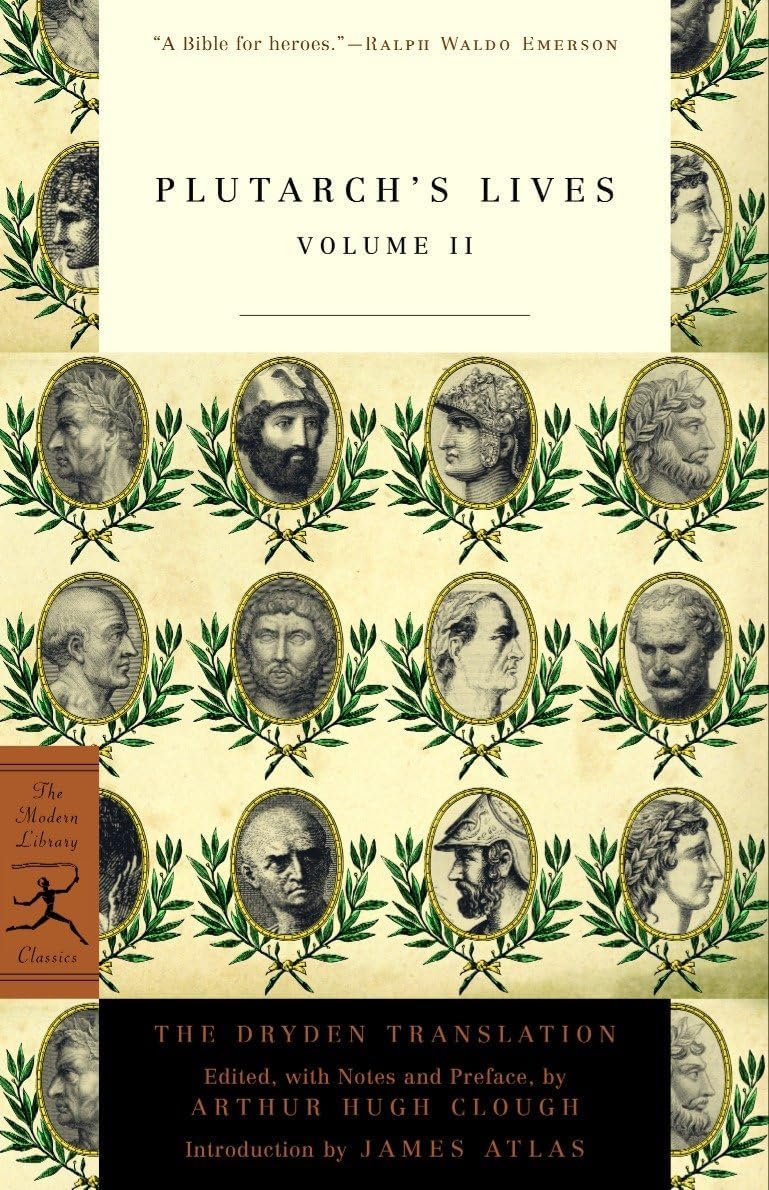
Plutarch's Lives, written at the beginning of the second century A.D., is a brilliant social history of the ancient world by one of the greatest biographers and moralists of all time. In what is by far his most famous and influential work, Plutarch reveals the character and personality of his subjects and how they led ultimately to tragedy or victory. Richly anecdotal and full of detail, Volume I contains profiles and comparisons of Romulus and Theseus, Numa and Lycurgus, Fabius and Pericles, and many more powerful figures of ancient Greece and Rome. The present translation, originally published in 1683 in conjunction with a life of Plutarch by John Dryden, was revised in 1864 by the poet and scholar Arthur Hugh Clough, whose notes and preface are also included in this edition. Review: A few thoughts from my reading of Plutarch's Lives - In my review of the first volume of the Modern Library edition of Plutarch's Lives of the Noble Greeks and Romans, I explained my preference for the Modern Library edition as opposed to the Loeb or the Penguin Travesty Edition. Please refer to that review for some thoughts on which edition to choose to read. What I first want to do in this review is to provide a little background to a reading of Plutarch. Hopefully, this will provide an explanation of why Plutarch remains such a vital author in the Western Canon. Plutarch lived from around 46 to 120 CE. He therefore lived in the Roman Empire from the reign of Nero to the beginnings of Hadrian's reign. He was contemporaries with Tacitus and Epictetus. He lived for a while in Rome but most of his life was spent in Boetia in Greece. He was a priest of the oracle at Delphi for several decades and a prolific writer on philosophical, scientific and ethical themes. In addition the the Lives, Plutarch wrote many essays and dialogues that have been collected together under the general title of the Moralia. The Loeb Classical Library provides a complete English rendering and there are several good one volume selections. I mention the Moralia because I believe that a reading of some of the essays are essential to understanding the ethical explorations of the Lives. Consider the opening to his essay, "On Moral Virtue". Plutarch starts off by distinguishing "moral" virtue from "contemplative" virtue. The differences lies "chiefly in that it has as its material the emotions of the soul and as its form reason" (p.19 of the Loeb Moralia, Vol.6). This gives us a picture of Plutarch as Middle Platonist with an Aristotlean idea of virtue as a mean. The picture we get is of a human world where evil and vice are as real as virtue and reason, where the emotions can work as the energizing element of both virtue and vice and where the achievement of virtue is always the result of education and discipline and is never complete. It is this picture of the world that is then explored so magnificently in the Lives. The Lives focus of the political and military realm of the statesmen and uses the various people discussed as the raw material for the exploration of all the ways that excellent men (and a few excellent women)can succeed or fail at virtuous leadership. One of the themes that I feel Plutarch explores is whether Roman hegemony can be defended on any grounds other than their success at arms. In this, he is writing as a cultured Greek testing the Roman leadership by the standards of a conquered people. He looks at the ways that various personal failings (lack of prudence in a general, an excessive love of drink, uncontrollable lust whether for boys or women or greed or any pretty much any excess) can waylay and overturn a lifetime of achievement. Another favorite theme of Plutarch's is the turning of Fortuna's (or Tyche's)wheel. Plutarch exemplifies the belief that we are laid low or allowed success almost whimsically by this goddess who will surely turn our lives upside down again soon. Just because She can (At least, as far as we know). Against these backgrounds of Roman hegemony, personal failings and the twists and turns of Fate, Plutarch tries to show us the struggle of the individual to serve his city, his Empire or his own petty whims. It is a great theme, one that he writes about with insight and with sympathy for those whose stories he is telling. This gets to my annoyance with the Penguin volumes of the Lives. By separating the paired Greek and Roman lives and by presenting them out of sequence, Penguin is trying to present Plutarch as an historian, a role he explicitly denies for himself. While I think he is a very good historian, he is even more a uniquely great essayist in practical political and personal ethics. This is, I believe, how Montaigne read Plutarch and I think both Jefferson and Madison as well. This is how Plutarch has helped to shape our cultural history. In fact, I am going to make the claim that it is impossible to fully understand the debate around the adoption of the U.S. Constitution unless you have read the whole of both Plutarch and Livy. Anyone who wants to persue that thesis with me, please write a comment. My recommendation is that you get the Modern Library edition and dig in. If you don't like it, wait a year or two and try it again. For Plutarch presents us with the broadest possible experience of the world. You may find, like me, that you have to wait a while for your own experience to grow broad enough in order to really see just what an amazing book this ancient neighbor of ours has given us. Review: It's Plutarch's Lives - It seems strange to "review" a classic like this. The book itself was in decent shape on receipt, 2 chapters had highlights by the previous owner, not a problem for me.

| Best Sellers Rank | #34,965 in Books ( See Top 100 in Books ) #5 in Historical Greece Biographies #10 in Ancient Rome Biographies #1,262 in Classic Literature & Fiction |
| Customer Reviews | 4.8 out of 5 stars 194 Reviews |
G**R
A few thoughts from my reading of Plutarch's Lives
In my review of the first volume of the Modern Library edition of Plutarch's Lives of the Noble Greeks and Romans, I explained my preference for the Modern Library edition as opposed to the Loeb or the Penguin Travesty Edition. Please refer to that review for some thoughts on which edition to choose to read. What I first want to do in this review is to provide a little background to a reading of Plutarch. Hopefully, this will provide an explanation of why Plutarch remains such a vital author in the Western Canon. Plutarch lived from around 46 to 120 CE. He therefore lived in the Roman Empire from the reign of Nero to the beginnings of Hadrian's reign. He was contemporaries with Tacitus and Epictetus. He lived for a while in Rome but most of his life was spent in Boetia in Greece. He was a priest of the oracle at Delphi for several decades and a prolific writer on philosophical, scientific and ethical themes. In addition the the Lives, Plutarch wrote many essays and dialogues that have been collected together under the general title of the Moralia. The Loeb Classical Library provides a complete English rendering and there are several good one volume selections. I mention the Moralia because I believe that a reading of some of the essays are essential to understanding the ethical explorations of the Lives. Consider the opening to his essay, "On Moral Virtue". Plutarch starts off by distinguishing "moral" virtue from "contemplative" virtue. The differences lies "chiefly in that it has as its material the emotions of the soul and as its form reason" (p.19 of the Loeb Moralia, Vol.6). This gives us a picture of Plutarch as Middle Platonist with an Aristotlean idea of virtue as a mean. The picture we get is of a human world where evil and vice are as real as virtue and reason, where the emotions can work as the energizing element of both virtue and vice and where the achievement of virtue is always the result of education and discipline and is never complete. It is this picture of the world that is then explored so magnificently in the Lives. The Lives focus of the political and military realm of the statesmen and uses the various people discussed as the raw material for the exploration of all the ways that excellent men (and a few excellent women)can succeed or fail at virtuous leadership. One of the themes that I feel Plutarch explores is whether Roman hegemony can be defended on any grounds other than their success at arms. In this, he is writing as a cultured Greek testing the Roman leadership by the standards of a conquered people. He looks at the ways that various personal failings (lack of prudence in a general, an excessive love of drink, uncontrollable lust whether for boys or women or greed or any pretty much any excess) can waylay and overturn a lifetime of achievement. Another favorite theme of Plutarch's is the turning of Fortuna's (or Tyche's)wheel. Plutarch exemplifies the belief that we are laid low or allowed success almost whimsically by this goddess who will surely turn our lives upside down again soon. Just because She can (At least, as far as we know). Against these backgrounds of Roman hegemony, personal failings and the twists and turns of Fate, Plutarch tries to show us the struggle of the individual to serve his city, his Empire or his own petty whims. It is a great theme, one that he writes about with insight and with sympathy for those whose stories he is telling. This gets to my annoyance with the Penguin volumes of the Lives. By separating the paired Greek and Roman lives and by presenting them out of sequence, Penguin is trying to present Plutarch as an historian, a role he explicitly denies for himself. While I think he is a very good historian, he is even more a uniquely great essayist in practical political and personal ethics. This is, I believe, how Montaigne read Plutarch and I think both Jefferson and Madison as well. This is how Plutarch has helped to shape our cultural history. In fact, I am going to make the claim that it is impossible to fully understand the debate around the adoption of the U.S. Constitution unless you have read the whole of both Plutarch and Livy. Anyone who wants to persue that thesis with me, please write a comment. My recommendation is that you get the Modern Library edition and dig in. If you don't like it, wait a year or two and try it again. For Plutarch presents us with the broadest possible experience of the world. You may find, like me, that you have to wait a while for your own experience to grow broad enough in order to really see just what an amazing book this ancient neighbor of ours has given us.
N**L
It's Plutarch's Lives
It seems strange to "review" a classic like this. The book itself was in decent shape on receipt, 2 chapters had highlights by the previous owner, not a problem for me.
K**R
Perfect condition
Delivered on time and in perfect condition
W**N
so amazing what knowledge we get from reading these history books ...
I still did not finish it,,, but believe me,, i can't wait for my bedtime to come for me to run to my books ,,, i am enjoying it greatly believe me,, so amazing what knowledge we get from reading these history books about great historic people,,, wonderful love you Amazon
O**M
Picture of TOC so you know whatโs included in Volume 2
Iโm including the TOC because it was frustrating when comparing different publishersโ versions of Plutarch and not knowing which Lives were in which book. This doesnโt have the line/paragraph cites you often see; for reading purposes, this is better, but maybe frustrating if youโre trying to reference it to scholarship.
T**N
Who can resist the biographies of ancient Greeks and Romans ...
Who can resist the biographies of ancient Greeks and Romans when they are compared to each other. Plutarch speaks to us today. Through the ages, these noble characters teach us about morality and real heroism. Plus, they offer lessons for today. A must own book, especially if you are an historian in the classical tradition.
S**8
Great addition to your library
I personally liked this translation. Wish Plutarch had more "Lives" to report on, like Augustus Caesar, Tiberius, and Caligula.
D**.
Font is very small
Hard to find copies with larger print.
R**C
nice read about the old ages
H**R
Plutarch's Lives Vol II
If you are into ancient Roman history this book and volume I are excellent, however, I am not into ancient Greek history and found the information confusing without some chronological reference. Apart from my pettiness everything else is fine.
A**R
very good
very good
Z**H
Low quality pages and spelling mistakes.
Very low quality pages. Pages are very thin and yellow. Number of pages in the book is much less than mentioned on the product's page. Cover page is too delicate, is wrinkled very easily. There many spelling mistakes. For example, Gauis is written Cauis, etc. Not worth 945/-
Trustpilot
2 days ago
3 weeks ago