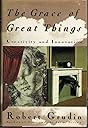
The Grace of Great Things: Creativity and Innovation
Product ID: 198738247
Desertcart purchases this item on your behalf and handles shipping, customs, and support to Greece.
The Grace of Great Things: Creativity and Innovation [Grudin, Robert] on desertcart.com. *FREE* shipping on qualifying offers. The Grace of Great Things: Creativity and Innovation Review: Perhaps my favorite book - I stumbled onto Robert Grudin's book on creativity and innovation over a decade ago, and have turned to it at least a half dozen times each year since. This is a scholarly and passionate effort -- one that encourages (and explains) ideas people, and gets the reader to think deeper about inhabiting and nurturing that role in society, business and life. I find it an agreeable companion to works such as Seth Godin's 'Linchpin,' Robert McKee's 'Story,' Jack Foster's 'How To Get Ideas,' Anne Lamott's 'Bird By Bird,' Stephen King's 'On Writing,' Luke Sullivan's 'Hey Whipple,' Chip and Dan Heath's 'Made to Stick,' and The Book of Gossage. It will inspire writers, designers, scientists, theologians. I think it can help managers and bureaucrats understand the volatility and importance of ideas and idea people. The Grace of Great Things offers keen insights into the inception of ideas across numerous fields (akin to and taken further than Rollo May's 'The Courage to Create'). I especially enjoy Grudin's efforts in clarifying the politics and responsibilities of being an ideas person as well as his solutions for the challenges facing those who aspire to bring ideas into the world. I've made this book required reading in several marketing and advertising courses I've taught. Too bad it's out of print (hello, Ticknor & Fields?). And the (red/brown and black) cover image shown on desertcart is likely for the hard cover edition. (I've never owned one, only softcover.) The softcover copies all use a white wrap with calligraphy title text and artwork of two white pencils facing each other underneath a white cloud. Some softcover wraps include bio and description info on the inside folds, while other copies are blank on the inside -- seems like every third copy I acquire has blank inside folds. And at times the softcover title text includes additional color (hot pink, purple) behind the words "Grace" as well as the "G" of "great" and "T" of "things." Chalk it up to different printing editions. All in all, a must-read for anyone who creates and nurtures ideas for a living. Review: A Classic! - I read this book years ago, but still had such a favorable impression about it that I purchased a copy as a gift a few years back for someone who had just completed his law degree, with a specialization in patents.
| Best Sellers Rank | #2,438,726 in Books ( See Top 100 in Books ) #1,132 in Popular Psychology Creativity & Genius |
| Customer Reviews | 4.6 4.6 out of 5 stars (19) |
| Dimensions | 5.75 x 1.25 x 8.75 inches |
| Edition | First Edition |
| ISBN-10 | 0899199402 |
| ISBN-13 | 978-0899199405 |
| Item Weight | 1.08 pounds |
| Language | English |
| Print length | 257 pages |
| Publication date | January 1, 1990 |
| Publisher | Ticknor & Fields |
T**E
Perhaps my favorite book
I stumbled onto Robert Grudin's book on creativity and innovation over a decade ago, and have turned to it at least a half dozen times each year since. This is a scholarly and passionate effort -- one that encourages (and explains) ideas people, and gets the reader to think deeper about inhabiting and nurturing that role in society, business and life. I find it an agreeable companion to works such as Seth Godin's 'Linchpin,' Robert McKee's 'Story,' Jack Foster's 'How To Get Ideas,' Anne Lamott's 'Bird By Bird,' Stephen King's 'On Writing,' Luke Sullivan's 'Hey Whipple,' Chip and Dan Heath's 'Made to Stick,' and The Book of Gossage. It will inspire writers, designers, scientists, theologians. I think it can help managers and bureaucrats understand the volatility and importance of ideas and idea people. The Grace of Great Things offers keen insights into the inception of ideas across numerous fields (akin to and taken further than Rollo May's 'The Courage to Create'). I especially enjoy Grudin's efforts in clarifying the politics and responsibilities of being an ideas person as well as his solutions for the challenges facing those who aspire to bring ideas into the world. I've made this book required reading in several marketing and advertising courses I've taught. Too bad it's out of print (hello, Ticknor & Fields?). And the (red/brown and black) cover image shown on Amazon is likely for the hard cover edition. (I've never owned one, only softcover.) The softcover copies all use a white wrap with calligraphy title text and artwork of two white pencils facing each other underneath a white cloud. Some softcover wraps include bio and description info on the inside folds, while other copies are blank on the inside -- seems like every third copy I acquire has blank inside folds. And at times the softcover title text includes additional color (hot pink, purple) behind the words "Grace" as well as the "G" of "great" and "T" of "things." Chalk it up to different printing editions. All in all, a must-read for anyone who creates and nurtures ideas for a living.
B**E
A Classic!
I read this book years ago, but still had such a favorable impression about it that I purchased a copy as a gift a few years back for someone who had just completed his law degree, with a specialization in patents.
S**L
I am glad I came across this writer
It is a must read for some artists. It supports those supposedly crazy detours and and quixotic pursuit of personal vision- no matter what the time frame. It is not for those who consider art as a "product", to please others or an engine of financial success or acclaim. Dale Carnegie, I suppose would be a better choice. Mr Grudin alsos nudges us to confront sometimes painfully) those habits in our life and thinking that disable us from fully accessing our fullest potential.
J**L
It felt like a required text book
I did not have the same opinion as most of the reviewers. I felt it was technical and read like a text book. I honestly was disappointed and not enlightened.
W**H
Most satisfactory.
Fast delivery. Book just as described ("slight signs of wear"). Reasonable price. Thank you.
Y**I
Five Stars
textbook
S**Y
"Origins and Practice of Innovation Through Creativity"
This book is a study of creativity in the social and ethical contexts, and of creativity as a result of innovation. It can also be used as a guide book for leading a life promoting innovation through creativity. The book has three distinct but closely related parts: The Creative Mind, The Ethics of Creativity and The Politics of Innovation, explaining how the building blocks of creativity - inspiration, imagination, sense of beauty, integrity, persistence, vision and learning - all lead to innovation. While one could use this as a resource for inspiration and as a guidebook for practicing and promoting creativity in everyday life, the author makes no efforts to sell the book as such. Instead, he has opted for a conversational style that aids critical reading, and inspires further thinking. This helps to frequently stop and think about the material, and to inquire the logic. The language is very crisp and to the point. The editing is very sharp. One could read the book just for the anecdotes, both historic and the contemporary ones, which are plentiful in the book. The notes at the end is really an annotated bibliography, which can also be very useful. This is a great antidote for the current day world where success is often wrongly equated with "fast", "immediate", "creating powerpoint slides", ... and the likes; where, the examination of things is becoming increasingly superficial, and the critical evaluations are frequently regarded as a hindrance to "productivity", and where the incompetence is frequently promoted for the resulting political expediencies. Dr Grudin explains why some people despise the concept of "working the system" to your advantage, and why they often take routes that look more elaborate and longer. He explains what is it that some people who get paid for forty-hours but seem to be always at work, are seeking and what drives them to voluntarily opt for such practices of hardwork and dedication. He explains why some people seem to take so much interest in every project around them, and seem to bounce back to success and happiness, from every failure they encounter. And, finally, he convinces us how creative work, even at the modest levels, can be the key to happiness. By not casting its title with something like "N-practices of super-creative people" or something akin to that, and instead giving it the current title, and thus choosing honesty and class over marketing, Dr Grudin has put to practice what he preaches in the book. But if that makes you not consider this book, it's your loss! A great baedeker for people and organizations wanting to promote creativity, and through creativity, innovation.
T**M
I have never been SO enlightened in SO FEW pages.....
Robert Grudin gave me a gift in this book. His insight into the creative process gave me what I needed to change careers in my mid-forties. He looks at innovation vs. creative thought and shows how "great things" get "done. I refer to it often, particularly the "Diplomacy of Invention". Thanks Robert. His "Time and the Art of Living" is also very insightful.
Trustpilot
1 month ago
1 week ago