
Buy anything from 5,000+ international stores. One checkout price. No surprise fees. Join 2M+ shoppers on Desertcart.
Desertcart purchases this item on your behalf and handles shipping, customs, and support to Greece.
desertcart.com: 25 Read and Write Mini-Books That Teach Word Families: 9780439155878: Sanders, Nancy I.: Books Review: Great, but hard to tear out & some sight words are difficult for Pre-K - We've been using these for almost a year now, so I feel I can give a fair review. Overall a great product. We bought these for my then-3 yr old early reader as his very first 'books' to read by himself. Although most of the word families were perfect for his level (vowel-consonent-vowel words), some of the sight words were way too hard! Wants, said, played, through...we were doing a lot of "this is a sight word, not a word you can sound out," which frustrated him and was too difficult for his early level. We switched to the Bob books for a few months, and then came back to these...and voila! Totally ready for the harder sight words. He just turned 4 and can read almost all of these with little assistance. It's a great tool for teaching common, weird combos like "-ing" as well as blending consonants (br, sl, ch, sh, etc.) and long vowel sounds when the word ends in e (gate). It's repetitive enough that he picks up on the rhyming most of the time...although he still has to sound them out. Downsides: - You have to rip or very carefully cut the pages out of the book. Why didn't they perforate the edges??!! My first few attempts ripped the pages. - Uncreative stories...or rather, they aren't 'stories' at all. But my kid doesn't care! When they're this young, they think it's funny when things don't make sense (a mop driving a car? Hilarious!). - Pictures give away the words. A kid can easily guess the word for most of these. I combatted this by having him tell me all the rhyming words on the second to last page; when the words are taken out of the sentence he had to sound the harder ones out instead of remembering from the pictures or story. The last page is also for spelling the words, which makes the kids think about the sounds, not just the pictures. My son has no problem doing these, but it's a great practice level for him. Review: Buy this book - Great for a "Science of Reading" phonics driven curriculum. I am using it for the CVC words in the card game on pages 8-14, and the mini-books to support fluency when practicing them with my beginning and struggling readers. This book has very limited examples of vowel teams -ai, -ee, VCe -a and -i, R Controlled -ar, digraph -ck. I have been buying each students a set of CVC flash cards to use in my classroom (they are really nice) - but now for the price of one set of cards; I can print up my own on card-stock. I drill students who are below grade level every morning and I also have these 2nd grade students carry their book-rings home and play this game with their family. I used the "Kami Circle Challenge" template to make a fun one month game sheet to keep track of their scores at home and at school. They always have 5 words they are learning at a time. Their score for the game is one point for each word they can read without sounding it out. As they learn the words they get additional new words and their scores go up and up. I find this is very motivating and fun for kids. It helps reinforce reading skills and improves their fluency and speed when reading. I am using it as a reading intervention - This is great for kindergarten, grade 1, 2 or 3rd and above. It is a fun way to have a quick daily review.


| Best Sellers Rank | #32,375 in Books ( See Top 100 in Books ) #66 in Early Childhood Education #76 in Reading & Phonics Teaching Materials #1,841 in Reference (Books) |
| Customer Reviews | 4.6 4.6 out of 5 stars (1,902) |
| Dimensions | 8.73 x 0.18 x 10.79 inches |
| Grade level | Preschool - 1 |
| ISBN-10 | 0439155878 |
| ISBN-13 | 978-0439155878 |
| Item Weight | 2.31 pounds |
| Language | English |
| Print length | 64 pages |
| Publication date | April 1, 2001 |
| Publisher | Scholastic Teaching Resources |
| Reading age | 3 - 7 years |
A**R
Great, but hard to tear out & some sight words are difficult for Pre-K
We've been using these for almost a year now, so I feel I can give a fair review. Overall a great product. We bought these for my then-3 yr old early reader as his very first 'books' to read by himself. Although most of the word families were perfect for his level (vowel-consonent-vowel words), some of the sight words were way too hard! Wants, said, played, through...we were doing a lot of "this is a sight word, not a word you can sound out," which frustrated him and was too difficult for his early level. We switched to the Bob books for a few months, and then came back to these...and voila! Totally ready for the harder sight words. He just turned 4 and can read almost all of these with little assistance. It's a great tool for teaching common, weird combos like "-ing" as well as blending consonants (br, sl, ch, sh, etc.) and long vowel sounds when the word ends in e (gate). It's repetitive enough that he picks up on the rhyming most of the time...although he still has to sound them out. Downsides: - You have to rip or very carefully cut the pages out of the book. Why didn't they perforate the edges??!! My first few attempts ripped the pages. - Uncreative stories...or rather, they aren't 'stories' at all. But my kid doesn't care! When they're this young, they think it's funny when things don't make sense (a mop driving a car? Hilarious!). - Pictures give away the words. A kid can easily guess the word for most of these. I combatted this by having him tell me all the rhyming words on the second to last page; when the words are taken out of the sentence he had to sound the harder ones out instead of remembering from the pictures or story. The last page is also for spelling the words, which makes the kids think about the sounds, not just the pictures. My son has no problem doing these, but it's a great practice level for him.
J**.
Buy this book
Great for a "Science of Reading" phonics driven curriculum. I am using it for the CVC words in the card game on pages 8-14, and the mini-books to support fluency when practicing them with my beginning and struggling readers. This book has very limited examples of vowel teams -ai, -ee, VCe -a and -i, R Controlled -ar, digraph -ck. I have been buying each students a set of CVC flash cards to use in my classroom (they are really nice) - but now for the price of one set of cards; I can print up my own on card-stock. I drill students who are below grade level every morning and I also have these 2nd grade students carry their book-rings home and play this game with their family. I used the "Kami Circle Challenge" template to make a fun one month game sheet to keep track of their scores at home and at school. They always have 5 words they are learning at a time. Their score for the game is one point for each word they can read without sounding it out. As they learn the words they get additional new words and their scores go up and up. I find this is very motivating and fun for kids. It helps reinforce reading skills and improves their fluency and speed when reading. I am using it as a reading intervention - This is great for kindergarten, grade 1, 2 or 3rd and above. It is a fun way to have a quick daily review.
A**R
Yes
Love this..it helps with reading
F**H
Reading tool
Easy to learn and read too your child. A great learning tool for anyone.
A**R
for my preschooler/kindergartner-fun
So, it matters what you are looking for. These aren't books, they are worksheets and coloring pages. That is why it is so inexpensive. If you are looking for books, put the money into buying bob books or other phonics books, or head to your local library because most systems have sets of phonics books to check out. My preschool/kindergarten daughter loves these. They are simple to put together. Cut them out, put them in order, staple three times at the end to make them a little book. My daughter helped me. She just picks them out of a basket and colors them and fills them in. She either writes the missing letters or uses our letter stamps to complete them. If your kids don't like coloring and such, maybe they won't like them. So, each day, she and my first grade son each choose a Bob book or a book from a phonics program we bought a couple of years ago and read it to us. We added these to the basket after she finished them and they get a mini m-n-m for reading us a book each day. They are an extra in our reading school work.
K**R
great book
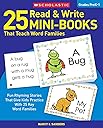
These are perfect word family mini-books to help young children to read. The books build on each word introduced, as you can probably see in the Look Inside feature. So that you can easily reuse the books, I would just point to the blanks for letters on the back to prompt a response from the child. However, the first time I tried to copy them, I could not figure out how to copy them double-sided properly to make the pages in the right sequence. I put them aside for a while and tried again recently. It took me a while but I figured it out. I am using an HP all-in-one type printer. I copy the first side, and my copy comes out facing up with the front page of the mini-book (e.g. "A Cat) on the bottom left of the page as it comes out. I insert the page back into the paper slot without changing the orientation at all. I turn the page in the book to the second side and I place it on the glass so that the "other" side of the book is hanging on the same side of the copier as the other side was for the first page. So if for my first copy the other side of the book was hanging on my side, over the paper slot, then the other side of the book is hanging on that same side when I copy the second page (as opposed to it hanging over the back of the printer). The "other" side of the book will be a different side of the book each time, it is the opposite side of the book than the page you are copying. I know that is confusing, but hopefully it will help if you are having trouble.
@**Z
Uma decepção … folhas do tamanho A4, da gramatura de jornal (que é ruim até para colorir), flash card para cortar, e as folhas para cortar em 4 e grampear… um fracasso, uma decepção com a editora.
G**L
Great to develop early reading and spelling.
S**H
These are great for phonics/phonetics learning. There is reading and a little bit of writing and the added bonus of it being a little book that kids can colour. The child I am using them with thinks they are super easy and uses the pictures for clues. Simple to put together (takes time if you make them all at once). Also if your child likes rhyming these are fun to read.
L**A
I just love this book. First I bought it from my homeschool kids later on I bought it for my English students. It is super useful. It has good quality. Many mini books to be creative coloring them and putting them together.
M**L
Really nice! It motivates kids to read n write...I can see the difference in reading confidence of my child after 5 or 6 mini books...she loves to create her own book, colour, write and read them again n again!
Trustpilot
3 weeks ago
2 weeks ago